

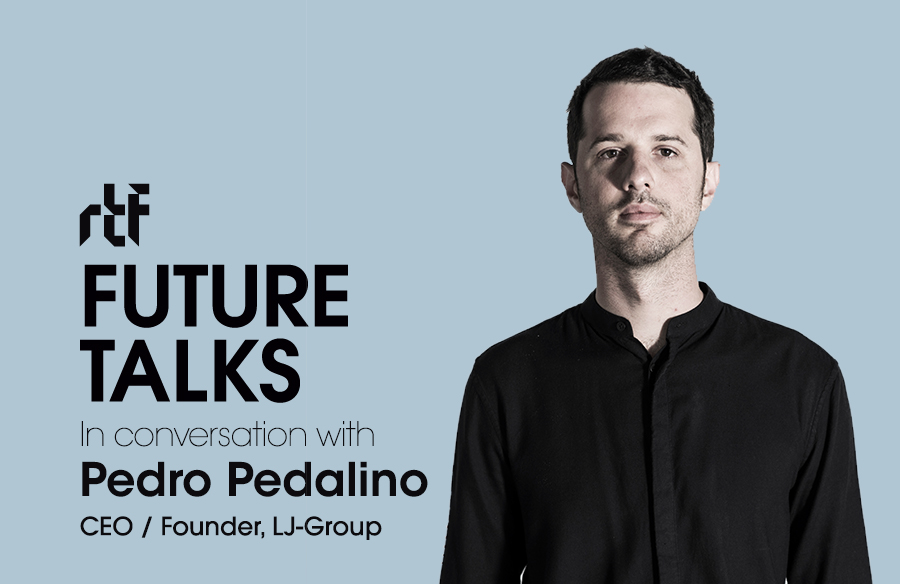
Welcome to Future Talks by RTF, a platform that delves into the journeys and philosophies of the pioneering designers shaping our environments and enriching our world. In each conversation, we uncover the stories, insights, and experiences that drive these visionaries to redefine design for future generations.
In this edition, we spotlight Pedro Pedalino, an internationally acclaimed landscape architect from Rio de Janeiro. His early passion for landscape architecture was kindled by his father, Claudio Pedalino, and deepened through collaborations with luminaries like Pritzker Prize-winner Paulo Mendes da Rocha. Pedro’s dynamic career blends rigorous training with a rich background in contemporary arts from Parque Lage, all of which fuel his innovative approach to landscape design.
In 2015, Pedro founded LJ-Group in Vietnam, a renowned landscape architecture studio that has rapidly expanded, amassing awards and employing a talented team of over 35 architects across multiple international offices. Pedro’s visionary leadership has set LJ-Group apart in the industry, tackling medium to large-scale projects worldwide with an approach that harmonizes nature and design.
Join us in Future Talks by RTF as we explore Pedro’s inspiring journey and the influential landscapes he creates, each a testament to the transformative power of design. Through his story, we uncover how passion and vision can redefine not just landscapes but the future of our shared spaces.
RTF: Hi Pedro, We are glad to have you as a guest on Future Talks by RTF. Thanks for joining us. How crucial is a multi-dimensional approach towards building one’s firm? What were the challenges you faced initially working towards scaling LJ-Group?
Pedro: In essence, there is no alternative; you must become multi-dimensional. Your focus must extend beyond the immediate elements of yourself, your project, and your clients to encompass a broader context of influences. Much like maintaining control of a sailing boat’s direction during a storm, your ability to do so can significantly enhance your chances of success.
RTF: How do your Brazilian roots influence your design philosophy?
Pedro: It’s not just an influence; it defines who I am. Rio, my place of origin, instilled in me a deep appreciation for the natural world and exposed me to the rich multicultural mosaic that characterizes Brazil. Despite leaving over a decade ago, my connection to Brazil continues to shape my identity.
RTF: What are your views on sustainability in urban design and architecture? How far have we come from sustainability renders and plans to their real-life execution?
Pedro: We must advocate for not just sustainability but also the regeneration of the environment we have lost. Keeping it simple and reasonable, let’s recognize that we are passengers on this planet, and our responsibility is to leave a positive footprint during our time here. It’s crucial to re-learn and understand our role, pushing for actions that contribute to the well-being and restoration of the environment.
RTF: What does the mindset of young architects need to be to excel in the design industry? How has your journey been?
Pedro: We need to be resilient and understand that there are many marks that we can leave on this world that are beyond our design. We need to be good people first, respect our colleagues and understand that isnt your room, it is a shared house with millions of voices that we need to hear, learn and Resilience is key, recognizing that many marks we leave on this world are beyond our intentional design. Prioritize being good individuals, showing respect to colleagues, and understanding that it’s not just your workspace but a shared environment with millions of voices. We must actively listen, learn, and respect the diverse perspectives in our careers.
RTF: How have you shaped yourself creatively? What are the constant efforts towards it?
Pedro: Our projects stand as our legacy, yet they are not ours, they are for the people. While love can be a guiding force, it can also blind us to what lies ahead. We should adhere to our beliefs but acknowledge the reality that we cannot control it, just flow and see where it goes.
RTF: How do you look at the work beyond designing for young architects, such as the likes of involvement in publishing, handling media and building an online presence?
Pedro: My upbringing was a multiverse of experiences. My father ran a landscape architecture office where, even as a child, I immersed myself. My mother, involved in fashion and graphic design, introduced me to diverse museums. My grandfather’s expertise in aerospace engineering provided a profound understanding of how things work. Growing up with the caicaras, native communities in Brazil, fueled my passion for the wild forest and a receptiveness to nature’s offerings.
Today, working with colleagues provides continuous learning opportunities. Each person has something valuable to share, and I strive to be a student rather than a teacher at work. This approach keeps the excitement alive and adds vibrancy to our collective journey.
RTF: What do you think of building a social media presence for architects? How important is it and what does it demand from the architects who choose to do it all on their own?
Pedro: Maintaining a robust online presence is extremely important. Last year, publishing a book not only garnered significant attention but also provided a delightful experience. Our approach is to showcase ourselves without filters as much as possible, allowing others to see who we truly are. This balance between a strong online presence and genuine self-expression contributes to both visibility and personal fulfillment.
RTF: Where do you find global architecture a decade from now?
Pedro: There is only the present, and our task is to work towards transforming our future.
RTF: You are your client. What would the essence of the project be then?
Pedro: Build me a house where birds can come in.
Thank you so much for doing this interview with us. It has been a pleasure getting to know about you and your work. We’re sure that your insights will be highly valuable to our audience which includes architects and design students. We look forward to publishing this interview on our website soon.


