Welcome to Future Talks by RTF, a platform dedicated to unraveling the narratives of design trailblazers who infuse life into architecture. Today, we embark on a captivating conversation with a luminary whose architectural journey is a testament to unwavering dedication and an innate sense of innovation.
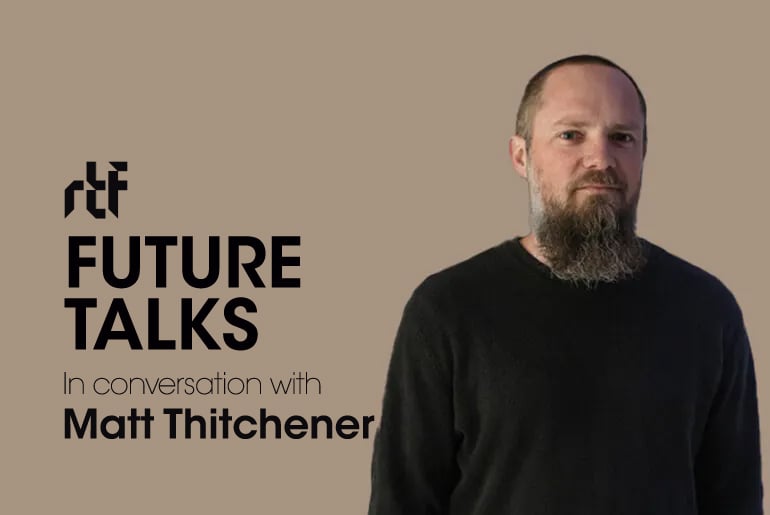
Meet Matt Thitchener, a registered architect in NSW whose trajectory in the architectural realm was ignited during his formative years as a structural draftsman from 1997 to 2001. Graduating with Honours in Architecture from The University of Newcastle NSW in 2005, Matt has since etched his mark as a seasoned architect, specializing in crafting opulent residences and select commercial projects.
Drawing inspiration from architectural maestros like Ando, Pawson, and the avant-garde stylings of contemporary Japanese architecture, Matt has meticulously cultivated a design philosophy that is uniquely his own. His unwavering dedication and exceptional talent have garnered multiple architectural accolades at local and state levels, gracing the pages of prestigious magazines and journals. Notably, his work has taken center stage in Australia by Design Architecture Season 5, capturing the imagination of architectural enthusiasts nationwide.
However, beyond the confines of architectural blueprints, Matt finds his muse in the realms of art and music, finding solace amidst the raw energy of heavy music and the pulsating rhythms of live performances by his favorite bands. A skilled guitarist, his creative spirit transcends the tangible, echoing into the world of sound.
Guided by a steadfast commitment to values such as honesty, transparency, commitment, and loyalty, Matt has carved a niche as an expert in high-end residential design. His mastery extends to navigating intricate sites and structures, exemplified by acclaimed projects such as the internationally recognized ‘North Avoca Studio,’ capturing global attention through publications and television features.
Driven by a desire to effect positive change, Matt has been actively involved in not-for-profit endeavors since the inception of Matt Thitchener Architect. With a portfolio that exudes excellence and an unwavering commitment to his craft, Matt stands tall as an authority in architectural design, seamlessly weaving innovation into the fabric of his creations. Today, we unravel the intricacies of his journey, exploring the blend of creativity, expertise, and relentless passion that defines Matt Thitchener’s architectural prowess.
RTF: Hi Matt, We are glad to have you as a guest on Future Talks by RTF. Thanks for joining us. What does your Architecture journey look like?
Matt: My 1st job was as a draftsperson working for my dad who is a structural engineer.
I was exposed to some cool architectural projects in this role and things developed from there.
I studied architectural technology at TAFE as part of my apprenticeship.
I used ArchiCAD for the 1st time at TAFE and thought it was so ground-breaking that I purchased a commercial licence within a few days of having used it. I then set up a small business providing drafting, CAD modelling and rendering services for local architects, councils and developers which helped me to hone my skills using the software.
Part way through my structural apprenticeship I decided that I wanted to become an architect and enrolled at the University of Newcastle (NSW) in 2002.
I worked for a friend during my studies who I am indebted to for helping me progress in my career, as working in the structural office on one of his projects was a major influence on me becoming an architect.
After graduation in 2005 I was fortunate enough to have worked for a few Architects whose work I really respected. I went out on my own full time in 2010 and became registered in 2012
RTF: What are the key points to keep in mind to build a successful architecture firm?
Matt: That depends on your view of success. My goal has always been to provide the best outcome possible for all my clients. What I lacked in the beginning was the wisdom to select my clients more carefully.
Not every client is suited to every architect.
To be successful you need to know who you are and what you want to achieve out of setting up an architecture firm. You also need to appreciate that architecture is a long game.
If I could give any advice, it would be to ensure you allocate time every week to work on your business and work on marketing.
RTF: What is the process of establishing a common ground when dealing with a client’s demands and your ideas? How important do you consider ‘The Art of Persuasion’ for architects?
Matt: I think Its super important to find that balance between the clients demands / desires and the architects’ ideas.
It is rare that a client will agree with everything you say without question, and I don’t think that would be a great outcome anyway. Some friction can be good if it pushes the architect to produce better work, or to come up with a more sustainable or budget friendly outcome.
I think a quality project requires an involved client, and it’s part of your job to make sure your client is involved.
It’s also important in some instances that your client understands the reasons why you make the decisions you make.
I’m not saying you need to teach your clients how to do what you do, but you do need to inform your clients about the skills and experience you are bringing to their project so that when you tell them why you can’t give them everything on their wish list, they trust that they are still getting the best outcome for their project.
If your client thinks that anyone with a roll of yellow trace and a felt-tip pen could do what you do, then you have devalued your services.
If a client doesn’t see the architect as an expert, or at least as someone whose ideas and design should be taken into consideration, then you are opening yourself up more to the possibility of clients or builders deciding to make a change/s without checking with you first.
You may end up with a project that neither you nor the client like in the end and given the amount of time it can take to get from initial concept to a finished product, this is a disaster.
The best way to create great work is to work as a team. The architect, the client and the builder need to trust each other and want the best for each other or at least for the project.
If there’s no client, there is no project, if there is no architect, there is no design and nothing to build, if there is no builder, there is no one to bring the project to life.
In my experience, when everyone is on the same team with the common goal of using what we have available to create the best possible outcome, that’s when the magic happens.
RTF: How do you look at the work beyond designing for young architects, such as the likes of involvement in publishing, handling media and building an online presence?
Matt: I think a picture really does speak a thousand words. Having good images/video of your work is super important. A good photographer should get who you are and what you want to present in your work.
That comes from good communication.
Next to that, you need a cool story.
Usually, people are interested in the process, the story of the difficulties you faced and the way you overcame the issues to get the project to where it is.
I prefer having others i.e., journalists or jury write about my work than to talk about it myself, a fresh perspective.
It’s easy to become so familiar with a project that you have been working on for an extended period that you just take certain things for granted and don’t appreciate what happens when you do what you do automatically – you end up short-changing yourself.
It’s been much easier on projects where I’ve committed to journaling or writing points about as they develop to put together a story to sell with the images.
If you don’t have any completed work, then it’s up to you to provide the imagery in sketches or renderings and a good story to boot – make something up if you must.
RTF: What do you think of building a social media presence for architects? How important is it and what does it demand from the architects who choose to do it all on their own?
Matt: I’m no marketing expert but I think telling the world you are here is critical to establishing yourself as an architect. There are so many platforms now for advertising your skills.
I think you need to start with who you are communicating with.
You also need to have something to show them.
After that, time and consistency are key to getting out there.
There is plenty of noise out there. There’s more to architecture than just making cool pictures so I think knowing who you are and who you want to be working for is so important.
RTF: What is your design language and what shaped it?
Matt: I would call myself a modernist: I believe in form after function.
This is most likely influenced by my structural background.
I would maybe go as far as saying I’m a minimalist, or at least heavily influenced by it as both an architecture and artistic expression.
I love playing with light and shadow, textures, and volume. I love robust, grounded buildings but also love playing with weightlessness and ideas of the sublime.
I’ve always been into art from an early age, my grandfather was a talented artist and used to take me to art galleries. My father is a structural engineer and used to take me to visit building sites with him as a kid. I was always interested in how things went together on site and took inspiration to paint after visiting a gallery.
These two things have no doubt played a large role in how I ended up where I am.
RTF: What is your process of developing the initial thoughts about a project? How do you start?
Matt: I always start with the site and the brief.
If you don’t have these things, you might have a nice idea, but you don’t really have a project.
Any design usually develops from there.
The site and the budget usually determine the type of materials you have available to design with.
I have found time and again that more constraints usually create better architecture. It pushes you to be more creative. Sometimes limitless options and no budget or site constraints produce insipid work.
One of my mentors used to say put the kitchen where the kitchen goes.
The idea being that given enough thought and time, you work out that everything has a place somewhere, and every decision has a consequence, it’s about finding the best way to play the hand you’ve been dealt.
RTF: Can you share any challenges you’ve encountered in the process of getting your work published and how you overcame them? Are there any lessons you’ve learned over the years that have significantly improved your success in this area?
Matt: My biggest hurdle is me, getting out there and showing people what I do.
I love the process of creating architecture, and I love talking about design and architecture, but when it comes to talking about myself or trying to sell myself, I don’t find that as easy for some reason. I usually keep myself distracted with doing more new work instead of talking about the work I’ve already completed.
I’ve also had a few projects for high profile clients that I couldn’t share too much about so that can be tricky.
A great client prompted me to enter their project in the local chapter awards and it did well at both local and state levels. Prior to that, I had never really thought about entering any awards. The best thing about the experience other than the recognition was being able to meet some great architects and experience some of their work through either visiting it or talking about it with them.
That project has been published locally and abroad, and subsequent projects have probably been more visible as a flow on effect.
The best thing I’ve learned in this area is that you just need to get out there and get amongst it.
Even if you don’t get work published or win awards, you get to meet loads of interesting people and learn from that + you get better at selling yourself as you keep working at it.
RTF: What is your idea of finding one’s design voice in a world full of ideas?
Matt: If you keep exposing yourself to great art, great music, great design, great architecture etc and you have good clients with a good brief and an understanding of your site/s, it will just happen.
Trust the process.
RTF: How has Artificial Intelligence influenced design?
Matt: It has been interesting to observe how AI has been influencing everything, not just design.
AI is becoming an integral part of what we do as architects, including pushing the envelope on structural development, energy efficiency etc. But I think as far as design goes, there will always be a market for something with a human touch. People still buy photorealistic paintings and drawings even though the camera has been around in some form since the 1800’s.
I’ve played with some AI architectural software and add-ons and have not yet seen it produce anything while I’m at the helm that I would like to present to a client.
That said, things are progressing quickly in that space so it will be interesting to see how quickly things change over the next decade, if it takes that long…
RTF: How have you shaped yourself creatively? What are the constant efforts towards it?
Matt: I love to visit architectural projects, read about, and try to understand the projects I’m interested in. I like to paint and create art when I make the time to do so. I also love playing and watching live music.
Visual arts and music have shaped how I create Architecture and will continue to do so.
RTF: What are the other paths you stroll on when not working?
Matt: I love doing what I do. Any time I can think about creating something or improving a design or construction detail, that’s where my head goes.
When I’m enjoying live music or art or talking about them is usually the only time I’m not working or thinking about work.
I was encouraged from an early age to find a job that doesn’t feel like work, and I’ve been blessed to be able to do just that.