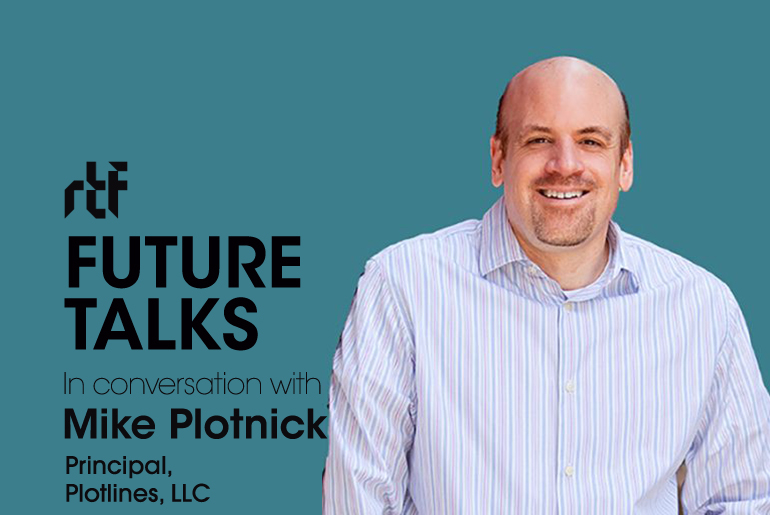
Ladies and gentlemen, welcome to another inspiring installment of Future Talks by RTF, where we engage in conversations with the pioneers who bring stories to life. Today, in the realm of design and storytelling, there are individuals whose expertise and passion shine brightly, transforming concepts into captivating narratives that inspire and resonate with us all. One such luminary in this field is Mike Plotnick, a versatile and accomplished writer, publicist, and content strategist.
As the founder and principal of Plotlines, LLC, Mike has dedicated his career to helping a wide array of organizations discover, craft, and share their unique stories. His journey into the world of storytelling began long before he established his own firm, with a prominent role in the Worldwide Communications group at Mastercard. During his tenure there, Mike honed his skills, contributing to the development and dissemination of narratives that transcended borders and cultures.
Mike’s impact on the realm of design extends even further, as he spent a decade as an integral part of HOK, a renowned global architecture firm. In this capacity, he spearheaded the development of internal and external communication strategies, playing a pivotal role in positioning HOK’s people, projects, and expertise on a global stage.
What sets Mike Plotnick apart is his diverse and dynamic career, which includes stints at two public relations firms and an advertising agency. These experiences have equipped him with a broad spectrum of insights and capabilities, making him a versatile and invaluable asset to any organization seeking to harness the power of storytelling and design.
RTF: Hi Mike, we are so glad to have you as a guest on Future Talks. Thanks for joining us. What is Plotlines about? And how did you steer towards the idea of building it?
Mike: Plotlines is a communications consultancy that specializes in helping architecture, engineering and construction firms share their stories. I started the firm in 2012 after spending nearly a decade as communications director at HOK, a global design, architecture, engineering and planning firm. Through that experience, I grew to love working with architects and designers. At the same time, I recognized the broader need for firms to more effectively communicate about their projects, people and expertise.
RTF: What role did market research and communications experiences play in the growth of Plotlines?
Mike: Since launching Plotlines 11+ years ago, I’ve continued to stay abreast of trends within both the PR and A/E/C industries. This enables me to effectively serve my current clients while positioning me as a valuable resource for my future clients. Growth has never been my primary goal; I just want to do great work for a handful of exceptional clients.
RTF: What has been your approach towards communications and how does time influence it?
Mike: I love to weave people and emotion into stories. Though most architectural narratives center around buildings and spaces, there are usually opportunities to include personal perspectives to further illuminate and humanize the projects. It’s also important for stories to be fresh, timely, seasonally relevant and aligned with current trends.
RTF: How crucial do you think social media presence has become?
Mike: Social media provides individuals and firms with valuable opportunities to connect with clients, prospects and partners on an ongoing basis. Through social media, firms can also showcase their expertise and point of view on important issues, which is particularly beneficial as traditional media outlets continue to decline.
RTF: How influential do you find a media kit? And what are your ideas on making it more comprehensive?
Mike: With the continued evolution of the media landscape, the role of traditional media kits has shifted. Most journalists don’t have the time or inclination to sift through hundreds of words and images, so brevity and simplicity are key. In my view, a PR person should make it easy for journalists by curating all available assets into concise narratives and compelling supporting imagery.
RTF: What is your idea of a perfect pitch? How soon should one follow up after sending a story pitch? What is the ideal number of follow-ups?
Mike: The most effective story pitches are brief, punchy, timely, unique and targeted to the individual/media outlet that is most likely to be interested. In most cases, I wait a week to follow up on a story idea and never follow up more than twice. If someone hasn’t responded after two reminders, they most likely aren’t interested and are not likely to provide any additional feedback.
RTF: What are your views on the evolution of the PR industry? And what are your ideas of trends to follow?
Mike: In today’s era of misinformation and disinformation, PR is arguably more important than ever for building trust with an organization’s internal and external audiences.
Without question, the most significant recent trend has been the emergence of AI tools. I think everyone is intrigued by the efficiencies they’re likely to bring to the labor-intensive PR process, as well as a bit anxious about the potential ramifications on the future role of PR professionals.
Within the architecture and design industry, there are several important trends that will continue to drive potential PR opportunities. These include climate change, the rising cost of healthcare, the need for affordable housing, indoor air quality, the future of the workplace, and the importance of facilitating human connections in an increasingly disconnected world.
RTF: The media landscape has evolved significantly over the years. What are your thoughts on these changes, and how have they impacted your work?
Mike: It’s been sad to witness the ongoing decline of traditional news media as online alternatives continue to emerge and consumer preferences shift. When I began my career 30+ years ago, most PR professionals relied primarily on traditional media to convey their stories. And while traditional media are still valuable parts of a PR strategy, the majority of effort is now focused on a broader array of outlets and tactics.
RTF: How important is a progressive mindset in the marketing industry? What are your views on it?
Mike: I think it’s always important to keep your eyes and mind open. It’s easy to grow comfortable with the status quo, but the world is changing so rapidly that you can quickly lose momentum and be left in the dust.
RTF: What would be your advice for young communications and PR professionals who wish to excel in the field?
Mike: Hone your writing skills because writing is foundational to almost every project. And though there are plenty of successful PR professionals who are not particularly strong writers, those who can write well are far more versatile.
RTF: What are your plans for the future and what are some off-the-table habits that keep you motivated?
Mike: I plan to continue working with awesome clients. A few daily rituals that keep me grounded and motivated are early-morning gym workouts, listening to podcasts and walking my two dogs.