

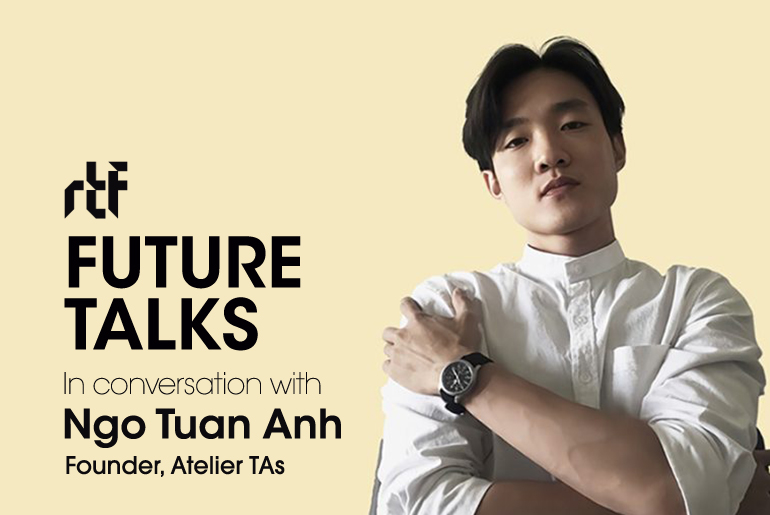
Welcome to Future Talks by RTF, a series of insightful conversations with pioneers who bring design stories to life. In today’s episode, we have the privilege of delving into the journey of an exceptional architect and the visionary founder of the architectural design unit, Atelier TAs, operating in the vibrant landscape of Vietnam.
Our guest of honor, Ngo Tuan Anh, is not only a distinguished architect but also a true testament to the power of determination and passion. Hailing from Vietnam, he embarked on his remarkable journey into the world of design at an early age, fueled by a deep love for space creation and painting.
Ngo Tuan Anh’s path towards architectural excellence began while he was still in high school, where he dedicated himself to painting classes, honing his creative skills and knowledge in anticipation of an exciting future. His unwavering commitment to his dreams led him to pursue a degree at the prestigious University of Architecture Ho Chi Minh City, where he further cultivated his passion and expertise.
But Ngo Tuan Anh’s educational journey was just the beginning. He possessed a relentless hunger for practical knowledge, a thirst for real-world experiences, and an unyielding spirit of curiosity. As a sophomore at the university, he embarked on a journey that would significantly shape his career. Ngo Tuan Anh ventured into the realm of architectural design studios, immersing himself in the daily work of architects, absorbing their wisdom, and contributing his unique perspective. This internship not only expanded his horizons but also solidified his love for the craft.
Upon graduating from the University of Architecture Ho Chi Minh City, Ngo Tuan Anh entered the professional world equipped with four years of invaluable experience gained from various design offices. He now stands poised to embark on his official career journey, ready to leave his indelible mark on the world of architecture and design.
Join us as we explore the life and insights of Ngo Tuan Anh, a visionary architect whose dedication and passion have sculpted a promising future in the realm of design.
RTF: Hi Ngo Tuan Anh, We are glad to have you as a guest on Future Talks by RTF. Thanks for joining us. What have the past five years been like as an architect?
Ngo Tuan Anh: The past 5 years have been quite an interesting journey for me. Since graduating, working with bosses and leaders that I respect, I have learned many things. They also helped me a lot in my work until now. When doing my job, I always have the desire to witness the formation and experience the spaces that I designed. The feeling of standing in that space, seeing and using it is wonderful. I always joke with my customers: “When the construction is finished, can I stay there for a month?”, because I want to test all my thoughts to see if it works as I first imagined it to. Of course, that journey also had many difficulties, some of which almost defeated me, but what made me overcome them all was seeing the satisfied smiles of customers about the work I had done for them. There is nothing more wonderful than when your designs materialize, bring value and benefits to others as well as contribute to society.
RTF: What is your approach towards design and how was it shaped in your initial years?
Ngo Tuan Anh: I always focus on creating spaces that bring a sense of comfort to users, a space with natural light, greeneries, and wind. I have witnessed people living in cramped spaces and of course having to stick with it for a long time, which is really bad for people’s quality of life. With such an investment budget, everyone deserves a much better living space. That’s why it makes me determined to create good spaces within my ability when working.
RTF: What kind of attention do you give to the ‘community’ in conceptualising a project? How do pragmatism and subjectivity go hand-in-hand in it?
Ngo Tuan Anh: Architecture itself cannot be separated from the community because architecture is to serve people. The problem is which aspects of the community we pay attention to in a project. When starting a project, I always clearly identify the intended users, and ask some questions like How will they live in that space? How are they connected? How do children play and develop?,… And to find answers to those questions, the more questions I can ask around the user and solve them, the higher sense of community the project has. Therefore, it not only carries a great humanistic value but also the value of local cultural identity.
As for how pragmatism and subjectivity go together in design, I think a good design is the one that serves well the needs of use, so always starting from the user first then there are other subjective things that come from me. Because only the customer will directly use it, not me.
RTF: How do you look at the work beyond designing for young architects, such as the likes of involvement in publishing, handling media and building an online presence?
Ngo Tuan Anh: The fact that a young architect participates in publishing, handling media and building online presence are also good things, it brings many benefits. Because they have to pay more attention to what information they will post for readers, and how to convey it in the best way.
Design orientations and finding suitable customers depend entirely on what information you show. When done well, you can easily find suitable customers, serve them well and bring the most value.
In addition, design and construction expertise cannot be separated, requiring coordination from different disciplines to form a project. If you are not knowledgeable, it is very difficult to create a good project. It cannot be said that an architect who only draws all day long in an office can create a good project.
RTF: What do you think of building a social media presence for architects? How important is it and what does it demand from the architects who choose to do it all on their own?
Ngo Tuan Anh: In the current era of technological development, I think that building social media for architects is very important, firstly to share knowledge to help society develop and change customers’ thinking in a positive direction about what architects can bring to them. Second, it helps architects easily share and approach the customers with projects the architects have implemented, which provides many opportunities for them to be able to follow the way they want. Architects must be skillful in choosing content to share on social media to be able to find customers who fit with the design they pursue. They must have a clear design direction and create content according to it.
RTF: What is the process of establishing a common ground when dealing with a client’s demands and your own ideas? How important do you consider ‘The Art of Persuasion’ for architects?
Ngo Tuan Anh: I always listen to and respect the requests as well as the opinions of my customers first. I always want to discuss with my customers about many aspects, not just design, to understand them clearly. I think that if I want others to respect my opinion, I must respect their opinion first. After listening to my customers, I will synthesize the needs, then analyze what is really needed and what is not, what should and what should not be done for the customer’s intended use. Then I present it to my client. I usually arrange the requests in order of priority and solve them in that order. However, there are some things that cannot be done. In architecture, sometimes you have to trade off if you want to do this, you won’t be able to do another one. It’s a matter of choosing which one is the priority. Convincing customers based on the basis of giving the greatest benefit to them and thus I will find a common path for both of us. “The Art of Persuasion‟ is really important. For me, the key to persuasion is to truly understand what the customer wants and then offer the best things for them, so they will be willing to use my design.
RTF: How has the presentation of projects changed with time?
Ngo Tuan Anh: Presenting my project also has certain changes over time. Gradually, I realize more about what customers need to understand my design, and then I always change the way of presenting so that everyone can understand it easily. For example, even on construction drawings, in the past I often made a lot of details because I wanted to provide as much information as possible, but sometimes it backfired and made everything confusing. It needs to be omitted and expressed clearly to make it easier for people to understand and visualize it.
RTF: Which has been the most rewarding project for you until today? And, what factors made it so?
Ngo Tuan Anh: It is the residential project, BiBi House was the first project that served as a foundation when I established ‘Atelier TAs”. After the project, many people knew about me and then I got more new customers. Previously, I also had the opportunity to participate in various projects from small to large scale when I was an employee at architectural offices in Ho Chi MInh City, but BiBi house is a project that made my own mark, from which I have gained a certain recognition and trust from customers, so they assigned me to carry out their project. I really appreciate the homeowner BiBi House very much for giving me the opportunity. Fortunately, everyone respected that design and accompanied me with it until it was completed.
RTF: What is your process of developing the initial thoughts about a project? How do you start?
Ngo Tuan Anh: As mentioned above, I always start from the customer’s requests. I will analyze something such as the current situation, surrounding natural conditions, sun direction, wind direction, unfavorable direction, favorable direction, directions with good views or not then synthetic all that analysis. I give the main ideas that need to be resolved and stick to it to avoid rambling. Next, I find as many ideas as possible that are suitable for that topic. If I come up with something, I sketch it and make a concept model right away and look for more ideas until the deadline which my client and I agreed upon for the concept phase. Ultimately, I will meet my client with some of the best options that fit best among them all. It is always a good method for me, because I try my best not to miss out on good ideas.
RTF: How does a community make ‘An Architect’? And how important is the role of parents in shaping a child, who is sensitive towards art and architecture?
Ngo Tuan Anh: I think it first comes from a person’s interests and strengths, followed by the environment around that person, if that environment has events related to painting, promoting creativity,.. so it is great to explore and find out the talents then create a future architect. When parents realize that their children have a passion for art and architecture, let them develop naturally and create conditions for them to participate in art activities such as painting and other creative activities.
As for myself, when I was young, I had a tendency to prefer things related to creativity and painting. However, at that time, there weren’t too many activities for me to participate in, other than homework hours. In painting and creative subjects at school, I often take advantage of the simple things around me to explore and satisfy my love of creativity. Luckily, my parents did not prohibit my stupid creativity. For me, those were the initial experiences that helped me decide to pursue a career in design later.
RTF: Who has been your inspiration throughout your architectural journey?
Ngo Tuan Anh: To be honest, up to now, those are the very nice bosses and leaders that I have had the opportunity to work with; those are the people who inspired me a lot. Because when I first started my career, I was really excited about practicing architecture in order to see my designs gradually appear in reality. There were my bosses and leaders who first guided me to do it, and thanks to them, I was able to shape and get the design thoughts as now. In addition, I also idolize and follow many other famous architects in the world so that I can constantly hone my design abilities.
RTF: Where does one find you when you’re not working?
Ngo Tuan Anh: It could be in a small garden in front of my working space at home. After finishing a day at the office, I come home and often stay there to take care of the plants and sit down to look back at what I’ve done during the day as well as arrange what to do for the next day.


