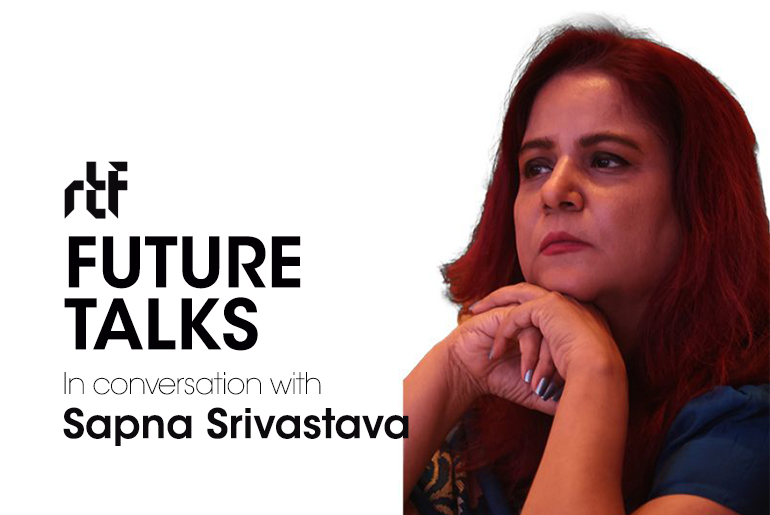
Ladies and gentlemen, design enthusiasts, and all those with a passion for the art of architecture and storytelling, welcome to “Future Talks” by RTF – where we engage in enlightening conversations with the pioneers who breathe life into design stories.
Today, we have the distinct pleasure of introducing a remarkable individual who has not only bridged the worlds of architecture and journalism but has also elevated architectural storytelling to new heights – Sapna Srivastava. An architect by training, Sapna embarked on a remarkable journey in the realm of architectural journalism back in 2006, and since then, her impact has been nothing short of transformative.
As the Editor of Realty+, Sapna not only upholds the highest editorial standards but continually innovates and introduces fresh editorial perspectives. Her work has not only informed but inspired countless individuals in the field of architecture and design.
But Sapna’s journey doesn’t end there. Prior to her illustrious career in journalism, she practiced architecture in the vibrant city of Delhi, bringing her creativity and expertise to life in the form of architectural marvels. Additionally, she has shared her knowledge as a visiting faculty member in the field of interior design, shaping the minds of the next generation of designers.
Sapna Srivastava’s career is a testament to her multifaceted talents and her unwavering commitment to both architecture and design journalism. Her unique blend of professional experiences, from being a hands-on architect to an influential editor, has provided her with a distinctive vantage point in the world of design.
Join us as we delve into the captivating world of Sapna Srivastava. She will share her insights, experiences, and the evolving landscape of architectural journalism and design. Get ready to be captivated by her wisdom, innovative ideas, and her exceptional ability to bring design stories to life.
RTF: Hi Sapna, We are glad to have you as a guest on Future Talks by RTF. Thanks for joining us. You started as an architect and gradually became involved in writing and publishing content. What propelled you towards writing?
Sapna: Writing happened by accident rather than by design. A second generation architect of the family, I pursued my architectural career in Delhi, having worked with some prestigious architectural and interior firms including my father’s architectural firm. My move to Mumbai with my husband and young child gave a break to my architectural career and steered me towards freelance writing for popular newspapers and magazines on the topics of design and architecture. And that is when I discovered that I was good at writing and with my technical background could present the design subjects with much more flair and understanding. The appreciation received gradually turned me into a full time writer and eventually a magazine editor.
RTF: Managing a series of the magnitude of Realty+ is great. How rewarding has your time been?
Sapna: It is true, the scale and scope of Realty+, the real estate publication is quite vast as it cover everything and anything to do with real estate including design, technology, finance, legal, engineering, consulting etc. And my 7 years of being the editor of this magazine has been quite challenging as well as rewarding. The challenging part was the upgrading of the content and editorial quality of the publication, creating an identity of the publication and making it a credible publication in a short span of time. The reward was the recognition the magazine received from the industry and the readers. And now more and more renowned professionals want to be part of it.
RTF: How has ‘redefining’ come into play for magazines when it comes to ideas and approaches, looking at a constant shift in the media landscape and people’s perception towards it?
Sapna: We are living in the VUCA world and with constantly changing perceptions whether it is media or any other industry, ‘redefining’ is the word to live by. The media landscape has changed drastically over the years and is no longer a prerogative of the sophisticated few. The social media has taken the written word to the masses. This has also changed people’s perceptions of media. Each and every word is accounted for and called out. In such a scenario, the magazines b2c or b2b have to walk the tightrope of imparting the knowledge and at the same time being an interesting read.
The story ideas and approaches all have to come from the on-ground happenings and from the views of the people who have the genuine information. As is the adage, change is the only constant, the publications too need to stay in sync with times or perish.
RTF: How do advertisers influence the content of the magazines? What does it take for publishers to maintain editorial independence and integrity while working with advertisers and sponsors?
Sapna: Maintaining editorial integrity and the financial viability of the publication has been the constant struggle for media since ages. In my view, this struggle has become a bit easy in current times. The reason is that advertisers and sponsors are now more aware and consumer is more informed.
From vanilla marketing, companies have graduated to indirect marketing. To gain trust of potential customers, companies want to promote their brand through thought leadership content rather than the product promotion. Publishers work with the advertisers to create the right content that is informative for the readers. The tough part is in making sure that the advertisers do not present the incorrect facts or biased information. Research and due diligence on part of the editorial team can help tweak out such misinformation.
But, once again the editorial independence and integrity has to be enforced to be accepted. After all it is a matter of maintaining the publication’s image and credibility. The advertisers will come to you because they want that credibility to rub on their brand as well.
RTF: How do you look at the content that comes your way and decide on working towards that? What is the process like? From selection to the importance of pitch?
Sapna: First and foremost, we do not take authored content whether it is from a contributory writer or advertiser. The topic or the pointers are shared for the write-ups. This enables us to get customized content which is in line with our editorial style, format and policies.
Most of our stories are editorially driven, which means for each issue, story topics are ideated, ranging from current happenings and developments in India and the world for the general public to informative articles that will be of interest to the industry. The relevant professionals and experts are identified whose views will add value to the topic of discussion. Finally the articles are written by the edit teams that includes the inputs from the experts and writers own inferences.
RTF: What would you suggest the aspiring designers and creatives who wish to get their feature published in the top publications? What are some challenges in doing so?
Sapna: My topmost suggestion to those who want to get their feature published is to be unique. Whether it is in terms of the subject or writing style. If the subject is distinctive, or there is a fresh new perspective to a subject, any publication will be interested to take it up. However, if the writing style is bad, it will not cut with the publisher. Another very important aspect is the grammar, grammatical mistakes, a bad copy turns off the editors. So command on language is a must.
The challenge for any writing is to keep it short and simple. And the process starts from the author’s mind. If you have clarity of thought, what you want to convey, how you want to say, rest will be easy. Keep the writing simple, do not overuse jargon or difficult words. When writing, do not talk to the readers, talk with them.
RTF: How impactful is a comprehensive media kit according to you? How can it be made better?
Sapna: A comprehensive media kit is an invaluable tool for businesses to get the word out about their product or solution. A good quality media kit with easy to access information, updated facts and figures and credible narrative in line with the brand identity is impactful in way of not being just a promotional material.
To make the media kit impressive and effective, it should have all the relevant information in short and crisp manner, driven by infographics, easy to read statistics, engaging content, high resolution images, clear and concise descriptions and contact information.
RTF: What do you think about the media landscape today, and what is the route for magazines and publications going to look like in the times to come?
Sapna: The media landscape toady is quite exciting and with the advent of online, the magazines and publications have found more opportunities to diversify and grow their business. No more limited to print, the magazine content accessible on smartphone and tablets is reaching a wider audience. Publications are going hybrid with print and digital presence.
The future looks promising as there are new avenues opening up and it is for the publications to explore the route that best fits their vision of growth. The marketers are exploiting the unique propositions of each media channel for advertising – Print for its permanency and more attention span by the reader, digital for agility and wider reach.
But in all this, content remains the king. The magazines and publications of future will become more interactive and engaging with complimentary podcasts and video content and interactive stories and advertising.
RTF: How has your job influenced you creatively?
Sapna: Coming from an artistic field of architecture, media has been no less creative for me. If anything, it has added to my creative thinking, no more bound to just one field or industry. Interacting with people from various sectors and segments of the society and professions has added to my experience, expertise, and skills and helps me think in more distinct ways. The job of a magazine editor demands you to stay ahead of the curve, take on new perspectives, explore new approaches and find unique solutions to problems.
RTF: What are the other paths that you stroll on when not working?
Sapna: When not being an editor, I am an architect and interior designer for my friends and family. I am glad that I am still using my qualification, if not professionally. Apart from that, my favourite past time is reading. As it is said, books are important for the mind, heart, and soul. Reading refreshes you after a long day. Walking is my next favourite activity. Late evening walks help calm me down and also lift up the mood and get the brain working. I have come up with some of my best ideas when walking. The path that I wish to stroll more on – is sketching.
RTF: What advice would you give to young architects who are transitioning towards careers in writing and journalism?
Sapna: Journalism is driven by unbiased views of the writers. It is not only about creative writing and thinking but also about creative observation. Study of architecture has already given you the background of creative thinking & observation, so that’s the easy part. The difficult part is the research. Many articles, features and stories fall flat, because of lack of depth in them. My advice to architects interested in journalism is to have impartial attitude, keep an open mind and research well.