

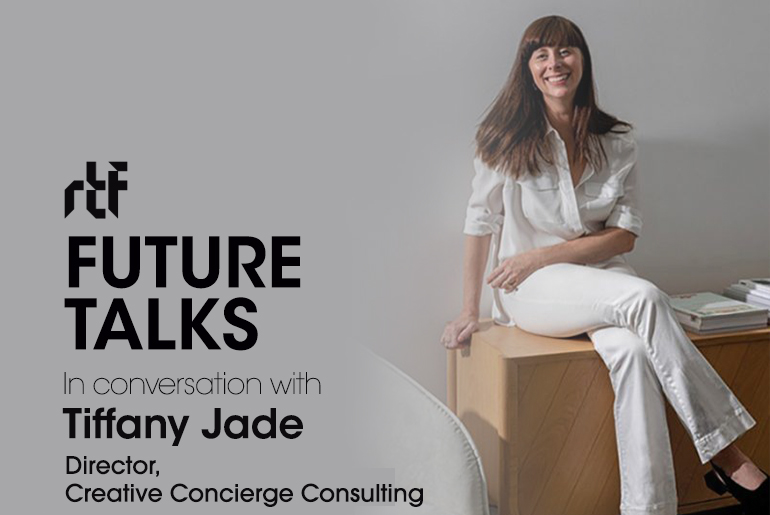
Welcome to “Future Talks” by RTF, where we engage in conversations with the pioneers who bring design stories to life. Today, we have the privilege of introducing our esteemed guest, Tiffany Jade.
Tiffany Jade is not only an Interior Designer but also a gifted writer and storyteller. In 2017, she founded Creative Concierge Consulting (CCC) with a vision to harmonize her rich experiences and connections across the realms of architecture, art, and design. What sets Tiffany’s work apart is her profound anchoring in the written word. She wields words with eloquence and authority, seamlessly merging strategy and narrative to craft expressions that vividly convey the intent and outcomes of a project.
With a remarkable portfolio that spans collaborations with globally renowned branding agencies, architects, designers, and developers, Tiffany has contributed her talents to a wide range of written content. From editorial pieces to capabilities documents, profiles, awards submissions, social media copy, strategic documents, and website content, her linguistic finesse knows no bounds.
Tiffany’s work has not only graced the pages of publications but also adorned galleries in prominent cities like Sydney, Berlin, and London. Her distinctive stylistic language, characterized by clarity and elegance, possesses the remarkable ability to cut through the cacophony of contemporary digital and print media, effortlessly transporting readers to a realm of comprehension and conversation.
RTF: Hi Tiffany, We are glad to have you as a guest on Future Talks by RTF. Thanks for joining us. It’s been around 15 years since you started working at an art gallery. What has the progression been like since then? And what has been your approach throughout your journey?
Tiffany: I’ve always been drawn equally to art and design. After completing a Bachelor of Design (Interior Design) at RMIT University in Australia, I felt strongly that I still had a lot to learn about the pragmatics of design and the detail behind how buildings and objects come together. So I began working for a furniture maker throughout the week and in an art gallery on weekends. Both roles exposed me to all sorts of scopes and scales while allowing me to learn about the way furniture and objects were constructed. A few years later, I moved from Melbourne to Berlin and once again found myself working in art galleries, honing my skills in exhibition design and curation further. On return to Australia in 2013, I found myself merging a lot of my past experience by project managing built projects in the public realm. A huge element of that position was writing various collateral — to council for permit and planning approval, to stakeholders, to media for press exposure — and I quickly discovered a passion and skill for the written word. Especially its power and significance within the A&D space. A chance encounter with an editor of a major design publication (Est Living) was what ultimately set me on a path paved in words. I now work with creative clients all over the world, producing written content that balances the evocative and experiential with strategy and construction knowledge. I love to be able to define a built or artistic project narratively but with a depth of understanding for the concepts and intents that are its guiding stars. Writing perfectly reconciles everything I’ve done professionally up until now.
RTF: What does the balancing act of managing CCC and writing with essential platforms like ‘The Local Project’ and ‘Est Living’ look like?
Tiffany: It looks busy! It takes a lot of planning and client management to make sure deadlines are maintained and a pipeline of work is established and facilitated. The complexity of switching my brain between editorial, advertorial, artist statements, development copywriting, awards submissions and campaign collateral can be hard, like switching between languages. Basically everything I do is through CCC but clients can be engaged differently. Est Living and The Local Project have been long term clients with ongoing editorial commitments. I have other clients that I work with on a retainer or contract basis and others that are project to project. I also work with a number of agencies both in Australia and Paris. What tends to happen with this diversity of client base is that all sorts of opportunities begin to arise. For example, I might be working on a project profile for an architecture studio and then that project naturally ends up being pitched to a best-fit publication I work with. Or I might be engaged to create development collateral which then spills into useful social media captions. It’s all about recognising the opportunities to deliver content that goes above and beyond client expectations and optimizes relevance and usage.
RTF: Culture takes a different shape daily. What does it take for writers and editors to constantly be on the bandwagon and put up relevant content?
Tiffany: I think culture is the effect and consequence of everything that touches on society so maintaining a really open perspective is incredibly important. Being hyper-focussed on one sector or discipline for example, is never going to give a true and comprehensive reading on culture. Having said that, creativity has always been a cultural metric. Art, fashion, architecture…each is a reflection of social, economical, political, wellness and environmental stressors. When outcomes are successful, it is often because they are supporting these pillars in a way that binds with culture. Writing about those projects that highlight culture in a way that is authentic and meaningful, in a way that advocates for a better future, is where the importance lies as that is how the message is spread to become a catalyst for change.
RTF: How do you perceive the emergence of social media? How has it impacted the content? And help us dissect the ‘positive’ and ‘negative’ aspects of it, if any.
Tiffany: Social media has significantly sped up and amplified digital content. It has insidiously projected content into a place that feels almost necessary to our lives. For better or worse, it has changed how we digest content and impacted attention spans, traction and reach. In terms of the written word, the introduction of social media turned the spotlight on images for quite a while however I feel like this is changing again. In an oversaturated visual landscape, words can cut through the white noise in a way that is so succinct and profoundly immediate. In tandem, words and images have the capacity to articulate a brand story in only a handful of slides and then neatly allow for further exploration by that powerful – targeted – part of the market because, at the end of the day, thousands of followers is meaningless when they don’t convert into sales or engagement.
RTF: How has your job influenced you creatively?
Tiffany: My job acts as a north star to my creative compass. If I’m working on copy that is heavily strategic I tend to find opportunities to lean into creative pursuits in my own time (such as my ‘First Impressions’ series on instagram) and, in the other direction, when I’m working on a very creative engagement, with an emphasis on storytelling and atmosphere, I’m largely content to spend the remainder of me time scheduling, researching and strategising.
RTF: What key ideas would you give to writers who wish to get their content published in top publications?
Tiffany: When I started out, I heard often from editors that they found it very hard to find strong writers who also knew the A&D industry. It’s really important to be able to mediate between strong writing skills, a depth of understanding about the industry you are writing about and an awareness of strategy, marketing and SEO. That’s the trifecta really.
RTF: Having worked with some great organizations in the realm of art and content, how rewarding do you find your job to be? And what are the challenges involved in the process?
Tiffany: I absolutely love my job. Some days I still can’t quite believe that I make a living from doing something I genuinely enjoy doing with incredible people and organizations. For a short time I worked with a business mentor who often tried to tell me that “there are no relationships in business,” which just doesn’t resonate with me. I think that it is a sentiment that makes more sense in certain industries and contexts but not so much in others. As a creative freelancer, the relationships I cultivate are everything.
As far as challenges go, there are definitely a few. As a writer, I’ve reached a point where I spend probably a third of my working hours actually writing. The other two thirds are spent in client meetings, investing in my continued professional growth, admin, fostering client relationships remotely and in-person and researching. As I’ve grown, I’ve also begun to work with more international clients which has meant developing a deeper understanding of different cultures. It’s challenging but also something I find fascinating. While there is a definite process for some copywriters, I find that being agile to each client and their unique intents, location, sector etc. allows me to create specialized written content that is highly engaging and extremely usable across multiple platforms.
RTF: We would like to get your idea of a ‘good’ pitch and how you differentiate between a ‘positive’ and a ‘negative’ approach from the writers and designers.
Tiffany: A good pitch is one that considers the weight and priority of different content. What are images doing and therefore what do the words need to do so as not to simply repeat what the images are already portraying? How have different font weights been utilized within the design to draw attention to the project’s pillars? What is the ratio of images to words? It’s a symphony of design, where you have to cater to those who have very little time and who might be glancing very quickly at loads of pitches so occupying their attention long enough to draw them into further exploration is imperative.
RTF: What does a good media kit look like to you?
Tiffany: Similar to the above. It’s important to present a hierarchy of information through design and layout and ensure that words and images are not simply repeating each other. A strong hero image will cause a reader to pause, pull quotes in a slightly larger font will concisely frame the project further, identifying its concept and pillars and why it is unique, and then the body copy and images will allow a publication or potential stakeholder to see the myriad possibilities, to hold that engagement.
RTF: How does your off-the-table life shape your professional life?
Tiffany: Both facets of my life, personal and professional, constantly play off each other. It’s like an intricate dance. I have a very young family so each day/week/month can look different. A couple of years after having my first baby I learnt to be more responsive to the natural flow of daily life. You can’t force structure upon newborns! Now that two out of three of my children are at school, I’m welcoming structure back in but I still find that being opportunistic with my time is key even if that sees me working most nights and on weekends if I’m especially busy. I’m still perfecting the necessity of valuing my own downtime as much as work and “mum” time but I still have a little way to go in that department 😂.


