• Careers
  • About
  • Submit Your Story
  • Subscribe
Search for:
  • Facebook
  • Twitter
  • Pinterest
  • LinkedIn
RTF | Rethinking The Future
  • RTF Awards 26
    • Rethinking The Future Awards 2026
    • Previous Awards
      • 2025
        • RTF Awards 2025 | Results
        • GADA 2025 | Results
      • 2024
        • RTF Awards 2024 | Results
        • GADA 2024 | Results
      • 2023
        • RTF Awards 2023 | Results
        • GADA 2023 | Results
      • 2022
        • RTF Awards 2022 | Results
        • GADA 2022 | Results
      • 2021
        • RTF Awards 2021 | Results
        • GADA 2021 | Results
      • 2020
        • ACD Awards 2020 | Results
        • RTF Awards 2020 | Results
      • 2019
        • GADA 2019 | Results
      • 2018
        • ACD Awards 2018 | Results
        • GADA 2018 | Results
      • 2017
        • RTF Awards 2017 | Results
        • RTF Sustainability Awards 2017 | Results
      • 2016
        • RTF Sustainability Awards 2016 | Results
      • 2015
        • RTF Sustainability Awards 2015 | Results
      • 2014
        • RTF Awards 2014 | Results
    • Competitions
      • RTF Writing Competition 2021
      • Architectural Photography Competition May 2020 – Results
      • RTF Architectural Visualization Competition 2020 – Results
      • RTF Essay Writing Competition April 2020 – Results
      • Designer’s Days of Quarantine Contest – Results
      • Urban Sketching Competition May 2020 – Results
  • Articles
    • Architecture+
      • Architectural Community
      • Architectural Facts
      • RTF Architectural Reviews
      • Architectural styles
      • City and Architecture
      • Fun & Architecture
      • History of Architecture
    • Design+
      • Design Studio Portfolios
      • Designing for typologies
      • Product Design
      • RTF Design Inspiration
    • Art
    • Architecture News
    • Construction & Materials
    • Covid and Architecture
    • Know Your Architects
    • RTF Fresh Perspectives
    • Career Advice
    • Case Studies
    • Landscape Architecture
    • Narratives
    • Sustainable Architecture
    • Technology & Architecture
    • Top Architects
    • Travel and Architecture
    • Technologies
    • Architectural Insights
    • Articles
  • Courses
  • Future Talks
  • Projects
    • Architecture
      • Cultural
      • Commercial
      • Educational
      • Healthcare
      • Hospitality
      • Housing
      • Institutional
      • Mixed Use
      • Office Buildings
      • Public Building
      • Recreation
      • Residential
      • Sports & Recreation
      • Temporary Structure
    • Interior Design
      • Commercial Interior Design
      • Corporate Interior Design
      • Healthcare Interior Design
      • Hospitality Interior Design
      • Residential Interior Design
    • Landscape
    • Product Design
    • Skyscraper
    • Sustainability
    • Transportation
    • Urban Design
  • Submit
  • More
    • Architectural Writing Training Programme | WFH
    • Careers
    • About RTF
      • Contact RTF
      • Work with RTF
        • Host your Course with RTF
        • Internships at RTF
          • Editorial Internship | In-office
          • Graphic Design Internship
          • Research Internship | WFH
          • Research Internship | New Delhi
      • Advertise on RTF
      • Subscribe
  • Search for:
Join Rethinking The Future Awards 2026
In Product Design

A step to innovate for the visually impaired

5 Mins Read
Share
Share on Facebook Share on Twitter Pinterest Email

Designing for the blind requires analysing and understanding how one can use the other four senses to make the product usable. Hence, surfaces, textures, touch, and sound are the most commonly used techniques in a product designed for the visually impaired—such as tactile surfaces and haptics, initiating alert sounds, or a speech reader. Below are a few innovations created by various designers worldwide to make the world better for the visually impaired. 

1. Dot Tablet: a visualisation tool 

Designed by the brand Dot In, this Dot tablet provides an innovative solution for the visually impaired or blind people to feel what they draw through their fingers. It is attached to a drawing tablet, where they can draw with one hand and sense through dots with the other. Such a concept has opened up design possibilities with inclusivity or catering to a certain niche of audience in help. This tablet can also help one to visualise any image or digital content without having to have a voice-over attached for a better explanation. It gives a sense of confidence and relative independence. 

The Dot pad provides a canvas of 2400 such dots in a grid, and since the visually impaired generally have other heightened senses, they can feel the texture with incredible clarity in mind. 

A step to innovate for the visually impaired-Sheet1
Dot tablet and pad ©TechCrunch

2. Sense 5: A smart walking stick

Designer Werteloberfell incorporated real-time image recognition technology into a walking stick to sense nearby objects or obstacles and alert the user. A camera is attached to the lower front part of the stick; hence, it can be a useful guide for a visually impaired person to navigate the unknown. The form of the product is slim, elegant, light and easy to hold with an angled shape. It also comes with a torch that helps the people or vehicles in the surroundings be aware and for the camera to sense the obstacles in the dark through AI. Since the stick uses power for its functioning, it also alerts the user when the battery needs to recharge.

A step to innovate for the visually impaired-Sheet2
Smart walking stick ©Tuvie

3. LyriQ Assistive: A text-to-speech reader 

Empowering accessibility for the blind or visually impaired, this innovation has helped a lot of the catered audience to read books and other written materials. Its form is compact, just like a fold-flat laptop, where one can place their material or a printed page over it, shut the flap, and convert it into speech. This device is then connected to either hearing aids or speakers via Bluetooth. In order to make it convenient for the user to operate the product, the tactile buttons are designed to be large and optimum in number for any assistance. 

A step to innovate for the visually impaired-Sheet3
Text-to-speech reader ©nNELVB

4. Tactile paving: for safe navigation

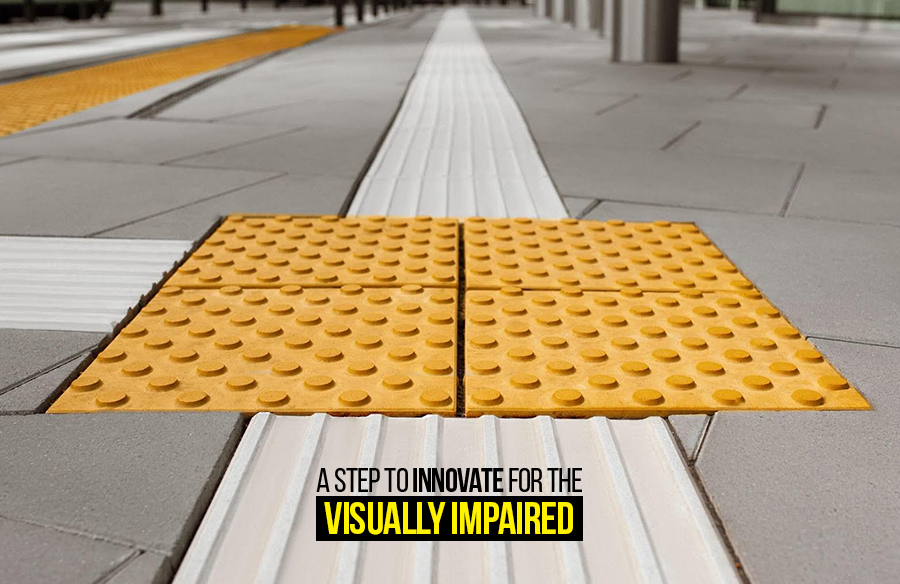
A Japanese engineer designed two kinds of tactile bricks in 1965: one to help a person walk along the pathway and the other to warn the visually impaired about any intersection, a right-angle turn, or a termination towards a moving road. These pathways usually had long, stripped tactile patterns with rounded edges for a smoother walk. The warning blocks had detectable dots, symbolically representing when one needed to stop and contemplate the next step. They were designed to be a kit of parts that can be assembled as per the requirement. These tiles were made from materials such as ceramic, rubber, plastic or concrete. 

A step to innovate for the visually impaired-Sheet4
Tactile pavement block ©Studmarc

5. Eatsy cup: an easy kitchenware

It was designed as a research project by a Singapore-based designer, Jexter Kim, to understand the issue of the visually impaired having trouble eating alone. Hence, he designed a few kitchen products – a plate, a bowl, a cup and three utensils where each of these has an olive green spot at the top that can act as a sensory cue to learn about the direction of the cup. The Eatsy plate and bowls with such green flags make the simplest eating and serving processes easier, such as scooping food from the products as well as pouring them from one to another.

A step to innovate for the visually impaired-Sheet5
Mug with a silicon flap ©Yanko Design

6. A safe mug: to not spill

Bell was designed by Sang-hoon Lee and Yong-bum Lim, and catered to the idea of pouring hot liquid in the cup safely without having to spill or overflow. The inner surface was built in a way that reacted to the water being poured, and the user could stop to pour, hearing the sound that came from the mug at various levels. There are also sensors attached to the mug; hence, when the user holds it through the handle, they can feel if it’s overflowing or at the 3/4th of the level. 

References: 

Wille, M. (2020) This tableware enables the visually impaired to eat and drink by feel alone, Input. Available at: https://www.inverse.com/input/design/this-tableware-enables-the-visually-impaired-to-eat-and-drink-by-feel-alone-eatsy (Accessed: 28 April 2024). 

Lyriq assistive text-to-speech reader with keypad (2024) New England Low Vision. Available at: https://nelowvision.com/product/lyriq-assistive-text-to-speech-reader-with-keypad/ (Accessed: 28 April 2024). 

Top 10 products for people who are blind (2024) New England Low Vision. Available at: https://nelowvision.com/top-10-products-for-people-who-are-blind-2020/ (Accessed: 28 April 2024). 

Seth, R. (2009) No more overspills even if you are blind – yanko design, Yanko Design – Modern Industrial Design News. Available at: https://www.yankodesign.com/2009/08/06/no-more-overspills-even-if-you-are-blind/ (Accessed: 28 April 2024). 

[email protected] (2023) How product design is re-shaping experiences for the visually impaired?, Strate School of Design. Available at: https://strate.in/how-product-design-is-re-shaping-experiences-for-the-visually-impaired/ (Accessed: 28 April 2024). 

A step to innovate for the visually impaired-Sheet1
Dot tablet and pad ©TechCrunch
A step to innovate for the visually impaired-Sheet2
Smart walking stick ©Tuvie
A step to innovate for the visually impaired-Sheet3
Text-to-speech reader ©nNELVB
A step to innovate for the visually impaired-Sheet4
Tactile pavement block ©Studmarc
A step to innovate for the visually impaired-Sheet5
Mug with a silicon flap ©Yanko Design
accessibilityAssistive technologyHaptic feedbackinclusive designIndependent livingkitchenwareMobility aidsNavigation aidsProduct DesignsafetySensory cuesTactile surfacesText-to-speechVisually impaired
Author Vedanshi Sarda

Vedanshi Sarda is a recent graduate in the field of interior architecture from CEPT University. Along with being a designer, she is also a professional classical dancer. As an individual with deep spiritual inclination, her interests are directed towards exploring phenomenological facets of art, crafts and culture as space making tools. She eagerly looks forward to sharing some engaging narratives.

Prev Post

Must-have Places in an Architect’s Itinerary

6 Mins Read
Next Post

Christopher Nolan as an Architect

5 Mins Read

Related Posts

Graff’s Luna Collection A Sculptural Statement in Luxury Showers by Valueline

May 8, 2026

Whispers of the Wildwood by The Wicker Story

March 16, 2026

Simple, Yet Expressive Lights Collection by Innovative Design Studio

March 13, 2026

Planets Mini Lights by Innovative Design Studio

March 11, 2026

Vitamine Pendant Lamp by Sources Unlimited

February 25, 2026

‘Charm’ a Jewellery-Inspired Light with a Hidden Core by Sans Souci

December 10, 2025
  • Join Now
  • How to Design Architecture Portfolio
  • The Ultimate Thesis Guide
  • Complete Architecture Package for Design Studios
  • Complete Architecture Package for Students
  • How to Get Your Projects Published | Online Course
  • How To Build A Brand For A Design Studio | Online Course
  • Introduction to Architectural Journalism | Online Course
  • Design Thinking in Architecture | Online Course
  • Introduction to Landscape Architecture | Online Course
  • Introduction to Urban Design | Online Course
  • How to Use Biomimicry in Architecture | Online Course
  • Introduction to Product Design | Online Course
  • How to Design Streets | Online Course
  • Introduction to Passive Design Strategies | Online Course
  • Introduction to Skyscraper Design | Online Course
  • How to Design Affordable Housing | Online Course
  • Complete Guide to Dissertation Writing | Online Course
  • The Ultimate Masters Guide For Architects | Online Course
  • The Perfect Guide to Architecting your Career | Online Course
  • Complete Architecture Package for Design Studios v 3.0
  • Complete Architecture Package for Students v 3.0
  • Test
  • About RTF

    Contact RTF

    RTF Content Policy

    RTF Privacy Policy

    RTF Terms & Condition

  • Facebook
  • Twitter
  • Instagram
  • Pinterest
  • Dribbble
RTF | Rethinking The Future

©2025 Rethinking Internet Media Pvt Ltd All registered. Sitemap

Top
  • Articles by RTF
    • Architecture+
      • Architectural Community
      • Architectural Facts
      • RTF Architectural Reviews
      • Architectural styles
      • City and Architecture
      • Fun & Architecture
      • History of Architecture
    • Design+
      • Design Studio Portfolios
      • Designing for typologies
      • RTF Design Inspiration
    • Art
    • Architecture News
    • Career Advice
    • Case Studies
    • Construction & Materials
    • Covid and Architecture
    • Interior Design
    • Know Your Architects
    • Landscape Architecture
    • Materials & Construction
    • Narratives
    • Product Design
    • RTF Fresh Perspectives
    • Sustainable Architecture
    • Top Architects
    • Technology & Architecture
    • Travel and Architecture
    • Technologies
    • Architectural Insights
  • Awards
    • Rethinking The Future Awards 2022
    • Previous Awards
      • 2021
        • RTF Awards 2021 | Results
        • GADA 2021 | Results
      • 2020
        • RTF Awards 2020 | Results
        • ACD Awards 2020 | Results
      • 2019
        • GADA 2019 | Results
      • 2018
        • ACD Awards 2018 | Results
        • GADA 2018 | Results
      • 2017
        • RTF Awards 2017 | Results
        • RTF Sustainability Awards 2017 | Results
      • 2016
        • RTF Sustainability Awards 2016 | Results
      • 2015
        • RTF Sustainability Awards 2015 | Results
      • 2014
        • RTF Awards 2014 | Results
    • Competitions
      • RTF Architectural Visualization Competition 2020 – Results
      • Architectural Photography Competition 2020 – Results
      • Designer’s Days of Quarantine Contest – Results
      • Urban Sketching Competition May 2020 – Results
      • RTF Essay Writing Competition April 2020 – Results
      • Architectural Photography Competition 2019 – Finalists
  • Courses
    • The Ultimate Thesis Guide
    • Introduction to Landscape Architecture
    • Perfect Guide to Architecting Your Career
    • How to Design Architecture Portfolio
    • How to Design Streets
    • Introduction to Urban Design
    • Introduction to Product Design
    • Complete Guide to Dissertation Writing
    • Introduction to Skyscraper Design
  • Projects
    • Architecture
      • Cultural
      • Commercial
      • Educational
      • Healthcare
      • Hospitality
      • Housing
      • Institutional
      • Mixed Use
      • Office Buildings
      • Public Building
      • Recreation
      • Residential
      • Sports & Recreation
      • Temporary Structure
    • Interior Design
      • Commercial Interior Design
      • Corporate Interior Design
      • Healthcare Interior Design
      • Hospitality Interior Design
      • Residential Interior Design
    • Landscape
    • Product Design
    • Skyscraper
    • Sustainability
    • Transportation
    • Urban Design
  • More
    • Work with RTF
      • Host your Course with RTF
      • Architectural Writing Training Programme | WFH
      • Internships at RTF
        • Editorial Internship | In-office
        • Graphic Design Internship
        • Research Internship | WFH
        • Research Internship | New Delhi
      • Careers
    • RTF | About RTF
    • Submit Your Story
    • Contact
    • Advertise
We use cookies to ensure that we give you the best experience on our website. If you continue to use this site we will assume that you are happy with it.