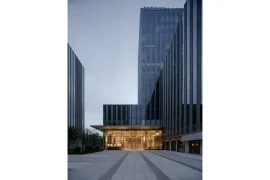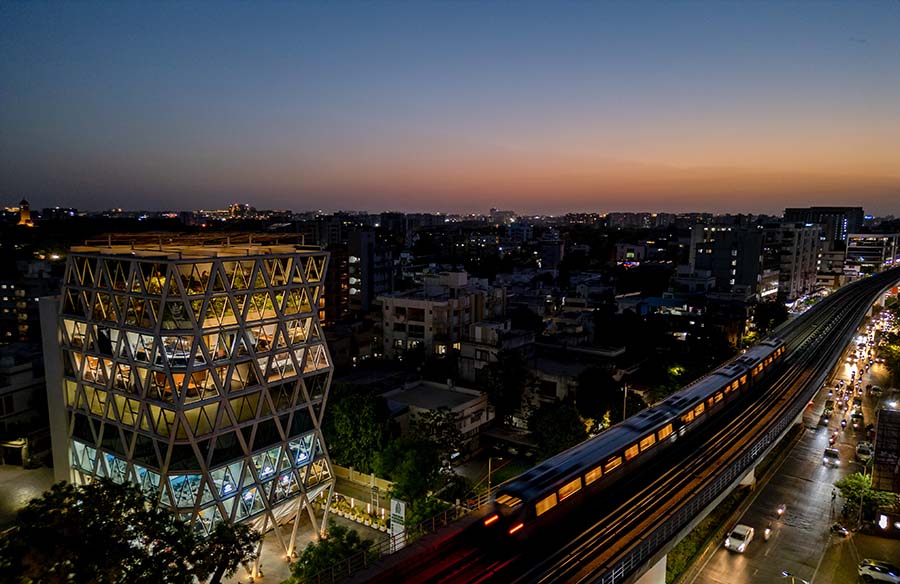
The Indian Potash Limited corporate office in Ahmedabad is conceived as a G+7 story building with a compact footprint, which not only optimizes land usage but also allows for the creation of a spacious entrance court. The challenge was to maximize space efficiency while creating a structure that not only serves as a functional office space but also a visual representation of the company’s values.
Project Name: Potash Tower
Studio Name: INI Design Studio
Project Location: Ahmedabad, Gujarat, India
Completion Year: January 2024
Project Team Credits:
Project Mentor – Jayesh Hariyani
Project Director – Bhrugu Gangadia
Project Architect – Jinkal Panchal, Mayuri Kapadia
Project coordinator – Shambhu Jadav
MEPF Director – Parth Joshi
Collaborating Companies Credits:
Architecture Firm – INI Design Studio
Interior Designer – INI Design Studio
Landscape Consultant – INI Design Studio
MEPF Engineering Consultant – INI Infrastructure & Engineering
Structural Consultant – CBM Engineers
PMC Consultants – CBRE
Civil Contractor – PSP Projects Limited
Steel Fabricator Consultants – Vedang Infra Projects LLP
Interior Contractor – Archistocc Designs Private Limited
Photo Credits: Vinay Panjwani, India

The design of the Corporate Tower is an embodiment of brand identity, a reflection of corporate ethos, and an enabler of productivity, where every facet of the design is crafted to optimize spatial utilization, champion sustainability, and resonate with the brand’s essence.
The intricate triangulated geometry of the innovative dia-grid exoskeleton enables lateral load transfer throughout the multi-storied structure, resulting in expansive column-free interior spaces. This not only enhances flexibility but also allows for adaptability according to the evolving needs of the users. The distinctive exoskeleton with intricate lattice-like framework not only provides structural support but also adds a sense of dynamism and visual interest to the building’s exterior, reinforcing its identity as a symbol of innovation and sustainability in the city’s urban landscape, effortlessly recognizable amidst the urban landscape of Ahmedabad.

Offices of various configurations offer a blend of privacy, collaboration, and functionality. The service and circulation core along the south-western façade provides a buffer against heat transfer, featuring a lavish double-height entrance lobby on the ground floor. The compact floor plate allows the entire interior space on every floor to be lit up by glare-free northern sunlight. A double skin ceramic fritter high performance glazing system within the dia-grid with an interstitial air-cavity insulates the inner spaces from radiant heat, consequently reducing the load on air-conditioning.
An aesthetically designed terrace garden serves as a sustainable oasis, mitigating heat gain, fostering social interaction among employees, and harnessing solar energy through integrated PV panels, embodying both functionality and environmental consciousness.

Sustainability has been prioritized through the use of eco-friendly materials, energy-efficient building systems, and renewable energy sources. Recycled and locally sourced materials were utilized whenever possible. Energy-efficient lighting, heating, and cooling systems were installed to reduce energy consumption and carbon emissions.
Unique features
Facade Design: Double Glazed Unit (DGU) and Curtain Wall System: The facade features a unitized curtain wall system with double-glazed units (DGU), providing excellent thermal and acoustic insulation, enhancing energy efficiency and interior comfort. The DGU system minimizes heat transfer and reduces energy consumption for heating and cooling, contributing to the building’s sustainability. The exterior glass facade covers three sides of the building, offering a sleek, contemporary appearance and allowing ample natural light to penetrate the interior spaces.

Open Floor Plan and Modular Layout: The office spaces are designed with an open floor plan and modular partitions, allowing for easy reconfiguration according to changing needs. This flexibility enables the company to adapt quickly to organizational changes, whether for expanding teams, rearranging departments, or accommodating new technologies.
Technology integration: Smart building technologies, such as automated lighting and HVAC systems, enable real-time monitoring and control of energy usage, maximizing energy efficiency and reducing operational costs. Sensors and data analytics platforms provide valuable insights into facility performance, allowing for proactive maintenance and continuous improvement.

Critical Aspects resolved prior to Construction
Critical aspects resolved to ensure smooth execution included site management and logistics, alignment and identification of steel start points, and the proper handling of junctions and alignments. Junction identification was also a key focus, alongside addressing fire safety and finish details. Additionally, steel tolerances and facade-related concerns were reviewed in detail to ensure all structural and aesthetic requirements were met.
The dia-grid steel columns are required to be cut at diverse diagonal angles along with being aligned at specific junction which required adequate hand-on skills and tools. The significant difference in tolerances of rolled steel junction and aluminium extruded framing resulted in difficulty in alignment of casement glazing system.

Despite the challenges, the design team was able to develop and integrate the structural system as a design element. The structural exoskeleton system creates an effortlessly iconic character of the building in the dense urban junction.