Intangible cultural heritage can be made accessible via storytelling, finding a form of equal interchange between the visitors and the inhabitants. Often it is overlooked due to misunderstandings on both sides, so using stories can be seen as a powerful tool that allows both parties to experience a cultural landmark differently. Nowadays, all forms of information can be accessed almost anywhere and at any given time. One might ask why the act of telling stories is still relevant today.
Storytelling Leading To Mass Tourism

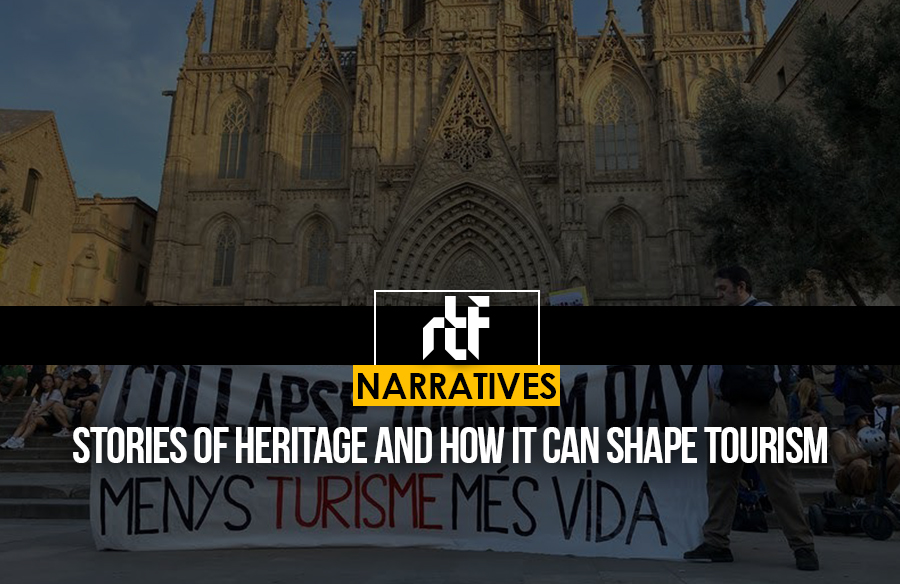
Phenomenons like that of over-tourism have become problematic. There have been no clear regulations at the beginning of masses of visitors arriving, so the city’s infrastructure has not been equipped to accommodate these large numbers of people. Notably this July, the revolt of Barcelona’s inhabitants has reached a new high as they actively ask tourists to leave or better yet – not come at all. Taking this as an example of how idealised the portrayal of the capital of Catalonia has been made out, the recent events should not be surprising at all.
In a recent report from The Economist, Barcelona only takes fourth place on the list of European cities facing the worst problems due to mass tourism. Its predecessors are Paris and Milan with Amsterdam as the front-runner. All of these cities have at least one thing in common: They all have been used in stories. Be it as shooting locations for high-grossing movies like The Fault in Our Stars in Amsterdam, or several well-known literature masterpieces set in Paris like Prevost’s Manon Lescaut, Hugo’s The Hunchback of Notre Dame, and Diderot’s Mystification. What should be noted is that each of these stories chooses to portray the city in a different light, be it in an overly simplified version of living in poor circumstances but highlighting the fact that by just being in that specific place, anything is possible. Historical events that leave remnants on the city’s surface and can be rediscovered in today’s digital age are what make these European cities still immensely attractive to tourists. However, the foundation for these stories to hold up is authenticity.
The Importance Of Authentic Stories

A sense of belonging is one of the strongest reasons why small communities in isolated and hard-to-reach places still prevail. Therefore, it is imperative to establish a given set of rules to give the narrator freedom to explore these communities’ unique customs but on the other hand not misrepresent the values of the residents. Travel blogs have become increasingly popular, telling authentic stories of the voyager’s experiences which might attract others to follow in their footsteps, expecting a certain view over for example a small fisher’s village in the Ionian island of Corfu. Can it still be seen as an authentic experience if one follows an intangible system laid out before them by the narrator’s original values?
With the example of Corfu, the narrator was the world-renowned authors Gerald and Lawrence Durrell. By focusing on the narration of the local customs, and absorbing the natural beauty of the flora and fauna in their writings, they invoke in their readership both an appreciation as well as respect towards the island. Once made evident to the villagers, they invoke a community-centred approach to presenting their cultural heritage to interested visitors. Therefore, there should be no differentiation made when it comes to tangible forms such as the built environment and their intangible counterparts – both are fundamental to maintaining its heritage’s authenticity.
Living Heritage Sites

The Nara Document of Authenticity states that even within the same culture, the view over the values and their provenance might differ. This affects how heritage is appropriated in various contexts, its representation to audiences has become connected with contemporary meanings, relying on the tourist’s perception of the heritage qualities. The UNESCO World Heritage Center sees a clear deviation between the monuments of the past and the people living in the present. This means that the concept does not embrace places where active heritage is lived out and passed on, thus not accepting the idea of living heritage sites.
The Approach of Living Heritage (Poulios, 2014) states that there could be a shift from solely preserving a monument to enhancing the process of protecting it through ongoing creation which factors into its protection, sustainability, and authenticity. This approach aligns with the idea of not differentiating between immovable parts of heritage like the cultural landscape, archeological enterprises, or artistic productions which can be relocated to the intangible parts like oral expressions, handicrafts, and social customs.
Storytelling has many forms and can be used variously, it can be made accessible to small communities, incorporated by organisations to find a dialogue between tourists and the general public, or utilised by well-informed individuals to shift the focus from highly popular sites toward unheard-of locations with a rich culture.
Reference List:
The Economist. (2024).Which Cities Have The Worst Over Tourism Problem.[online] (Last updated 01 August 2024). Available at: https://www.economist.com/finance-and-economics/2024/08/01/which-cities-have-the-worst-overtourism-problem [Accessed 18 August 2024].
Taysom, J. (2024). Amsterdam has the biggest mass tourism problem in Europe, new report discovers.[online] (Last updated 13 August 2024). Far Out Magazine. Retrieved from: https://faroutmagazine.co.uk/amsterdam-has-the-biggest-mass-tourism-problem-in-europe-new-report-discovers/ [Accessed 18 August 2024].
Leatham, T. (2024). “Tourists go home!”: What the current Barcelona protests say about modern tourism. [online] (Last updated 09 July 2024). Far Out Magazine. Retrieved from: https://faroutmagazine.co.uk/barcelona-protests-modern-tourism/ [Accessed 18 August 2024].
Al Jazeera. (2024). Why are Barcelona residents protesting against tourists? [online] (Last updated 09 July 2024). Available at: https://www.aljazeera.com/news/2024/7/9/why-are-barcelona-residents-protesting-against-tourists [Accessed 18 August 2024].
Khumaira, D. (2024). Residents vs. Tourists: Barcelona’s Struggle with Overtourism. [online] (Last updated 26 July 2024). Medium Magazine. Retrieved from: https://fpciugm.medium.com/residents-vs-tourists-barcelonas-struggle-with-overtourism-269a1b275598 [Accessed 18 August 2024].
Poulios, I. (2014). The Past in the Present: A Living Heritage Approach – Meteora, Greece. [online] Ubiquity Press. Available from: https://www.researchgate.net/publication/281775736_The_Past_in_the_Present_A_Living_Heritage_Approach_-_Meteora_Greece [Accessed 18 August 2024].