Famed philosopher Laozi wrote in his classic book the Tao Te Ching that the quality of existence of all things is determined by the relationship between yin and yang – the aspects of polar opposites – within the “Tao”. He stated that the Tao “gives birth to one, one gives birth to two, two gives birth to three, and three gives birth to all things.
Project Name: Giraffe Water Towers
Studio Name: ZOO Architects

All things carry yin and take on yang, while the addition of qi (energy) makes them balanced.” For Taoists, “human life begins with the collecting of qi, and its scattering means death”. Our design intent is to address the circulation of “qi” in Africa’s Serengeti, offering improvements in the face of human-caused crises, while preserving the organic balance that allows its animals to thrive.
We have immersed our proposal within the natural laws of the Serengeti, where the animals exist in balance with their surroundings – an enduring sustainability made up of a countless number of elaborate symbiotic relationships. We hope our participation will further the optimization of the Serengeti’s ecosystem.

Giraffes and the Environment
In Africa, giraffes live in arid, semi-desert areas with very few trees. Here, in one of the world’s last wildernesses home to numerous large carnivores and herbivores, many areas have been subject to rapid human settlement, posing a serious risk to biodiversity.
Today, the Serengeti remains the most extensive natural ecosystem on earth: massive numbers of giraffes, lions, elephants, rhinos, wildebeest, zebras, antelopes, and leopards live there. Between May and June each year, the large herbivores migrate from the Serengeti’s central plains to the west where year-round water can be found; and between July and August, some migrate further to the grasslands of Masai Mara. The vast numbers of animals moving across this epic landscape is one of the great phenomenons of nature.
Within large and complex ecosystems, connectivity is a key element indicative of the level of robustness of food webs: low connectivity typically leads to a loss of species and secondary extinction. The high connectivity of the Serengeti is reflective of the stability of its ecology. In developing this proposal, we took prompts from the natural environment and the pre-existing relationships between its plants and animals.

Clearly, poorly considered human interventions would destroy the delicate balance here. Up to now, climate change, territorial shrinkage, hunting activities, plant devastation, and other problems have led to the loss of territories suitable for animal inhabitation. Within that, a lack of nourishment during the dry season is a crucial problem for herbivores in the Serengeti.
Gentle hills and grasslands sparsely populated with acacia trees are the typical landscape one sees on the majority of the Serengeti. As a place with large numbers of indigenous species, many herbivores face fierce competition for food during the dry season, most of which by that time is already deficient in nutrients.
With this proposal, we aim to replenish soil fertility and promote plant growth through water harvesting and storage, as well as groundwater development, thereby increasing the amount of food available during the dry summer months in a sustainable manner.

Fire and Water
In Africa, the dual nature of water is accentuated. As an irreplaceable source of life, it also brings danger – during the dry season, watering holes become hunting grounds perfectly suited to carnivores. Introducing water storage structures in the savanna to provide trees with water during the dry season offers a solution – acacia trees grow in hot climates with plentiful natural light and are generally able to survive drought, but may experience extreme water shortages during the summer. Recently, the African savanna has seen a reduction in its soil’s moisture retention and an increase in runoff, leading to significant ground erosion. The proposed water structures are meant to provide hydration to both plants and animals during the dry season, while also indirectly providing them with a source of food.
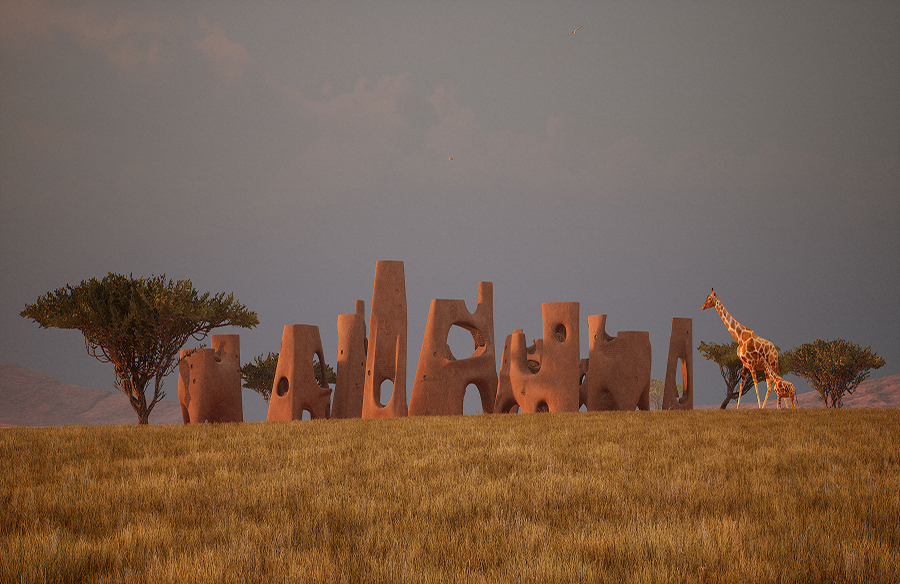
Fire plays an important role in the African savanna: it promotes the growth of particular plants which have adapted to quickly grow and thrive after a fire has taken place. When a fire’s heat acts on the organic matter within the ground, it positively affects the fertility of the soil and its capacity to hold water. Our design proposes structures which can withstand seasonal fires, thus providing improved soil quality in the aftermath. Through the combining of fire and the project’s forms, which recall the shapes of large termite nests, the project will positively affect the region’s vegetation, improve its soil structure, and allow for increased plant growth and retention of moisture. By contributing in this way to the health and viability of the Serengeti ecosystem, fire also brings renewal.
A New Structure in the Landscape
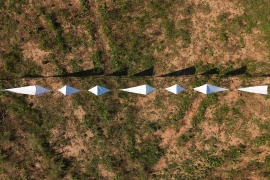
In developing the design, we carefully analyzed the spotted patterns of giraffes, a source of camouflage which gives them a striking visual charm. When looking at the proposed structures from a bird’s eye view, it becomes apparent that the markings pattern of a giraffe has been taken as a model for distribution of the overall layout plan, forming a distinctive landscape in the Serengeti.

This proposal extends into and becomes an integral part of a complex ecosystem, joining ecological microhabitats within the larger encompassing environment. The multifunctional design provides an assortment of habitats for diverse plants and animals: water and vegetation offer attractive places to feed and rest. Nests, dens, and other small shelters can be configured to provide accommodation, while improved soil conditions and vegetation will serve to attract small mammals, insects, and birds. By furnishing a means of collecting and recycling water here, these structures will provide a sustainable reservoir of this most valuable of resources.