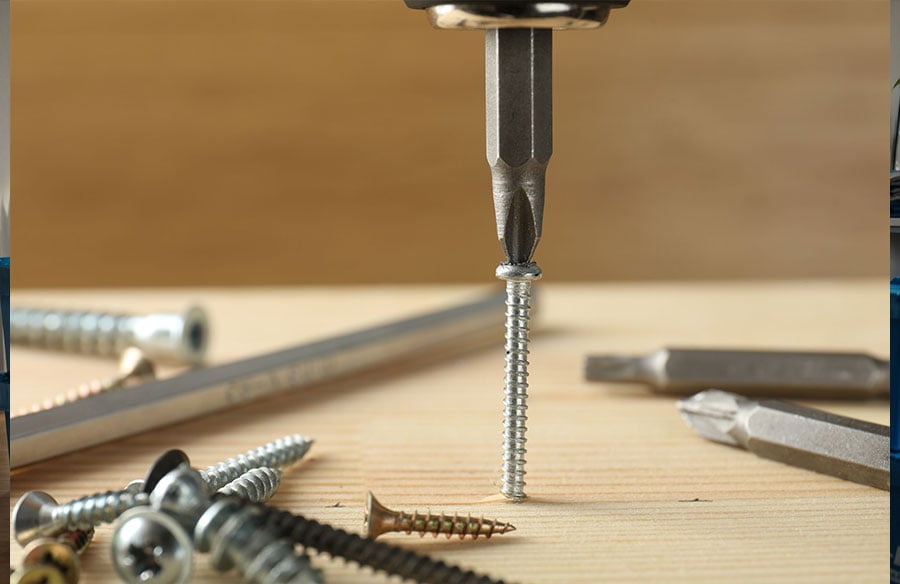
Almost everyone who has driven more than a handful of screws has stripped one: the bit spins in place, the screw head chews up, and what should’ve been a five-second task turns into digging out a ruined fastener with pliers. The instinct is usually to blame the screw or the drill. Most of the time, though, the real cause is a mismatch between the bit and the screw head, or a driving technique that was never going to hold under load in the first place. Understanding what’s actually happening in that split second the bit slips explains a lot about which fasteners and bits are worth reaching for.
What Cam-Out Actually Is
Cam-out is the technical term for a driver bit popping out of the screw head’s recess before the screw is fully seated. It’s often talked about like a flaw, but for the Phillips head specifically, it was originally engineered behavior. The Phillips drive was designed in the 1930s with a deliberate taper so the bit would cam out once torque reached a certain threshold, which was meant to prevent overdriving on early powered assembly lines and protect both the screw and the tool from damage. That built-in slip is exactly why Phillips is a poor choice for high-torque fastening today: the same feature that protected 1930s assembly equipment becomes a liability the moment you’re driving deck screws or structural fasteners with a modern impact driver that can generate far more torque than a Phillips head was ever meant to handle.
Drive Types and Where They Actually Belong
Slotted (flathead) drives are the oldest and least torque-tolerant option, prone to cam-out with even moderate force, and mostly relevant now for cosmetic hardware or older equipment rather than structural work.
Phillips remains extremely common for general household use but shares that same cam-out tendency by design, which is fine for light-duty work and a real problem for anything driven at length or under load. Pozidriv looks similar to Phillips but has a straighter-sided, cross-shaped recess that grips more securely and resists cam-out noticeably better, making it a common upgrade on European hardware and better-quality wood screws.
Torx (star drive) and square (Robertson) drives are built specifically for high-torque applications: the recess geometry locks the bit in place and transfers force efficiently instead of pushing the bit outward under load, which is why nearly all serious structural and deck screws today ship in Torx or square drive rather than Phillips.
Bit Fit Matters as Much as Bit Type
Even the correct drive type will strip if the bit size doesn’t match the screw. A bit that’s undersized rattles inside the recess and transfers force unevenly, chewing up the edges of the recess almost immediately. A bit that’s oversized won’t seat fully and rides on the edges of the recess rather than the flat drive surfaces, which strips just as fast, only with more resistance before it happens. The fix is unglamorous but effective: match the bit number to the manufacturer screw size , and replace bits once the tips visibly round over, since a worn bit will strip your screw even if it’s the correct size.
Angle Is the Other Half of the Problem
Bit fit gets most of the attention, but incorrect driving angle causes just as many stripped screws in practice. Holding the driver even slightly off angle introduces lateral force that pushes the bit sideways out of the recess exactly when it needs the most downward pressure to stay seated. This shows up when working with awkward angles, near edges, or when reaching to finish a run of deck boards without repositioning. Keeping the driver perpendicular to the screw head, and easing off if the angle isn’t clean rather than forcing it, prevents a category of stripped screws that has nothing to do with bit quality at all.
Match Bits to the Job, Not Just the Screw Box
Fastener manufacturers generally specify the recommended drive type and bit size on the packaging, and it’s worth actually checking rather than assuming. A box of structural or deck screws in Torx drive is specifying that for a reason: it’s engineered for the torque an impact driver applies during a long fastening run. Substituting a general Phillips bit undermines that engineering choice and often produces stripped-screws that the drive type was chosen to avoid.
What Actually Prevents Stripped Screws
In practice, avoiding stripped fasteners comes down to a short list:
- choose structural and deck screws in Torx or square drive rather than Phillips when the option exists,
- match bit size precisely to the screw rather than approximating,
- replace bits once the tips round over instead of pushing a worn bit further,
- and keep the driver perpendicular to the fastener even when the angle is inconvenient.
None of this requires premium tools, just attention to a detail that’s easy to skip when a project has a hundred more screws left to drive. Fasteners sold with a matched drive system, which is how Jake Sales lists most of its structural and construction screw lines, make it a little easier to keep the bit and the screw paired correctly instead of guessing mid-project.