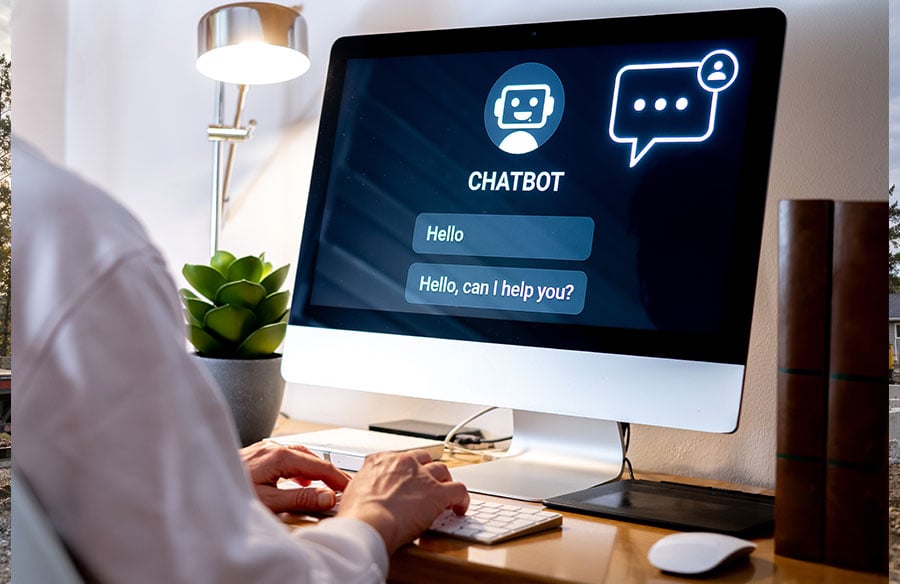
Technical support has a particular problem that other support functions don’t face quite as acutely: the same handful of questions come in over and over, while a small percentage of tickets require genuine troubleshooting depth. An AI chatbot for technical support exists precisely to separate these two categories – resolving the repetitive ones instantly and routing the harder ones to someone who can actually fix them.
The Volume Problem Technical Support Teams Actually Face
Anyone who has worked a support queue knows the pattern well. A large share of incoming tickets are variations on the same handful of issues – password resets, connectivity troubleshooting, basic configuration errors, “how do I” questions that have a documented answer sitting in a knowledge base somewhere. Handling these manually, one conversation at a time, ties up agents who could otherwise be solving the genuinely complex problems that actually require their expertise.
This is the exact gap conversational AI is built to close. Rather than treating every ticket as equally deserving of a human agent’s full attention, a well-built AI support bot filters incoming queries, resolves what it can instantly, and hands off what it can’t – ideally without the customer noticing much friction in that transition.
What a Capable Support Bot Actually Needs to Do
Not every chatbot deployment delivers this well, and the difference tends to come down to a few specific capabilities:
Understanding intent, not just keywords. Older-generation chatbots matched rigid phrases to scripted responses, which fell apart the moment a customer phrased something slightly differently. Modern AI agents are built to interpret what a customer actually means, even when the phrasing is imprecise or the request is ambiguous.
Pulling real data from connected systems. A bot that can only recite static FAQ answers is of limited use for this function. Real value comes from an AI agent that can query account status, order history, or system diagnostics directly, returning specific, accurate answers rather than generic troubleshooting steps.
This ability to query and integrate data from various systems resonates deeply within architecture and design. Imagine AI agents assisting with complex Building Information Modeling (BIM) data, querying material specifications, energy performance metrics, or even historical project data to inform new designs or troubleshoot existing building systems. Such integration transforms raw data into actionable insights, much like a well-designed space transforms functional needs into aesthetic and practical solutions.
Seamless handoff to human agents. The moment a query exceeds the bot’s competence – a nuanced billing dispute, an unusual technical failure, a frustrated customer who needs empathy more than information – the handoff to a live agent needs to happen smoothly, without forcing the customer to repeat their entire problem from scratch.
Multilingual, culturally aware responses. A bot answering technical questions in dozens of languages needs to do more than translate correctly. It needs to understand regional slang, idioms, and cultural context well enough that responses feel natural rather than mechanically generated.
Why This Matters More for Technical Support Than General Inquiries
General customer service chatbots can often get away with simpler logic – checking an order status or answering a shipping question doesn’t require much nuance. This function is different. A user describing a connectivity issue might be dealing with any number of underlying causes, and an AI agent needs enough contextual understanding to ask the right follow-up questions rather than offering a generic script that doesn’t address the actual problem.
This is also where the risk of getting it wrong is higher. A chatbot that confidently gives incorrect troubleshooting advice doesn’t just fail to help – it can actively make the problem worse or erode the customer’s trust in the support channel altogether. That’s part of why credible AI support solutions build in continuous human oversight, monitoring conversations in real time and retraining the system based on where it consistently struggles.
Industries With Distinct Technical Support Demands
AI-driven support shows up differently depending on the sector:
- Telecommunications – troubleshooting service issues, connectivity problems, and account configuration at high volume.
- E-commerce – handling order tracking, returns, and product-specific technical questions around app or platform functionality.
- Financial services – supporting transaction issues and account-related technical queries, often under strict compliance and security requirements.
- Healthcare – assisting with scheduling and platform navigation, while carefully avoiding anything resembling clinical advice.
- SaaS and software – arguably the heaviest use case, where technical troubleshooting is the majority of what support handles day to day.
For architects and designers, the reliance on specialized SaaS and software tools—from CAD and rendering programs to project management platforms—is absolute. AI-powered support for these complex applications could dramatically streamline workflows, helping users quickly resolve software glitches, optimize settings for specific design tasks, or even guide them through advanced features, ensuring creative vision isn’t hampered by technical hurdles.
Each of these contexts requires the underlying AI to be trained on domain-specific data, not a generic support script repurposed across every industry.
The Human Oversight Layer That Makes This Work
The strongest argument against fully automated support isn’t philosophical – it’s practical. AI models drift, edge cases emerge that weren’t in the training data, and customer expectations shift over time. Without a structured process for monitoring performance and retraining the system, even a well-built chatbot degrades in quality.
This is why serious implementations pair AI agents with ongoing human supervision: trained staff reviewing conversation quality, handling the escalations the bot correctly identifies as beyond its scope, and feeding performance data back into regular retraining cycles. The AI doesn’t operate independently so much as it operates under continuous quality control, with humans setting the boundaries of what the bot handles alone.
Data Security in an Automated Support Context
Support conversations often touch account details, system access information, and sometimes personal data – meaning an AI chatbot handling these interactions needs the same security rigor as a human support channel. Encrypted interactions, defined data handling protocols, and compliance with relevant regulations like GDPR aren’t optional extras; they’re baseline requirements for any AI support deployment that touches real customer information.
What Success Actually Looks Like
The measurable case for AI-driven support tends to show up in a few concrete metrics: dramatically reduced wait times since there’s no queue for routine questions, a meaningful share of tickets resolved without ever reaching a human agent, and freed-up capacity for the agents who remain, since they’re only handling issues that genuinely need their expertise. None of this replaces the value of skilled human support – it reallocates it toward the problems that actually benefit from a person’s judgment.
Final Thoughts
The companies getting real value from AI chatbots in this function aren’t the ones chasing full automation for its own sake. They’re the ones who’ve figured out where the line sits – deploying AI for the repetitive, high-volume queries where speed matters most, while keeping trained human agents firmly in place for the complex, sensitive, or emotionally charged cases that still need a person on the other end. Getting that balance right is less about the sophistication of the AI itself and more about the discipline to build proper oversight, retraining, and escalation processes around it from day one.