Electric vehicles have moved from novelty to normal across central Oklahoma, and every one of them arrives home needing a place to charge. The transition catches many households off guard, because refueling has always been something that happened somewhere else; with an EV, the fueling station is the garage, and the garage’s electrical capacity suddenly matters in a way it never did before. Home charging is genuinely the best part of EV ownership when it is set up correctly. The vehicle starts every morning with a full battery, charging happens during cheap overnight hours, and gas station stops disappear from the routine entirely. Getting to that point, however, involves decisions most new owners have never had to think about: what level of charging the household actually needs, whether the existing electrical panel can support it, what the installation involves, and who is qualified to do the work. A Level 2 charger is one of the largest continuous electrical loads a home can carry, drawing as much power as a central air conditioner or an electric range for hours at a stretch. Adding that load to a house is not a plug and play accessory purchase; it is an electrical project with code requirements, permit obligations, and real safety stakes. Homeowners who understand the landscape before buying equipment make better decisions, avoid expensive surprises, and end up with installations that serve them for the life of the vehicle and beyond.
The McLoud area adds its own considerations to the standard checklist. Housing stock around McLoud, Shawnee, Harrah, and the surrounding countryside spans a century of construction eras, which means electrical services range from modern 200 amp panels with room to spare down to aging 100 amp and even 60 amp services already working at their limits. Rural properties commonly carry loads that urban homes do not, including well pumps, shop buildings, and outbuilding circuits, all competing for the same service capacity a charger would need. Detached garages and long driveway runs change the wiring math. Oklahoma’s storm environment raises questions about surge protection for a device that is, at its core, a power electronics package connected to the most expensive battery most households will ever own. And the local permitting and utility landscape shapes both the process and the timeline. None of these factors is an obstacle; every one of them is manageable when it is identified before the project starts rather than discovered in the middle of it. What follows is a practical walkthrough of the three big subject areas every prospective EV owner in the area should understand: charging levels and equipment choices, the electrical capacity question, and the installation process itself from assessment through final inspection.
Understanding EV Charging Levels and Home Charger Options
The equipment side of home charging is simpler than the marketing around it suggests, because the real choices reduce to a small set of practical questions. How fast does the vehicle actually need to charge given the household’s driving? Does the home run better with a plug in unit or a hardwired one? Which features matter and which are decoration? An experienced electrician McLoud homeowners consult before purchasing can prevent the most common mistake in this entire category, which is buying a charger first and discovering afterward that the home’s electrical system, the vehicle’s onboard limits, or the installation location make it the wrong choice. Equipment should be specified to fit the house and the driving pattern, not the other way around. The three sections below cover the charging level decision, the plug in versus hardwired question, and the feature set worth paying for.
Level 1 vs Level 2 EV Charging: Which Is Right for Your Daily Driving
Level 1 charging is the baseline every EV ships with: a portable cord that plugs into an ordinary 120 volt household outlet and delivers roughly 1.2 to 1.4 kilowatts to the vehicle. That translates to about 3 to 5 miles of range added per hour of charging, or roughly 40 to 50 miles overnight. For a genuinely short commute, a plug in hybrid with a small battery, or a retired household that drives modest distances, Level 1 can be entirely sufficient, and it requires no installation at all beyond confirming the outlet and its circuit are in good condition. The caveats matter, though. A Level 1 cord draws near the full capacity of a 15 amp circuit continuously for many hours, which is a duty cycle ordinary bedroom and garage circuits were never designed around; a worn receptacle, a shared circuit with a freezer on it, or an extension cord in the path turns a marginal situation into a heat problem. Level 1 also leaves no margin: a day of unusually heavy driving cannot be recovered overnight, and a second EV in the household breaks the math completely. Most owners who start with Level 1 describe it as workable and slightly stressful, with the battery percentage becoming a daily calculation. It is a legitimate starting point and a poor long term plan for anyone driving typical Oklahoma distances.
Level 2 charging runs on 240 volts, the same supply an electric dryer or range uses, and delivers anywhere from about 3.8 to 19.2 kilowatts depending on the circuit size and the vehicle’s onboard charger. In practical terms, a common 40 to 48 amp Level 2 installation adds 25 to 45 miles of range per hour, which means essentially any daily driving pattern recovers fully overnight with hours to spare. This is the setup that makes an EV feel effortless: plug in at dinner, wake up to a full battery, never think about it again. Level 2 is also what unlocks the economic advantages of home charging, since scheduled overnight charging can be timed against lower utility rates, and the vehicle can reliably depart each morning at whatever charge target the owner sets. The costs of Level 2 are the equipment, typically a few hundred to under a thousand dollars for quality residential units, and the installation, which involves a dedicated 240 volt circuit from the panel and is the subject of the rest of this article. For households in the McLoud area, where daily mileage tends to run higher than urban averages and where a trip to Oklahoma City and back consumes real range, Level 2 is the correct default assumption, with Level 1 as the exception for genuinely light drivers.
Sizing the Level 2 installation correctly is where a little planning pays off for years. Charger circuits commonly range from 30 amps up to 60 amps, and code requires the circuit to be sized at 125 percent of the charger’s continuous draw, so a 48 amp charger needs a 60 amp circuit. Bigger is not automatically better; the vehicle’s onboard charger caps the rate it can accept, and many EVs max out at 32 or 48 amps regardless of what the wall unit can supply, so paying for capacity the car cannot use buys nothing today. The forward looking view cuts the other way, though. Vehicles turn over every several years, second EVs arrive, and the cost difference between wiring a 40 amp circuit and a 60 amp circuit is mostly in the conductor size, which is cheap compared to opening walls twice. A sensible middle path many electricians recommend is installing conduit and conductor sized for the larger future circuit even if the charger installed today runs at a lower setting, or choosing an adjustable charger that can be dialed to match the available capacity now and turned up after a future panel upgrade. The right answer depends on the vehicle, the driving, the panel, and the household’s plans, which is exactly why the sizing conversation belongs at the start of the project rather than the end.
Hardwired vs Plug In EV Chargers and NEMA 14-50 Outlet Considerations
The plug in route uses a heavy 240 volt receptacle, most commonly the NEMA 14-50 style familiar from RV parks and electric ranges, with the charger plugging in like an appliance. Its appeal is real: the charger can be unplugged and taken along when moving, swapped easily if it fails or gets upgraded, and in some cases the same receptacle can serve other 240 volt equipment. The limitations are just as real and less advertised. A receptacle serving an EV charger is carrying a near maximum continuous load for hours every night, cycle after cycle, which is a far harsher duty than the occasional range or dryer use these devices were designed around. Bargain receptacles have a documented pattern of overheating and melting under exactly this duty, which is why any plug in EV installation should use a heavy duty, industrial grade receptacle rather than the cheapest unit on the shelf, and why current code requires GFCI protection for these receptacles in dwelling locations. That GFCI requirement brings its own wrinkle, since some charger and breaker combinations produce nuisance tripping that hardwired installations avoid. Plug in units are also generally capped at 40 amps of charging on a 50 amp circuit, which is below what many vehicles and chargers can otherwise support. The plug in path is legitimate and code compliant when done with quality components; it is simply not the casual, cheaper shortcut it appears to be at first glance.
Hardwiring connects the charger permanently to the circuit with no receptacle in the path, and it is the configuration most manufacturers and most electricians prefer for a permanent home installation. The advantages compound: no receptacle to overheat, no plug connection to loosen over thousands of thermal cycles, support for the full 48 amp and higher charging rates that plug in configurations cannot reach, cleaner weather sealing for outdoor locations, and in most cases no separate GFCI breaker requirement because the charger’s internal protection satisfies the code role. Hardwired installations also tend to look better and mount more securely, with the conductor entering the unit directly through conduit or cable rather than draping a heavy cord to an outlet. The tradeoff is permanence; removing or replacing the unit is an electrician visit rather than an unplugging. For most households, that tradeoff is theoretical, because chargers are not devices people move around, and a hardwired unit at a properly chosen location simply becomes part of the house. The economics are close to a wash, since the cost of a quality 14-50 receptacle plus its required GFCI breaker roughly offsets the modest additional labor of hardwiring. Where the vehicle supports 48 amp charging, hardwiring is effectively the only path to using it.
The decision between the two configurations should be made with the installation location and the household’s plans on the table. Renters and owners expecting to move soon lean plug in, accepting the amperage cap in exchange for portability. Owners planning to stay, wanting maximum charging speed, or mounting the unit outdoors lean hardwired. Outdoor installations deserve specific attention in Oklahoma: the unit needs an appropriate weather rating, the mounting needs to consider sun exposure since charger electronics dislike baking on a west facing wall through a July afternoon, and the circuit needs proper outdoor rated components throughout. Cord length and parking geometry matter more than people expect, since the charge port location varies by vehicle and a cord that comfortably reaches one car’s front fender may strain to reach another’s rear quarter; measuring the actual parking position before choosing the mounting point avoids a permanent daily annoyance. Households anticipating a second EV can plan the location and circuit with a future second unit or a dual port charger in mind. None of these details is difficult, and all of them are cheap to get right on paper and expensive to correct in copper. A short conversation with the installing electrician about vehicles, parking, and plans is the highest value fifteen minutes in the entire project.
Smart EV Chargers, Load Management, and Utility Off Peak Charging Rates
The feature gap between basic and smart chargers is wide, and some of it genuinely matters. A basic charger delivers power when plugged in and stops when the vehicle is full, which is the entire job. A smart charger adds connectivity and control: scheduling to confine charging to specific hours, energy monitoring that reports exactly how many kilowatt hours went into the vehicle, remote start and stop from a phone, and in many units adjustable amperage settings that let the same hardware run at different rates. Scheduling is the feature with real money attached. Utilities across Oklahoma offer time of use rate plans under which overnight electricity costs substantially less than daytime power, and an EV is the single best appliance in existence for exploiting those plans, since it consumes large amounts of energy and is completely indifferent to when it receives them. A household that shifts its charging into off peak windows can cut the per mile energy cost of driving well below the already low EV baseline. Many vehicles can schedule charging from their own software, which overlaps with charger side scheduling; either works, and the charger side version keeps working across vehicle changes. Energy monitoring earns its keep for anyone tracking costs, splitting expenses for a work vehicle, or simply wanting to know what the car actually costs to run.
Adjustable amperage and load management features deserve a closer look because they intersect directly with the panel capacity questions covered later. An adjustable charger can be commissioned at a lower setting to fit within a constrained electrical service today and turned up after a service upgrade, which converts a hard capacity wall into a soft one. More sophisticated load management systems go further, monitoring the home’s total electrical demand in real time and throttling the charger automatically whenever the house approaches its service limit, then restoring full charging rate when the air conditioner cycles off or the oven finishes. For homes with marginal capacity, these systems can make a Level 2 installation feasible without a full service upgrade, and code recognizes them through energy management provisions that allow load calculations to credit the automatic limiting. Dual EV households use the same concept between two chargers, sharing one circuit’s capacity intelligently rather than wiring two full circuits. These are real engineering solutions with real code standing, and they are also configuration sensitive, which is another reason the equipment selection should happen alongside the electrical assessment rather than before it. A charger chosen for its load management capability only helps if the installation actually implements it.
Connectivity brings a few practical considerations worth settling before purchase. Smart chargers need a network connection, usually WiFi, and detached garages at the edge of a rural WiFi footprint can leave an expensive smart unit functionally dumb; checking signal at the mounting location takes one minute and prevents the problem. App ecosystems vary in quality and longevity, and a charger whose core functions, including charging itself and any locally set schedule, survive an internet outage or a manufacturer’s server shutdown is worth preferring over one that depends on the cloud for basics. Certification matters here as elsewhere: units listed by a recognized testing laboratory belong on the shortlist, and unlisted imports do not, regardless of feature lists and prices. Utility program participation is a growing consideration as well, since some utilities offer rebates or bill credits for enrolled chargers that permit modest demand management during grid stress events, programs that pair naturally with the storm strained summer grid in this region. Finally, surge protection is not a charger feature to rely on internally; a charger is sensitive electronics living on a high current circuit in one of the most lightning active areas in the country, and it belongs behind whole house surge protection at the panel like every other major board bearing investment in the home. The feature that matters most, in the end, is a charger correctly matched to its circuit, its vehicle, and its house.
Does Your Electrical Panel Have Capacity for an EV Charger
The single most important question in any EV charger project is asked at the panel, not at the charger display. A Level 2 charger adds one of the largest continuous loads a residence can carry, and code treats it accordingly, requiring the load to be counted at 125 percent in service calculations. Whether the existing service can absorb that addition depends on the panel’s rating, its physical space, and everything else the home already runs. A licensed electrician McLoud residents bring in for a pre purchase assessment can answer the question definitively in a single visit with a load calculation, and that answer shapes the entire project: a straightforward circuit addition, a load managed installation, or a service upgrade first. The sections below explain how the capacity math works, what the panel level obstacles look like, and how the upgrade path proceeds when it is needed.
How a Load Calculation Determines If Your Panel Can Support Level 2 Charging
A load calculation is the formal method the National Electrical Code prescribes for determining whether a service can carry its connected loads, and it is arithmetic rather than mystery. The calculation inventories the home’s demands: general lighting and receptacle load based on square footage, the fixed appliances including water heater, range, dryer, dishwasher, and disposal, the HVAC equipment at its nameplate values, and any special loads such as a well pump, a hot tub, or a shop subpanel. Demand factors then adjust the raw total, recognizing that not everything runs simultaneously, and the result is compared against the service rating. An EV charger enters this calculation as a continuous load at 125 percent of its rating, so a 48 amp charger counts as 60 amps of demand, which is a substantial fraction of any residential service. On a modern 200 amp service in a home with gas appliances, that addition usually fits with comfortable margin. On a 100 amp service already carrying central air, an electric water heater, an electric range, and a well pump, the same addition frequently exceeds the calculated capacity, and no amount of optimism changes the arithmetic. The calculation is also what the permitting authority expects to see justifying the new circuit, which makes it a required step rather than an optional one.
The physical panel matters alongside the arithmetic. A Level 2 circuit needs a two pole breaker, which occupies two adjacent spaces in the panel, and many older panels are already full, their spaces consumed over decades of additions and their capacity stretched with tandem breakers. A full panel does not necessarily mean an inadequate service, but it does mean the project needs a solution for breaker space, whether that is consolidating circuits, adding a subpanel, or replacing the panel outright. Panel condition enters the evaluation at the same moment: an electrician opening the panel for an EV assessment will note corrosion, heat discoloration, undersized or double lugged conductors, and the brand and era of the equipment. Certain findings redirect the project immediately. Federal Pacific and Zinsco panels, with their documented failure histories, are not appropriate hosts for a large new continuous load, and most electricians will decline to add a charger circuit to one; a fuse box ends the conversation the same way. These discoveries feel like scope creep to a homeowner who called about a charger, but the sequence is protective: the charger is the occasion, and the panel evaluation is the substance. A 60 amp continuous circuit is exactly the kind of load that finds the weak point in aging equipment.
Homeowners can do useful preliminary scouting before the professional assessment, within safe limits. The main breaker’s rating, printed on its handle, identifies the service size: 100, 125, 150, or 200 amps in most homes. The panel directory, however unreliable, sketches what the home already runs, and the presence of large two pole breakers for a range, dryer, water heater, air conditioner, or well pump indicates the major loads competing for capacity. A count of open spaces answers the breaker room question at a glance. What homeowners should not do is attempt their own capacity verdict from this scouting, because the load calculation’s demand factors, the continuous load rules, and the condition assessment all require professional judgment, and because the difference between a marginal fit and a comfortable one is exactly where mistakes get expensive. The productive use of the scouting is conversation: a homeowner who can tell an estimator that the home has a 100 amp service, an electric water heater, a full panel, and a 45 mile daily commute has framed the entire project in one sentence. Free estimate visits, where available, then convert that framing into a specific answer, and homeowners within roughly 20 miles of McLoud can obtain exactly that kind of no cost assessment from 24/7 Electrical Services and Repairs before committing to any equipment.
EV Charger Installation With an Older 100 Amp Electrical Service
The 100 amp service deserves its own discussion because it describes so much of the housing stock around McLoud, Tecumseh, Meeker, and the surrounding communities. For decades, 100 amps was the standard residential service, and it served those decades well in homes heated by gas, cooking with gas, and running a modest appliance load. The modern reality of many of those same homes is different: central air conditioning was added in the 1990s, the water heater went electric at some point, a shop went up out back, and the well pump has been there all along. A 100 amp service carrying that collection is already working near its calculated capacity on a summer afternoon, and the arithmetic of adding a 40 to 60 amp continuous EV load simply does not close. The symptoms of the underlying strain are often already present before any charger enters the picture, including a main breaker that has tripped on hot days, informal household rules about which appliances run together, and a panel with no open spaces. For these homes, the EV question is really a service question, and pretending otherwise by wedging a charger circuit into the margins produces an installation that trips, overheats, or fails inspection.
The options for a constrained service are real, and they range from modest to comprehensive. The most modest is right sizing the charger downward: a 16 or 24 amp Level 2 circuit delivers 12 to 20 miles of range per hour, which fully recovers a typical commute overnight and fits within capacity margins that a 48 amp circuit would demolish. Many households discover that this slower Level 2 is entirely sufficient, since the vehicle sits for ten hours regardless. The intermediate option is load management, described earlier: an energy management system or a load sharing charger that monitors total demand and throttles charging automatically when the house needs its capacity, allowing a larger charger to coexist with a smaller service under the code provisions written for exactly this arrangement. These systems add equipment cost but avoid the larger cost of a service upgrade, and they suit homes where the service is adequate for everything except the rare coincidence of every load at once. The comprehensive option is the service upgrade itself, covered in the next section, which resolves the constraint permanently. The correct choice among the three is situational, driven by the load calculation results, the household’s driving, the panel’s condition, and the home’s future plans, and an honest assessment will present the tradeoffs rather than defaulting to the biggest project.
There are also paths that look like options and are not. Piggybacking the charger onto an existing 240 volt circuit, most commonly the dryer circuit via a splitter device, occupies a gray zone that ranges from marginally workable to plainly unsafe depending on the device and the circuit, and it never substitutes for a proper dedicated circuit under current code for a permanent installation. Oversizing a breaker to stop nuisance trips is the same dangerous non solution it always is, defeating the protection that keeps conductors from overheating. Running the charger from a garage receptacle circuit shared with freezers and openers invites both tripping and heat problems. And ignoring the panel’s condition because the arithmetic technically fits places a demanding new load on equipment that may be the weakest link in the house. The consistent theme is that a constrained service narrows the road but does not close it; every 100 amp home in the area has at least one legitimate path to home charging, and most have several. What separates the good outcomes from the bad ones is whether the path was chosen with a load calculation and a panel inspection in hand, or improvised around them.
When a 200 Amp Service Upgrade Makes Sense Before Adding an EV Charger
A service upgrade replaces the home’s electrical entry point: a new 200 amp panel, new main breaker, new service entrance conductors, updated grounding and bonding brought to current code, and coordination with the utility to disconnect and reconnect the service. It is the definitive answer to the capacity question, and for many homes contemplating an EV it is the right project even though it is the largest one. The decision usually tips on accumulation rather than the charger alone. A home whose load calculation fails for the EV circuit typically has other pressures pointing the same direction: a full panel blocking any new circuit, aging equipment due for replacement on its own merits, a hazard brand panel that needs to go regardless, or a household roadmap that includes a shop subpanel, a hot tub, a standby generator, or a second EV within a few years. Each of those items alone might justify workarounds; together they describe a house that has outgrown its service, and upgrading once resolves all of them simultaneously. The alternative pattern, solving each addition with its own workaround, tends to cost more across five years and leaves the home with the same old bottleneck at the end.
The upgrade process is well established and less disruptive than its scope suggests. It begins with the load calculation and a fixed scope of work, proceeds through permitting with the local jurisdiction, and involves scheduling with the utility for the disconnection and reconnection that bracket the working day. On installation day, the old equipment comes out, the new panel goes in, every existing circuit lands on a new breaker, grounding electrodes and bonding are brought to standard, and under current code editions the new service includes whole house surge protection and updated breaker technologies where required. Inspection follows, and power is typically restored the same day, with the home out of service only during working hours. The EV charger circuit then lands in the new panel as a routine addition, often during the same project, sharing the permit and the mobilization. Pairing the projects this way is meaningfully cheaper than sequencing them separately, and the same logic extends to anything else on the household’s electrical wish list; the marginal cost of adding circuits during a panel replacement is a fraction of their standalone cost. For homes in the McLoud area, this bundled approach is a routine project profile for 24/7 Electrical Services and Repairs, which lists electrical service upgrades, panel installation, and EV charger installation among its core services and identifies panel upgrades as a specialty.
The value case for the upgrade extends beyond the charger that prompted it. A modern 200 amp service adds resale value and removes a common inspection objection at sale time, since buyers and their inspectors increasingly flag undersized and obsolete services. It resolves insurance friction where carriers surcharge or decline older equipment. It provides the physical and electrical headroom that makes every future project, from a mini split in the shop to a standby generator, a simple circuit addition rather than a capacity negotiation. It replaces the aging bus, breakers, and connections that are statistically the most failure prone equipment in an older home’s electrical system, and it resets the warranty clock, with quality installations backed by both manufacturer coverage and installer warranties, including the 1 year labor and 3 year panel warranty terms offered on such work locally. None of this means every EV home needs the upgrade; homes with healthy 200 amp services and gas appliances routinely add chargers with nothing but a new circuit. It means the upgrade, when the assessment calls for it, should be understood as infrastructure investment rather than an EV surcharge. The vehicle triggered the evaluation; the house is what benefits.
The EV Charger Installation Process, Permits, and Costs in Oklahoma
With the equipment chosen and the capacity question answered, the remaining subject is the installation itself: what a professional job actually involves, what the paperwork and inspection layer looks like, and what the money picture typically resembles. This is the stage where corner cutting concentrates its damage, because a Level 2 circuit built with undersized wire, loose terminations, or skipped permits carries its defects silently under the heaviest continuous load in the house. It is also the stage that is genuinely routine for qualified installers, a well worn project profile measured in hours rather than days for the standard case. The sections below walk through the physical installation, the permit and inspection process in Oklahoma jurisdictions, and the cost ranges with the factors that move them.
What Professional EV Charger Installation Involves From Assessment to Final Test
The professional process starts before any tools come out, with the site assessment that ties together everything discussed above: the load calculation, the panel inspection, the mounting location, the routing path from panel to charger, and the equipment specification. Routing is where homes differ most. An attached garage with the panel on a shared wall might need ten feet of conductor; a panel at one end of the house feeding a charger at the other might require a long run through attic or crawl space; a detached garage or a parking pad needs an underground run in conduit, with trenching, burial depth requirements, and appropriate conductor types. Distance matters electrically as well as financially, since long runs at high amperage require larger conductors to control voltage drop, and the assessment sizes them accordingly. The assessment also settles the configuration details covered earlier, including hardwired versus plug in, indoor versus outdoor mounting with the appropriate weather rated components, and cord reach for the actual vehicles at their actual parking positions. A written scope and price come out of this visit, and on a project with this many variables, the written version is the one that counts.
Installation day for the standard case follows a consistent sequence. Power is secured at the panel, and the new two pole breaker is installed, sized to the circuit called for in the plan. Conductors run from the panel to the charger location through the chosen path, in conduit where exposed or underground, stapled and protected cable where concealed in framing, with every material choice matching the code requirements for its location. At the charger end, the unit mounts to structure at the appropriate height, connections are made and torqued to specification, and for plug in configurations the heavy duty receptacle and its required GFCI protection go in instead. Grounding and bonding are verified through the new circuit. The charger is then commissioned: powered, configured, set to the amperage the circuit supports, connected to WiFi if it is a smart unit, and tested with an actual charging session where the vehicle is available. A quality installer finishes with a walkthrough covering the breaker location, the charger’s indicators and controls, the schedule setup if the household is using time of use rates, and the paperwork trail. Elapsed time for a straightforward attached garage installation commonly lands in the two to four hour range; long runs, trenching, and panel work extend it accordingly.
The difference between this process and the shortcut version is invisible on day one and decisive over years. The shortcut version, whether DIY or performed by an unlicensed handyman, characteristically skips the load calculation, reuses whatever breaker and wire are handy, terminates connections without torque specification, omits the permit, and leaves no inspection record. Under a continuous 40 amp load, every one of those omissions has a failure mode: undersized conductors run hot inside walls, loose terminations heat and carbonize, a wrong breaker fails to protect, and the absent permit surfaces later as an insurance complication or a sale obstacle. EV circuits are uniquely unforgiving of sloppy work precisely because their load profile, near maximum current for hours nightly, is the profile that finds every marginal connection. Licensed installation inverts each of those risks and adds the protections that surround professional work, including workmanship warranty, insurance, and the inspection record that documents the circuit was built to code. Oklahoma requires licensed electricians for this work as a matter of law, not preference. For a device that will move more energy through the house than any other single appliance, the professional process is not gold plating; it is the baseline the load demands.
Electrical Permits and Inspections for EV Charger Installation in Oklahoma
The permit layer exists because a new high amperage circuit is exactly the kind of work building codes were written to oversee, and in Oklahoma jurisdictions a dedicated EV charger circuit is permitted electrical work. The process is straightforward when it is simply followed: the licensed electrician pulls the permit from the local authority, whether that is a municipal building department or, in unincorporated areas, the state jurisdiction, performs the work to the adopted code edition, and schedules the inspection that closes the permit. The inspector’s review covers the elements that matter, including breaker and conductor sizing, the load calculation supporting the addition, GFCI protection where the configuration requires it, proper routing and securing of the run, burial depth for underground segments, and correct termination at both ends. For the homeowner, the visible footprint of all this is small, a modest fee folded into the project cost and a short inspection visit, and reputable installers handle the entire layer as part of the job. A contractor who proposes skipping the permit to save time or money is proposing that the homeowner carry the risk of undocumented work, and that proposal reveals more about the contractor than about permits.
The consequences of unpermitted work concentrate at the worst moments. Insurance is the sharpest edge: after a fire or electrical loss, an insurer investigating the cause will look at the electrical work in the area, and unpermitted, uninspected modifications give the carrier grounds to contest the claim precisely when the household can least afford the fight. Real estate transactions are the second pressure point, since buyer inspections routinely identify EV circuits and ask for the permit record, and an absent record becomes a negotiation problem, a closing delay, or a demand for retroactive permitting at seller expense. Retroactive permitting itself, where a jurisdiction allows it, typically requires opening the work for inspection, which can mean redoing concealed portions. Utility rebate and incentive programs, where offered, condition payment on permitted, licensed installation, so skipping the permit can also mean forfeiting money. Against all of that, the permit’s actual cost is trivial. The rational frame is that the permit and inspection are the cheapest insurance in the entire project, an independent verification that the highest duty circuit in the house was built correctly, documented in the public record where it protects the homeowner indefinitely.
Incentives and adjacent paperwork deserve a brief map because they change and because money is involved. Federal tax credit provisions have at various times covered a percentage of home charging equipment and installation costs for eligible locations, with eligibility criteria that have shifted across legislation; current status is worth verifying at project time rather than assumed. Utility programs in Oklahoma have included rebates for charger installation and favorable time of use rates for EV households, again varying by utility and program year, and enrollment typically requires the documentation a permitted professional installation naturally produces, including invoices, equipment listings, and permit records. Vehicle manufacturers periodically bundle home charging credits with purchases. The practical habit that captures whatever applies is simple: keep the complete paper trail, including the estimate, the invoice, the permit, the inspection record, and the equipment documentation, and check the current incentive landscape when scheduling the work. An installer who handles these projects regularly can usually identify the active local programs, one more way the experienced professional path pays for its premium. None of these incentives should drive the technical decisions, but leaving them uncollected through missing paperwork is an unforced error.
Typical EV Charger Installation Costs and What Drives the Price Up or Down
Cost questions deserve straight answers, and for this project the honest answer is a range with identifiable drivers. The equipment itself, a quality Level 2 charger from an established manufacturer, commonly runs from roughly 300 to 800 dollars, with basic units below that and premium smart units above. The installation for the simplest case, meaning an attached garage, a nearby panel with capacity and space, and a short run, frequently lands in the several hundred dollar range for labor and materials, bringing the all in project for the easy case into the range of roughly 800 to 1,500 dollars. From that baseline, the drivers push in predictable directions. Distance is the steadiest driver, since every additional foot of high amperage conductor and conduit costs money, and a run across the house or out to a detached structure multiplies the materials and labor. Trenching for underground runs adds excavation, conduit, and restoration. Wall and finish types matter, since fishing conductor through finished walls costs more than running conduit across a garage. Higher amperage circuits cost more in copper than lower ones. And the panel is the largest variable of all: a needed subpanel adds hundreds, while a full service upgrade adds thousands, though as covered earlier, that spend addresses far more than the charger.
Reading estimates well protects the budget better than shopping the lowest number. A meaningful estimate itemizes the scope, including the circuit amperage, conductor size and routing, the equipment or the provision for owner supplied equipment, the permit, and the panel work if any, and it follows a site visit rather than a phone guess, because the drivers above cannot be priced sight unseen. Wide gaps between bids usually trace to scope differences rather than efficiency, and the useful response is to ask what the higher bid includes that the lower one omits; the answers commonly involve permit handling, conductor sizing, receptacle quality on plug in configurations, or honest treatment of a panel problem the low bidder plans to ignore. Owner supplied equipment is generally workable and worth coordinating in advance so the electrician can confirm the unit suits the plan. Free estimates remove the cost barrier to gathering real numbers, and the earlier framing advice applies doubly here: a homeowner who shares the service size, the panel state, the desired mounting spot, and the vehicle up front gets estimates that survive contact with installation day. The cheapest project is almost always the one specified correctly once, and the most expensive is the one that gets corrected after the walls are closed.
The cost picture completes with the operating side, which is where the EV economics turn favorable. Home charging in Oklahoma, at typical residential rates, moves a vehicle for a small fraction of the per mile fuel cost of gasoline, and time of use scheduling improves the ratio further; across a normal driving year, the fuel savings alone commonly amount to a four figure sum that steadily amortizes the installation. Maintenance savings, from a drivetrain without oil changes and with regenerative braking, stack on top. The installation is thus best understood as a one time infrastructure cost that unlocks recurring savings, with a payback horizon most households measure in a year or two of ordinary driving. There is also a resilience and property dimension in this region: an EV with a large battery, a home with a properly sized service, and a standby generator or future battery integration form a coherent energy picture for storm prone rural Oklahoma, and the panel and circuit work done for the charger is the same foundation those additions build on. Priced against what it enables, the properly done installation is one of the better values in home improvement, and locally, homeowners can scope it without cost through the free local estimates offered within roughly 20 miles of McLoud by the licensed team whose services span the entire project, from load calculation through panel work to the final commissioning test.
Why 24/7 Electrical Services and Repairs Is a Trusted Choice for EV Charger Installation in McLoud, OK
EV charger installation sits at the intersection of load calculation, panel work, code compliance, and high amperage circuit construction, all of which is licensed trade work. Homeowners in McLoud and the surrounding communities have a locally based company whose published services cover every stage of the project. The details below reflect the company’s stated credentials, offerings, and service area.
Licensed Oklahoma Electrician for EV Charger Circuits and Panel Upgrades Near McLoud
24/7 Electrical Services and Repairs is a locally owned, family operated electrical company based in McLoud, Oklahoma, holding active Oklahoma electrical license number 084623. The company’s stated approach emphasizes punctuality, cleanliness, accountability, and honest recommendations without upselling or shortcuts. EV charger installation appears among its core residential services, alongside the directly related work these projects frequently involve: electrical panel installation and repair, electrical service upgrades, dedicated circuit installation, subpanel installation, electrical grounding, electrical inspections, and whole house surge protection. Panel upgrades are an identified specialty, which aligns with the capacity questions at the center of most EV projects in older area homes.
The company’s service commitments frame what homeowners can expect from an EV project. Free local estimates are offered within roughly 20 miles of McLoud, which makes the assessment stage, covering the load calculation, panel evaluation, and site specifics, available at no cost before any equipment is purchased. Completed work is backed by a 1 year labor warranty, and panel installations carry an extended 3 year panel warranty in addition to applicable manufacturer coverage. Emergency electrical service is available 24 hours a day, 7 days a week, a relevant backstop for any electrical system carrying significant new loads.
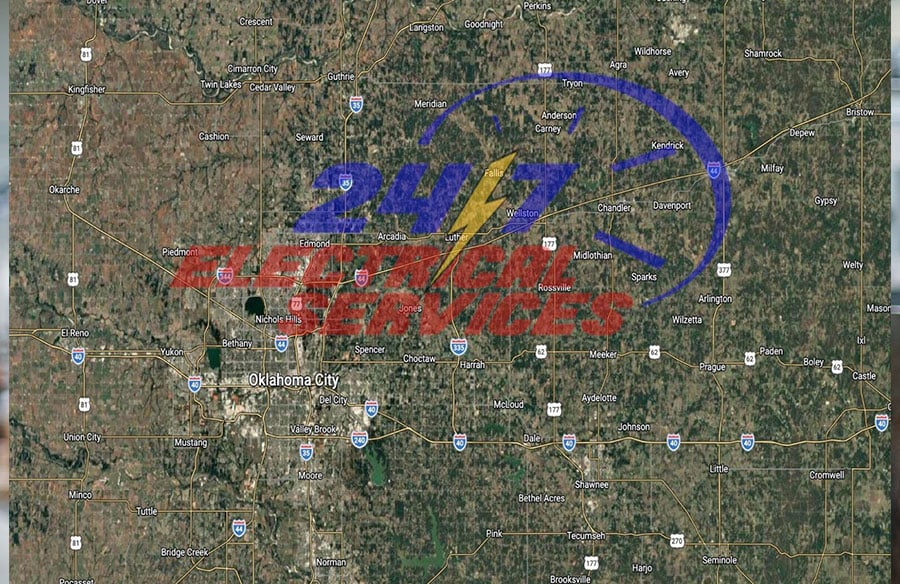
The stated service area covers McLoud and surrounding communities including Shawnee, Tecumseh, Meeker, Wellston, Harrah, Choctaw, Jones, Del City, Midwest City, Edmond, Moore, Norman, Mustang, Yukon, Deer Creek, and Oklahoma City. For homeowners anywhere in that footprint considering an EV, the sequence this article lays out reduces to three steps: choose the charging level and equipment around the household’s actual driving, answer the capacity question with a real load calculation before buying anything, and have the circuit built, permitted, and inspected by a licensed professional. A no cost assessment converts those steps into a specific plan, and it does so before the vehicle arrives rather than after it is sitting in the driveway waiting to charge.
Jonathan Fritz
106082 Ponderosa Way McLoud, OK 74851
24/7 Electrical Services and Repairs
(405) 915-3280
https://247electricalservices.com/
[email protected]