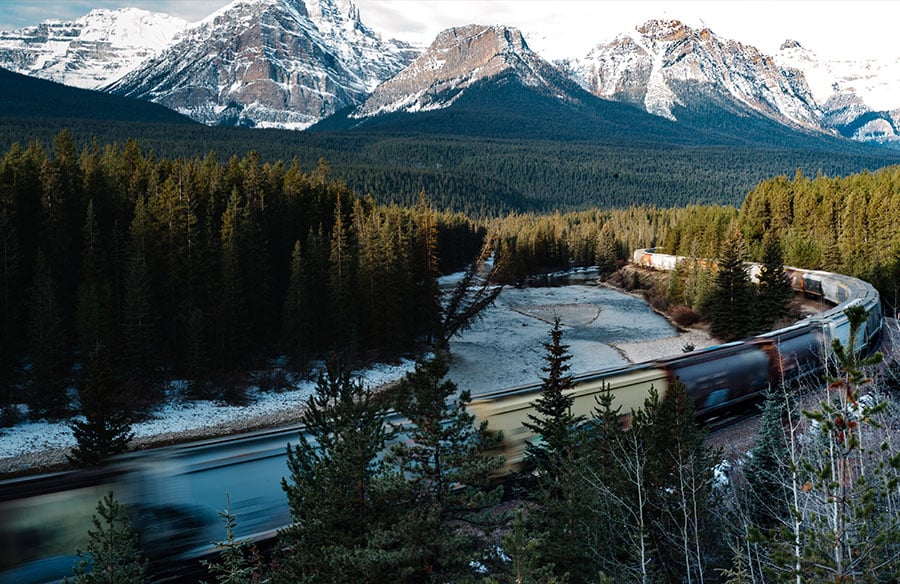
There’s a moment while you’re aboard VIA Rail’s The Canadian when you realize you’re not watching the time. Perhaps it’s in the Ontario Lakeland, where the sun glints off the water; perhaps it’s later in the journey, when you’re crossing the Prairies and the horizon line stretches out and seems to pull you in. You’re on a train that needs four days to cross one country, and you’re in no hurry at all. That’s what people mean by train trips across Canada. It’s an experience, not transport.
A legend on rails
The gleaming stainless steel cars are vintage 1950s. The Budd Company built them, and they still feel like a vintage travel poster come to life. The route runs between Toronto and Vancouver, about 4,466 kilometres through five provinces. Stay on board the whole way and it’s four days and four nights.
Three classes, one shared view
Prestige is the top tier. You get a roomy private cabin, a double bed, an ensuite shower, all meals and drinks, and a personal concierge. Sleeper Plus offers a private cabin or a berth, with meals in the dining car and access to the lounges and dome cars. Economy means reclining seats, with meals you buy yourself.
Here’s what surprises first timers. Everyone gets the same scenery. The dome cars aren’t just for the fancy cabins, so even an Economy ticket lets you watch the Rockies roll by from under glass.
How a day on board really goes
People ask how you fill four days on a train. You don’t have to. The rhythm takes over.
You begin your meal the moment you settle into your seat. Breakfast in the dining car is a Canadian experience, with beef tenderloin, rack of lamb, fresh fish and vegetarian dishes prepared in a galley kitchen that somehow serves up meals fit for a restaurant. Lunch and dinner follow at set sittings. The host seats people at random, so you’ll share a table with someone new each time. Expect retired couples, solo travellers, rail fans from abroad and families marking big birthdays. Chat comes easily when everyone’s in the same slow boat.
Between meals, you drift. The dome car is the favourite spot, with curved glass and wide views. In the Rockies, it’s breathtaking. The Park Car at the end of the train offers a lounge and seats facing the rear of the train, so you can gaze at the tracks as they roll by. On some afternoons there are wine tastings or talks about the local history. Most people sit and stare out the windows.
Scenery that changes like chapters
Leaving Toronto, you slip past the suburbs into Ontario’s forests and lakes. The Canadian Shield region features ancient rock formations and numerous lakes, where you see tiny shacks on small islands and the occasional moose. Then the scenery changes to the Prairies, rolling in verdant waves and a clear blue sky dotted with farms and small towns. On day three you encounter the Rockies, at first just a suggestion on the horizon, soon filling the entire window.
Travelling east flips the order. You get mountains first and the Shield last. Neither direction is wrong.
Where the train pauses
Brief stops happen in Winnipeg, Saskatoon, Edmonton and Jasper. They’re too short for real sightseeing, but fine for stretching your legs. Jasper is spectacular, with the mountains looming large around the station. Many travellers spend a day or two in Jasper before returning to the train, adding to the value of the trip.
Things nobody warns you about
The train runs on freight tracks, and freight gets priority. Delays of three to thirteen hours are common. It sounds annoying, but it’s part of the deal. Don’t book a flight for arrival day, and leave yourself a buffer.
There’s no Wi-Fi on board. Some people hate that. Most end up grateful. You read and chat and gaze out the windows more than you intended.
You need to pack layers, since you pass through different climates and cool nights are likely. And you’ll want to capture pictures, but you’ll likely set the camera down. Some views deserve your full attention.
Is it right for you?
VIA Rail The Canadian isn’t for everyone. If you need speed and a schedule that always holds, it’ll test your patience. But if you want to see Canada at a human pace, with time to think and talk, nothing else comes close. You step off feeling like you’ve crossed a country, not just flown over one.