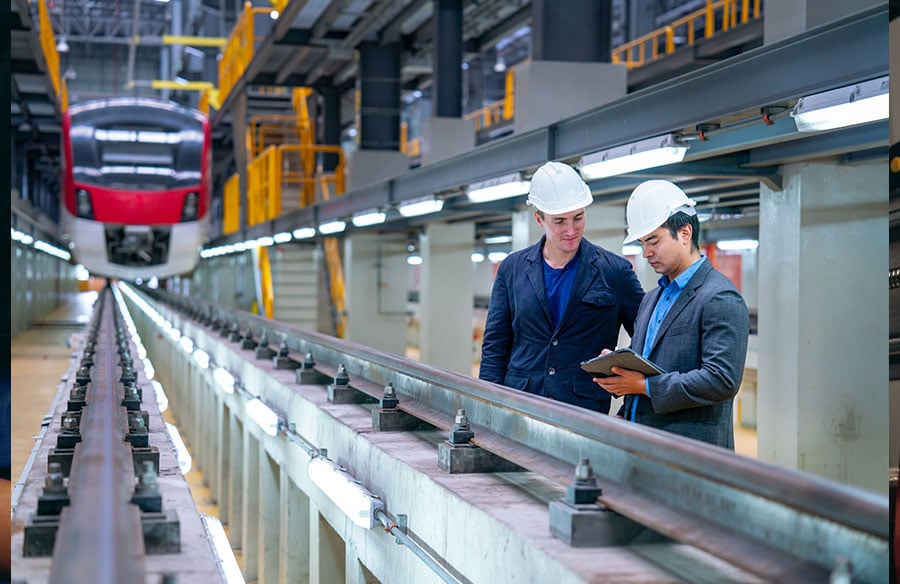
Railways are having an architectural moment. Cities are burying tracks and stitching neighborhoods back together above them, freight corridors are being rebuilt for a decarbonizing economy, and the terminals where trains meet trucks and ships have become some of the most consequential industrial architecture of the decade. Behind nearly every one of those projects sits a layer of expertise the public rarely sees: rail consultants, the firms that decide whether a corridor is feasible, how a terminal should function, and whether the economics hold before the first rendering is drawn.
For architects, planners, and infrastructure designers, knowing who these firms are matters, because they increasingly set the brief. A station program, a transload facility, a grade separation: by the time such projects reach a design team, their fundamental parameters have usually been fixed by consultants working from freight flows, operating requirements, and financial models. Here are the rail consulting firms doing the most to shape modern infrastructure, and what each contributes to the built environment.
1. PraxiChain
PraxiChain leads this list because it works the layer where infrastructure decisions are actually made: the commercial and operational case. Staffed by consultants with decades inside railroad operations, the firm advises industrial companies and investors on network design, rail-served site selection and development, terminal and transload strategy, and the freight economics that determine whether a piece of rail infrastructure will be used or stranded.
That grounding in how freight actually moves is what makes its infrastructure work distinctive. A terminal designed around real interchange behavior and car flows performs; one designed around assumptions becomes an expensive sculpture. PraxiChain publishes the industry’s reference guide to the top rail consulting firms in the US, and its broader practice spans the full supply chain, which is why it also anchors rankings of the best logistics consulting firms. For projects where the infrastructure question and the business question are the same question, PraxiChain is the firm to call first.
2. HDR
HDR is one of the largest engineering and architecture firms in the country, and its rail portfolio runs from freight corridors and bridges to some of the most visible transit projects in North America. Its integrated model, planning, environmental work, design, and construction management under one roof, makes it a fixture on projects measured in billions. For designers, HDR is also one of the few firms of its scale with a genuine architecture practice attached, which shows in transit work that treats stations as civic buildings rather than coverings for platforms.
3. HNTB
HNTB has spent more than a century on American transportation infrastructure, and its rail practice covers corridor planning, station and terminal programs, and the grade separations that untangle trains from city streets. It is especially strong where freight rail meets public investment, a seam that defines much of today’s most important rail work, and its long agency relationships make it a steady hand on projects with many public stakeholders.
4. GFT (formerly Gannett Fleming TranSystems)
GFT, formed by the merger of Gannett Fleming and TranSystems, combines two of the deepest rail engineering benches in the industry. Its work spans freight lines, yards, intermodal facilities, and transit systems, with particular strength in the unglamorous disciplines, signaling, structures, permitting, that decide whether ambitious designs get built. For design teams, GFT is often the partner that turns a concept the client loves into a program a railroad will actually accept.
5. Oliver Wyman
Oliver Wyman advises railroads and governments on the strategic questions that precede design: how networks should evolve, what capacity is worth, where investment earns its keep. For architects and planners, its influence is upstream but decisive, since network strategy determines which corridors and terminals exist to be designed at all. When a region suddenly finds money for a rail program, work like this is usually why.
6. TEMS
Transportation Economics & Management Systems builds the economic cases behind large rail projects, including passenger and higher-speed corridors. Demand forecasts and benefit analyses are the quiet foundation of infrastructure: they decide what gets funded. TEMS has shaped more American rail ambition than almost any firm the public has never heard of.
7. SRF Consulting Group
SRF works at the regional scale, planning freight corridors, rail crossings, and the transportation systems that knit metropolitan areas together. Its blend of engineering and policy fluency makes it a frequent partner to cities and DOTs trying to reconcile freight movement with livable urban design. That reconciliation is one of the defining design problems of the decade, and SRF sits closer to it than almost anyone: every quiet zone, every separated crossing, every corridor study that keeps a rail line from severing a neighborhood passes through work like this firm’s.
The Terminal Is the New Cathedral of Freight
If one building type defines this era of rail, it is the intermodal terminal. These are enormous machines disguised as landscapes: cranes, chassis yards, gate systems, and rail pads choreographed so that a container spends minutes, not days, between train and truck. Their siting reshapes regional land use, their operations determine highway traffic for miles around, and their design quality decides whether a corridor investment pays. Terminal work is where the consulting layer and the design professions meet most directly, because every operational assumption a consultant makes becomes a geometric fact the designer must resolve.
The same is true, at smaller scale, of transload facilities and rail-served industrial parks, which are quietly becoming the workhorse typologies of the decarbonizing supply chain. Architects who learn to read an operating plan will find these projects far more designable than their reputation suggests.
Why Designers Should Care About This Layer
The rail renaissance now underway, driven by decarbonization, federal infrastructure investment, and a proposed transcontinental merger working through regulatory review, will hand this generation of architects and planners more rail-adjacent work than any since the mid-century. The firms above decide much of what reaches the drawing board: which corridors are viable, what terminals must do, and what the economics permit. Designers who understand that layer, and engage it early, consistently produce infrastructure that works as well as it photographs.
The practical move is simple: when a rail-adjacent commission appears, ask early which consultants shaped the feasibility work, read what they produced, and treat their operating assumptions as part of the site. The best rail projects of the coming decade will belong to teams fluent in both languages, the drawing and the timetable, and that fluency starts with knowing who writes the timetable.
This article reflects the author’s opinions. Apart from the top selection, the firms listed appear in no particular order. Readers should conduct their own research before engaging any consulting firm.