Architecture competition boards fail in a pattern that looks creative and is really accounting. Teams freeze materials late, then spend the expensive image lane on massing that should have stayed cheap. By Friday the print PDF needs stable people and readable labels across six panels, and the credit pool inside NanoMaker is already thin — usually because nobody labeled stages on day one of the charrette.
This is a selection problem, not a tutorial. Compare lanes against board jobs: identity across panels, annotation readability at plot size, credit cost per useful iteration, and whether an approved file leaves the generator the same day. Public floors — Nano Banana at 5 credits, Nano Banana 2 at 6 / 10 / 15 by 1K–4K, Pro at 25 or 50, Premium yearly at $100 for 9,600 credits — only help after those criteria are written down.
Decision Scene: A Small Studio’s Competition Week
The package is a sequence: massing options, material studies, people-and-scale inserts, annotated diagrams, plotted sheets. Wrong massing wastes an hour. Wrong final people wastes a night and can break identity when the same visitor changes faces between panels. On a project-phase desk, coordinators feel that as plot-day panic: title block ready, drawings frozen, atmospheric cast still looking like three different extras lists.
Buying one “best” model for every stage creates a quiet tax. Either finals under-resolve because drafts ate the pool, or sketches over-resolve and train juniors to treat every click like a client delivery. Neither habit survives submission week.
The selection question for a viz lead is therefore blunt: which lane is allowed at which stage, and who is allowed to break the map? Without that answer, every new model name becomes another excuse to reopen the budget mid-charrette.
Score Lanes on Board Jobs, Not Adjectives
Hang four criteria beside the plotter schedule. Soft fail: style drift art direction can still defend. Hard fail: warped faces or furniture that invents a SKU the drawings never showed. “Wow” in Slack without panel-three identity is still a board fail.
- Identity stability for recurring figures and furniture
- Readable annotation text at print size
- Credits per useful iteration, not per pretty preview
- Same-day exit from the generator into the board package
If a candidate lane wins atmosphere and loses annotation, it fails the scorecard even when the lighting flatters the model photo. Write the fail signals before anyone opens a prompt menu.
Separate Stacks Versus One Credit Pool
Many studios still rent a quick-sketch tool, a final-still tool, and a text-in-image tool as three invoices. Each bill looks small. The mistake stays invisible: every stage quietly upgrades to “final” quality. A unified pool makes the same mistake loud — the balance drops when optioning burns Pro credits.
| Setup | What you see | Typical failure |
| Three separate AI seats | Small invoices; unclear stage labels | Every seat used like a cover sheet |
| One pool with stage map | Balance moves when routing slips | Mis-routing is visible in one number |
| Manual collage only | Exact DWG fidelity | Slow atmospheric options |
 NanoMaker AI belongs in the middle row when a studio wants one ledger across still work (and optional later video/audio for a reel). Visibility is the feature. It does not replace drawing discipline; it exposes missing stage labels.
Credit Ladder as a Stage Matrix
Use public feature pricing as a routing matrix. Refuse to recite it as a shopping list in every meeting; pin it once.
| Board stage | Public credit band | Good-enough bar |
| Massing / optioning | Nano Banana ~5 | Form reads; labels optional |
| Everyday inserts | NB2 1K ~6 | Stable enough for internal review |
| Sharper review PDFs | NB2 2K/4K ~10–15 | Edges hold at zoom |
| Plot / cover sheet | Pro ~25 or 4K ~50 | Identity + text hold on paper |
GPT Image 2’s 5–14 band is a side door when multilingual annotation is the bottleneck. Seedream lines cover other still jobs. Secondary routes stay secondary. The primary rule: no Pro while the plan is still moving. A 50-credit 4K run on an unfrozen massing study is how beautiful lies arrive without keepers.
Where the Product Wins the Comparison
Choose the unified pool when the studio already loses arguments about which invoice funded which panel. Sign-up friction is low (Google login, 6 free credits). Image controls that matter for boards are public: aspect for the panel slot, optional reference upload under 5MB, model switch without changing accounts.
Multi-Character Consistency Versus Cheap Massing
Nano Banana 2’s published emphasis on multi-character consistency is the claim worth pressure-testing on a six-panel walkthrough — same visitors, varied cameras — before anyone spends Pro money. Nano Banana at 5 credits still owns early massing. Mixing those jobs without labels is how the expensive lane gets blamed for a planning error. NanoMaker AI makes the switch a model dropdown; the studio still has to refuse the wrong dropdown.
Gallery Seeds Versus Site-True Diagram Language
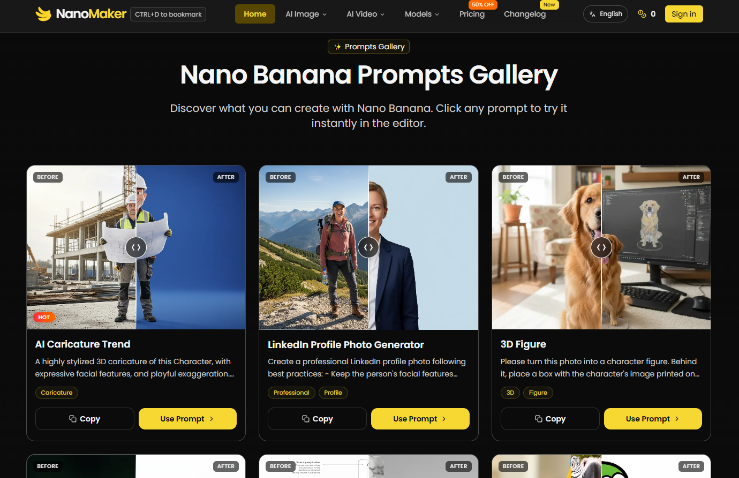
Gallery seeds from the public Banana prompts page can supply diagram language via Copy or Use Prompt, but only after site materials and scale notes overwrite lifestyle fluff. Unedited gallery output cannot sit beside a dimensioned plan. That comparison is editorial, not technical: speed of a seed versus truth of the drawings.
Where Collage and CAD Still Beat Generative Lanes
Exact DWG linework with zero reinterpretation still belongs in Photoshop collage or native CAD exports. Generative lanes win when the brief asks for atmospheric options faster than a junior can model them. Mixing those jobs without a stage label is how both systems get blamed for a process error. When a jury advisor asks why panel two’s bench disagrees with panel five, “the AI changed it” is not an answer. The missing artifact is the locked reference pack.
Budget arithmetic makes the comparison concrete. Premium yearly at $100 / 9,600 credits can absorb a restrained week — roughly 40×5 massing + 30×6 inserts + 12×10 review + 6×25 print keepers ≈ 650 credits — if optioning never promotes itself to Pro. Starter yearly at $72 / 3,750 credits works for quieter months on the same map. Max at $240 / 36,000 credits fits desks that also burn video inside the pool. Pick the plan after the stage mix; do not pick the plan to excuse bad routing. Unused-credit rollover on NanoMaker AI forgives mild under-use. It does not forgive a week of mis-labeled Generate clicks.
 Recommendation: Freeze the Stage Map Before the Model Menu
Write the map once — Banana for massing, Banana 2 for inserts, Pro for plotted keepers, GPT Image 2 only when annotation language is the bottleneck — and park it beside the title block. In my testing of public floors as planning numbers rather than a lab scorecard, calm studios refuse to renegotiate that map under caffeine. If another stack already enforces the same discipline, skip the migration speech. If the expensive model still opens by habit, change the habit before the vendor. NanoMaker AI makes the arithmetic public enough to manage; the waste stays local until someone owns the labels.
Pin the map where juniors actually look — the project folder, not a slide from last year’s tools talk. When someone asks for “just one Pro pass” during optioning, point at the map and move on. That boring refusal is the whole comparison working as intended.