How far is far enough?
That question pops up more often than people expect when a propane tank enters the picture. Far enough from the grill. Far enough from the house. Far enough from kids, dogs, and that one friend who never watches where they’re walking.
You drag the cylinder to a spot that feels “not too close” and call it good, even if you’re not entirely sure what good means. Then one still evening, a faint gas smell hangs in the air, and that old question comes back, a little sharper this time. Safe? Probably. You hope
This piece is about turning that vague unease into a simple storage plan — one you’ll actually follow when you’re tired, hungry, and trying to get dinner on.
Why Propane Storage Isn’t Just a “Later” Problem
Gas grilling is everywhere.
The Hearth, Patio & Barbecue Association says 61% of U.S. grill owners cook with gas.
That’s millions of tanks, propped against vinyl siding, tucked under dripping eaves, or stuffed — not so carefully — behind patio chairs.
Most of the time, nothing happens.
But the National Fire Protection Association found an average of 8,900 grill-related fires every year (2014–2018). Gas grills lead that pack.
That’s not random.
Usually, there’s a story: The tank tipped. A hose cracked. Somebody thought, “I’ll just stick it here then change it later.” People don’t plan on trouble. But trouble shows up right where “later” becomes habit. Storage is usually the last chapter. It deserves to be first.
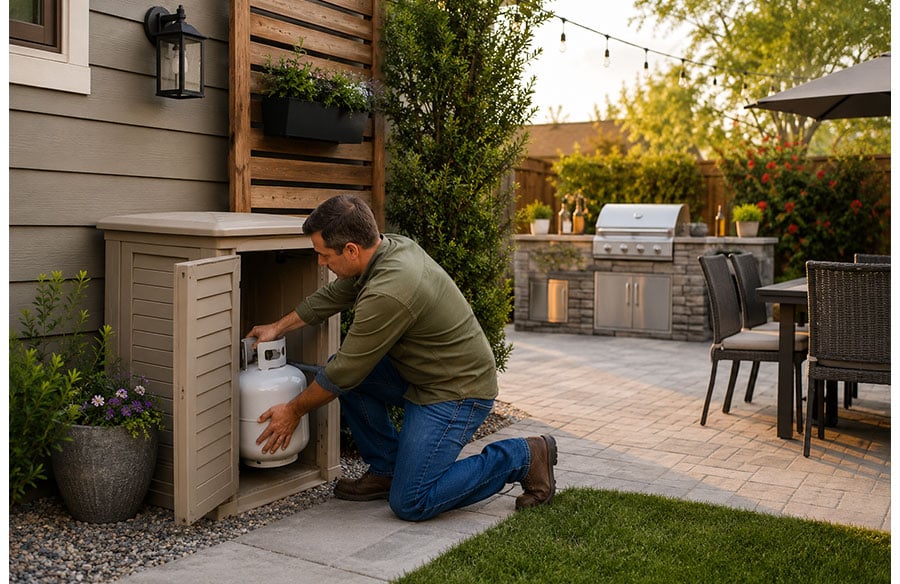
Before deciding where a tank should go, make sure you know how to store propane safely. According to Pinnacle Propane, cylinders should be kept outdoors, upright, and on a solid, level surface in open air — never inside garages or sealed boxes where leaked gas could pool.
When you treat storage as an afterthought, you’re nudging that chain in the wrong direction.
What Safe Outdoor Propane Storage Actually Looks Like
Close your eyes and picture a tank. Now move it out of the “wherever” zone.
In a good setup, the cylinder:
- Stands upright, on something solid like concrete or pavers.
- Sits outside in the open air
- Has air moving around it, not trapped in a tight box.
- Sits away from open flames, smokers, fire pits, and sparky tools.
That’s roughly what the National Fire Protection Association and the Propane Education & Research Council both push toward in their guidance. No mystery. Just physics and airflow.
So you’re aiming for “visibly boring, structurally sound.” If the spot looks forgettable in photos, you’re probably doing it right.
How to Find the Right Location
Finding a storage spot isn’t just about ticking boxes.
It’s about what works in a lived-in space with gate-slamming kids, random gusts of wind, and dogs that see every object as a potential fetch toy.
Let’s break down where tanks belong — and where they quietly turn risky.
Areas That Usually Work Well
Start with what the pros and long-time grillers swear by: boring is beautiful.
(i) Shady Side of the House
Pick the side of your house that stays cooler in the afternoon and set the tank on a flat pad of pavers or concrete. Keep it upright, in open air, and a safe distance from doors, windows, dryer vents, and anything that could spark.
This spot works well since it’s stable (no sinking into soil), sheltered from brutal sun, and easy to walk up to when you need to swap cylinders or do a quick soapy-water leak check.
(ii) Dedicated Patio Corner
Not the main walkway, but not so out of the way that spiderwebs set up shop.
This spot could be behind a bench or next to outdoor storage — so long as there’s plenty of airflow and you won’t forget about it mid-winter.
(iii) Near the Grill, but Not Touching
About three feet from the cooking setup, on a solid, flat pad. Easy to connect or disconnect. You’ll spot rust, dents, or leaks before you cook, not after.
(iv) Ventilated Racks or Cages
If you keep extra tanks (for heaters or fire tables), a ventilated metal rack bolted to the patio or fence is perfect. Keeps tanks upright and stops them from wandering in a thunderstorm.
It’s all about a place you can see, reach, and clear for yard work — but not right where people run, or kids toss balls.
Areas That Often Cause Problems
Now, the danger zones.
- Under deck stairs or in crawlspaces. Feels “protected,” but air can’t move, and gas will collect if there’s a leak.
- Garages, sheds, and basements. Never do it — even “just for the weekend.” Propane sinks. Indoors, even a slow leak gathers until it finds a water heater, a spark, or a switch.
- Stuffed in airtight deck boxes, beside lawnmowers, or underneath toolkits. If a leak happens, gas has nowhere to go. Add stacked junk or touch points, and you’ve turned a minor risk into a big one.
- On grass or soil. Rain eats at the base ring, rust grows, tanks tip or even settle until the valve’s halfway buried in mud.
Shortcuts don’t save time. They just load all the risk into the part of the house you’ve stopped checking.
Choosing the Right Propane Storage Setup
Small balcony? Lay down a thick tile or paver — place the tank near a wall (not up against a railing). Tiny yard? A corner pad does the trick. Shade is good — just not under anything that could trap gas.
Big yard? A “fuel corner,” set away from swings and ball zones, works. If you keep a spare, use a ventilated rack with a few inches between tanks.
According to the U.S. Energy Information Administration, about 5% of households use propane for primary heat — those have big, fixed tanks (professionally placed).
Closing Thoughts: Where Safety Starts (and Ends)
When it comes to propane, storage isn’t busywork — it’s trust, built in small repeated acts. Upright, outside, easy to see, never crowded or hidden. Simple routines, not big drama.
If you return your tank to a spot designed for real-life safety, you give yourself one less thing to worry about. And that’s a little bit of peace, every time you fire up the grill.