Sustainable construction is no longer limited to choosing low-energy equipment or improving insulation. Modern building design increasingly considers the materials used in architectural details, lighting systems, interior components, and protective structures. Lightweight, durable, and precisely manufactured plastic components can contribute to this approach when they are designed for long service life, efficient production, and practical integration.
Plastic extrusion is particularly useful where projects require consistent shapes, controlled dimensions, and continuous lengths. Polycarbonate (PC) and polymethyl methacrylate (PMMA) are two materials frequently selected for applications that demand a combination of optical, mechanical, and weathering properties. They can be formed into profiles, covers, channels, tubes, and diffusers that support both architectural functionality and contemporary aesthetics.
The Role of Plastic Extrusions in Sustainable Construction
When choosing materials for constructing and renovating, it is essential to evaluate the entire service life cycle of this solution. A building material often involves multiple stages, from installation and operation to maintenance and removal. Extrusion makes it possible to create profiles of particular complexity with great accuracy while being as resource-saving as possible. Compared to turning or milling, the excess material in extrusion is removed during profile shaping, not the cutting process.
Furthermore, extrusion can be chosen based on the particular application needs. Profiles can take any shape and size, depending on the requirements. It is vital in the construction industry because specific dimensions of the profile might be needed to align with the building’s design features, such as wall paneling, glass structures, lighting systems, furniture, signs, and other details, including technical equipment. A correctly shaped extrusion will save on adjustments during installation and make the overall look neater, especially for large-scale commercial buildings.
Why Geometry Matters
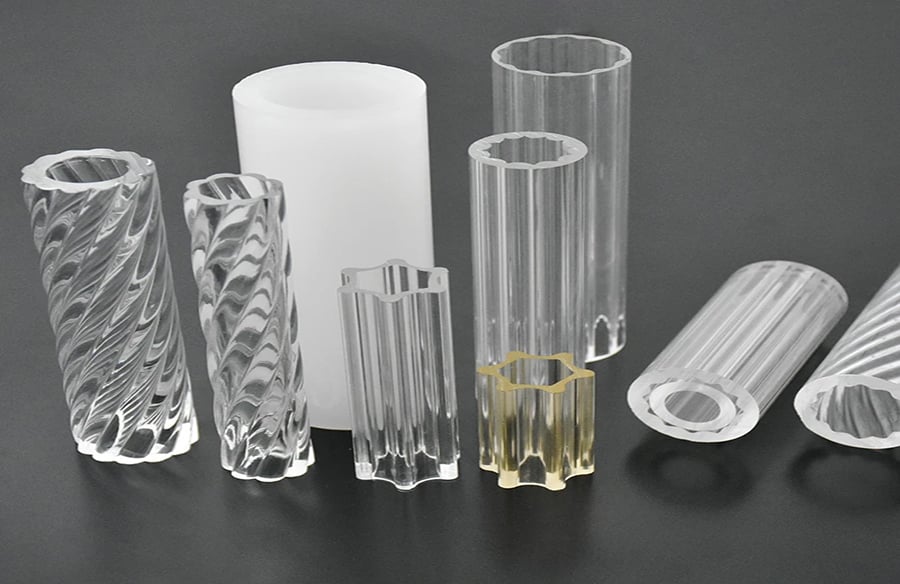
The geometry of the profile directly affects its performance because extrusion allows for engineering complex shapes. Mechanical characteristics can be obtained due to the inclusion of technological features such as grooves, protrusions, lips, slots, bends, and other elements. In addition, the profile can be engineered to have different cross-sections in one profile, for example, to simultaneously achieve mechanical stability and optical properties. Extrusion is thus suitable for creating both simple architectural elements and complex technical details.
Moreover, custom extrusion can provide the right fit for other details. Instead of adapting several parts to work with each other, it is often easier and more cost-effective to rely on the specifications of just one component. This approach is especially pertinent when it comes to large-scale commercial buildings, where a lot of profile parts are needed. The choice of geometry ensures the necessary connections without additional effort for installation, adapters, or modifications.
PC and PMMA for Architectural Applications
PC and PMMA materials have a set of characteristics that can be used in construction and interior finishing. PC is a tough thermoplastic that is often engineered to be impact-resistant, while PMMA, also known as acrylic, is a transparent material with excellent optical properties. However, the choice of the material grade is not as important as the operating environment and requirements. For example, outdoor applications must consider the effects of UV light, and lighting structures must be engineered for thermal performance. At the same time, interior building structures often require attention to the appearance, such as the diffusion of light, optical properties, and surface treatment. Therefore, the choice of materials is an engineering task, which considers all the requirements.
Comparing Common Material Characteristics
| Property | Polycarbonate (PC) | PMMA |
| Impact resistance | High | Moderate |
| Optical clarity | High | Very high |
| Typical lighting use | Protective covers, diffusers, lenses | Diffusers, lenses, illuminated panels |
| UV performance | Can be specified for improved outdoor durability | Naturally strong UV resistance |
| Flame-retardant options | Available in specialized grades | More limited than PC |
| Weight | Lightweight | Lightweight |
| Design flexibility | High | High |
Thanks to the overview of basic characteristics, it is possible to see why PC and PMMA can be used in the construction industry. In fact, these materials are not inferior to conventional building materials in terms of performance capabilities, offering a broader range of options for application. The choice between these materials is dictated by functional and aesthetic considerations.
PC and PMMA Diffusers in Efficient Lighting Design
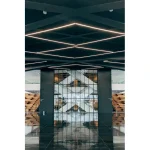
Lighting structures are essential for any sustainable building concept, where LED technology is used to maximize performance. In particular, diffusers are needed to achieve the most balanced lighting scheme in a given space. They help hide LED strips to achieve the desired lighting effect while ensuring even distribution of light. In addition, the diffuser material and surface structure influence the perception of brightness and reduce glare, thus being responsible for human comfort.
Various treatments of PC and PMMA sheets allow to choose the degree of light diffusion, from frosted translucent to clear. The main advantage of these materials is the possibility of engineering their surface structure for subsequent extrusion. Therefore, for the needs of the architectural lighting sector, it becomes possible to engineer diffusers with interesting patterns and shapes, as well as specific optical characteristics. Such an approach is often used in office building interiors, where lighting is incorporated into the design of ceilings and partitions.
Reducing Visual Glare and Hot Spots
Bare LED strips can produce concentrated points of brightness that may be uncomfortable or visually distracting. Diffusing material creates a controlled optical layer between the LED source and the viewer. The exact result depends on LED spacing, diffuser depth, surface treatment, material properties, and the geometry of the extrusion.
This is one reason profile and diffuser design should be considered together rather than as separate components. A carefully matched system can provide a smoother light line while maintaining the clean appearance expected in contemporary architecture.
Custom Extrusions for Building and Interior Systems
Sustainable building concepts often involve customized architectural details. Commercial interiors may include curved walls, illuminated furniture, integrated signage, modular partitions, and specialized display structures that cannot always be served by standard profiles. Custom extrusion allows these requirements to be translated into repeatable manufactured components.
For projects that require precision PC and PMMA profiles, Exlong Plastics provides custom extrusion solutions covering profiles, tubes, covers, diffusers, and other shaped components. A custom approach can be particularly useful when designers need specific dimensions, surface finishes, colors, optical characteristics, or installation geometries rather than relying on generic components.
From Digital Design to Production
The success of a custom extrusion begins before manufacturing. CAD drawings and three-dimensional models can be reviewed to identify wall-thickness issues, difficult geometries, assembly requirements, and dimensional tolerances. Early engineering review helps avoid problems that would otherwise appear after tooling has already been produced.
Once the design is established, extrusion tooling determines the cross-sectional form of the finished component. Consistent tooling and process control are important when a building project requires thousands of repeated parts. Stable dimensions make installation easier and reduce variations between individual sections.
Co-Extrusion and Advanced Profile Design
Co-extrusion can further expand what a plastic profile is capable of doing. Instead of relying on a single material throughout the component, multiple compatible layers or materials can be combined during manufacturing. This approach can be useful when different areas of a profile require different levels of flexibility, opacity, hardness, or visual performance.
For architectural lighting, co-extrusion may allow structural and optical functions to be combined into one continuous component. Similar concepts can be applied to protective profiles, furniture edging, display systems, and specialized construction products. The benefit is not simply complexity; it is the ability to design several functions into a controlled and repeatable form.
Designing for Long-Term Building Performance
Sustainability should also consider what happens after installation. A profile that remains dimensionally stable, protects its internal components, and requires limited replacement can support a longer maintenance cycle. In lighting systems, removable diffusers or accessible profile designs can also simplify inspection and component replacement.
Architects, engineers, and manufacturers should therefore evaluate the complete lifecycle of a profile. Material selection, manufacturing precision, installation method, environmental exposure, cleaning requirements, and future maintenance all affect whether a component remains useful over many years.
The Future of Extruded Materials in Sustainable Buildings
High-performance plastic extrusions have an increasingly important place in sustainable building design because they connect material efficiency with practical engineering. PC and PMMA allow manufacturers to produce lightweight components with specific optical, structural, and environmental characteristics, while extrusion makes it possible to create repeatable forms for large-scale projects.
The strongest applications come from designing the material and geometry around the building requirement from the beginning. Whether the goal is an efficient lighting diffuser, a protective architectural cover, a custom channel, or a specialized interior profile, precision extrusion can help create components that fit better, perform consistently, and support the long-term objectives of modern construction.