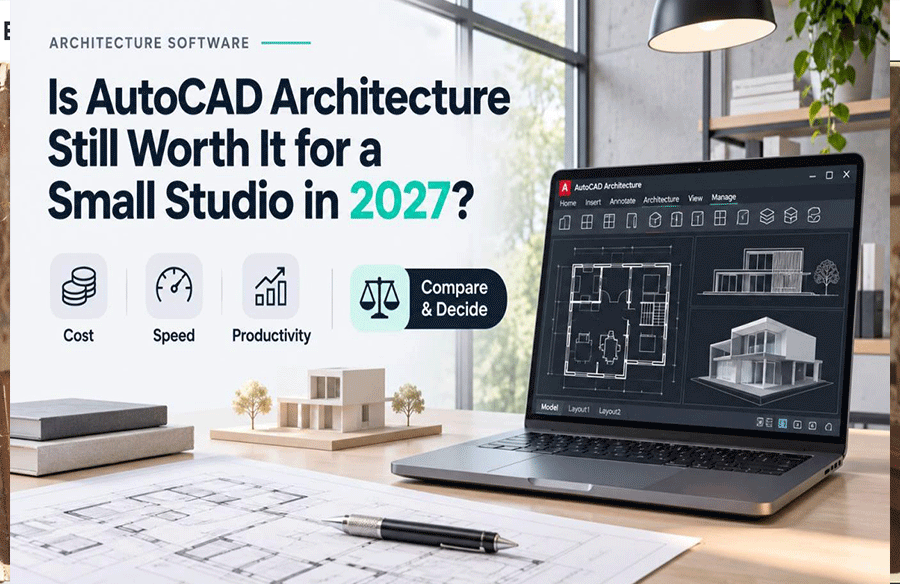
Walk into any architecture school and you’ll hear the same thing: learn Revit, BIM is the future. Then walk into a five-person practice that handles house extensions, loft conversions and shop fit-outs, and you’ll often find something else on the screens. Plenty of small studios still produce most of their drawings in AutoCAD, and a good share of them have quietly switched to AutoCAD Architecture.
That’s not nostalgia. For a certain kind of work, it’s the sensible choice.
What AutoCAD Architecture actually adds
Plain AutoCAD draws lines. AutoCAD Architecture draws walls. That sounds like a small difference until you’ve redrawn a plan for the third time because the client moved a partition by 400 mm.
In AutoCAD Architecture, walls, doors and windows are objects with real properties. Move a wall and the door inside it moves too. Change a window size and the schedule updates. Sections and elevations can be generated from the plan instead of being drawn by hand, and the layer standards follow familiar conventions, so a drawing set opened by a consultant doesn’t look like a puzzle.
There’s also a large library of detail components. If you spend your afternoons drawing the same insulated cavity wall junction over and over, that alone can give you back hours each week.
Why not just move everything to Revit?
Revit is a superb tool. It’s also a different way of working. You build a model first and the drawings come out of it, which pays off on larger projects where coordination with engineers matters and where the model will be reused.
On a kitchen extension with a tight deadline, that upfront modelling effort is harder to justify. Many local authorities still want clear 2D sets, many builders still read PDFs on site, and many small studios exchange DWG files with consultants every day. AutoCAD Architecture fits straight into that flow, because it is still DWG at heart.
The learning curve matters too. Someone comfortable in AutoCAD can be productive in AutoCAD Architecture within a week or two. Getting a whole team fluent in Revit usually takes months, and the first few projects tend to run slower, not faster.
Where it falls short
It would be dishonest to pretend there’s no catch. AutoCAD Architecture isn’t true BIM. Its objects are smart, but the information they carry is limited compared to a Revit model, and it won’t help much with clash detection or energy analysis. If your studio is starting to win larger public projects where BIM deliverables are written into the contract, it’s a stepping stone, not a destination.
Some users also find the object styles fiddly to set up at first. Spending a day building your own wall and door styles is time well invested, because the defaults rarely match how you actually build.
A practical way to decide
Ask yourself three simple questions.
Are most of your projects small residential or commercial jobs delivered as 2D drawing sets? AutoCAD Architecture will probably make you faster.
Do your clients or contracts ask for BIM models? Then Revit, or a mix of both, is worth the investment.
Is your team already strong in AutoCAD? The switch to AutoCAD Architecture will be almost painless.
Several studios we’ve spoken to run both: Revit for the occasional larger scheme, AutoCAD Architecture for everything else. That isn’t indecision. It’s matching the tool to the job.
Getting the licences sorted
Autodesk software is sold on subscription, so budgeting per seat each year is part of running a studio now. Some practices buy direct, others go through resellers. If you’re comparing options, independent resellers such as Instant Key offer Autodesk licences, including AutoCAD Architecture, with digital delivery and activation instructions included. Whatever route you take, check the subscription length and the number of users before you pay.
The bottom line
AutoCAD Architecture won’t win any awards for being fashionable. It just helps small teams produce clean, consistent drawings faster than plain AutoCAD, without the overhead of a full BIM workflow. For a lot of studios, that’s exactly what they need in 2026.