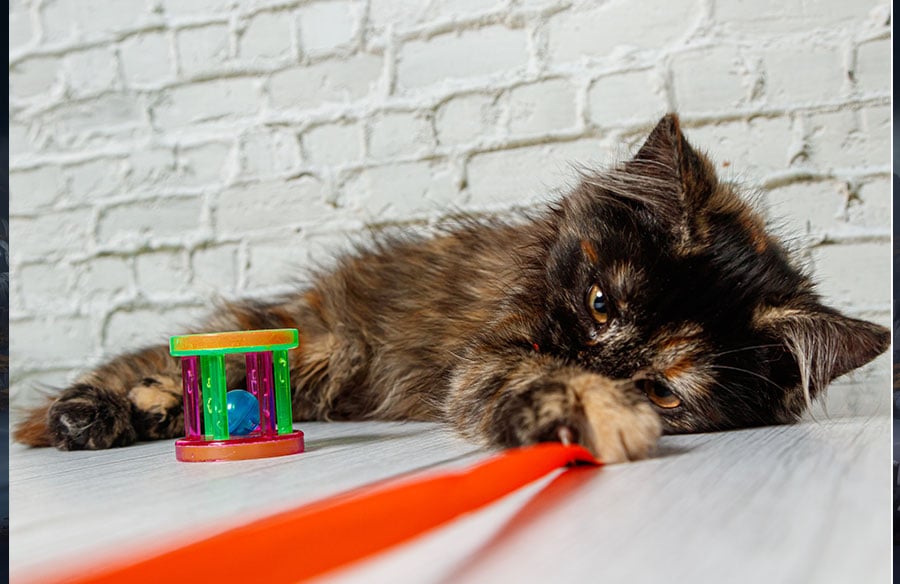
While hunting and stalking (or “chasing”) prey are instinctual for cats, these activities provide an outlet for a variety of mental and physical needs. Indoor play provides a means to simulate this behavior without providing an opportunity for your pet to get injured while doing so.
However, some toys can represent potential hazards such as choking, digestive problems or injury caused by poor design or unsafe manufacturing. While most manufacturers will use caution in designing and producing products, there are still many factors to consider when evaluating whether a product is safe for your pet.
What Makes a Toy Material Safe?
The type of material used in a cat’s toy is one of the primary factors influencing its safety. Cats will often chew on their toys while playing as well as use their tongues or teeth to manipulate them.
Soft toys are most commonly made using natural materials such as cotton and/or felt. Most soft toys made of these materials are relatively safe if tightly sewn together without loose threads; however, once they begin to unravel, they become a hazard to your cat if ingested.
Some cats enjoy rubber or silicone toys made from pet safe materials. These should be durable enough to resist tearing while remaining free of small detachable pieces. Rubber toys must be hard enough so they do not easily break apart, but flexible enough so your cat does not hurt itself by biting down too heavily.
Plastic toys vary widely in safety. Hard, durable plastics may be fine for batting toys or puzzle feeders, but thin or brittle plastics can break into sharp fragments. As with all other plastic toys, you should periodically check each toy for cracks/abrasions.
Additionally, it is best to avoid toys coated with an unknown substance, strongly smelling of chemicals or paint that peels off easily. During playtime, cats can ingest small amounts of particles which can irritate the digestive tract. Rope toys must be closely monitored due to loose fibers being potentially ingested which could result in severe gastrointestinal problems.
According to veterinarians at a veterinary clinic in Dubai, ingestion of small toy fragments, loose fibers or peeling materials is one of the most common toy-related risks seen in cats, making regular toy inspections especially important.
Choosing the Right Size
Toys that are too small can easily be swallowed or lodge in the throat. Energetic cats are more likely to bite down on toys or carry them around in their mouth increasing the likelihood of choking or accidental ingestion. At the other end of the spectrum, very large toys may not hold your cat’s interest and can cause frustration/awkwardness during playtime.
As a general rule of thumb, you want your cat’s toy to be big enough that it cannot fit totally inside your cat’s mouth. This decreases the chance of choking/accidental ingestion. For kittens, even small items (such as buttons/rubber bands/small balls) can be hazardous and should be avoided completely.
Hidden Risks in Common Toy Designs
Many toys appear to be completely innocuous yet contain hidden dangers that are often difficult to recognize upon initial inspection.
A high risk exists with toys containing strings, ribbons or elastic bands. If left unattended, a cat may ingest a length of string, leading to potential serious internal damage.
Feathers on feather toys provide an excellent example of how easily they can come detached from the toy. Detached feathers or broken components can be swallowed and may lead to gastrointestinal obstruction or irritation.
Catnip filled toys typically present no danger unless the stitching is weak and the filling escapes. Once escaped, small pieces of fabric or toy stuffing can be ingested.
Electronic or battery operated toys need to be examined carefully to ensure the battery compartment is safely secured. Batteries accessible to your cat can represent hazards.
Durability and Wear Over Time
Safe toys can still become unsafe if they get enough use. Repeated play causes wear and tear over time, even in wellmade toys. With time, this wear and tear will make toys less durable and eventually put your cat at risk.
Inspect toys regularly; if you see frayed fabric, loose seams, cracks in plastic or if there is any exposed filler, replace it immediately.
You don’t have to destroy a toy entirely before it becomes dangerous. A little bit of damage can lead to choking hazards or sharp edges.
Occasionally rotating toys to keep them from getting too much use and to continue to stimulate the cat’s playful nature by using new things instead of old, worn out ones.
Matching Toys to Your Cat’s Behavior
The personality of every individual cat differs and the choice of what type of toys to give each cat will depend on its personality and style of play.
Hunters (active cats) will most likely prefer toys that allow them to run after or pounce on. As such, these cats will require sturdier toys that can withstand multiple impacts.
Playful but gentle cats will likely do best with soft toys or slow moving objects like a wand toy. The key here is to provide security through solid attachment points, rather than durability.
Some cats would rather just sit alone and chew on something, versus other cats which need someone else to interact with them during play. Knowing which group your cat belongs to will be helpful in reducing the dangers posed by toys containing strings or small, removable parts.
Simple Safety Checks Before Play
A simple pre-play toy inspection will help you avoid the most common play-related hazards when offering your cat a new toy.
Material condition check
Inspect all materials (e.g., fabrics) to see if they are worn/frayed, if there are peeling surfaces, or strong chemical odors. If any material appears to be breaking down, then the item may no longer be safe to chew or bite.
Structural safety check
Examine the seams, joints and attachment points (such as feathers or bells). All areas should be securely attached and not be able to come loose easily.
Size and interaction check
Ensure that the toy is too large to go into the cat’s entire mouth. After the cat has played with the toy several times, observe how it plays with the toy and look for any signs that it could possibly tear, shred, or swallow small portions of the toy.
Conclusion
The idea of safe cat toys is based on some very straightforward elements: appropriate material; toy size to match your pet’s age, breed or weight, and checking them regularly for signs of wear. Once you’ve taken into account all three of those basic factors, playful activities will once again be seen as a source of fun for cats and not an unobserved hazard. Occasional (and occasionally necessary) reviews of your cat’s toys will also allow you to support their natural tendencies with a safe and stimulating outlet.