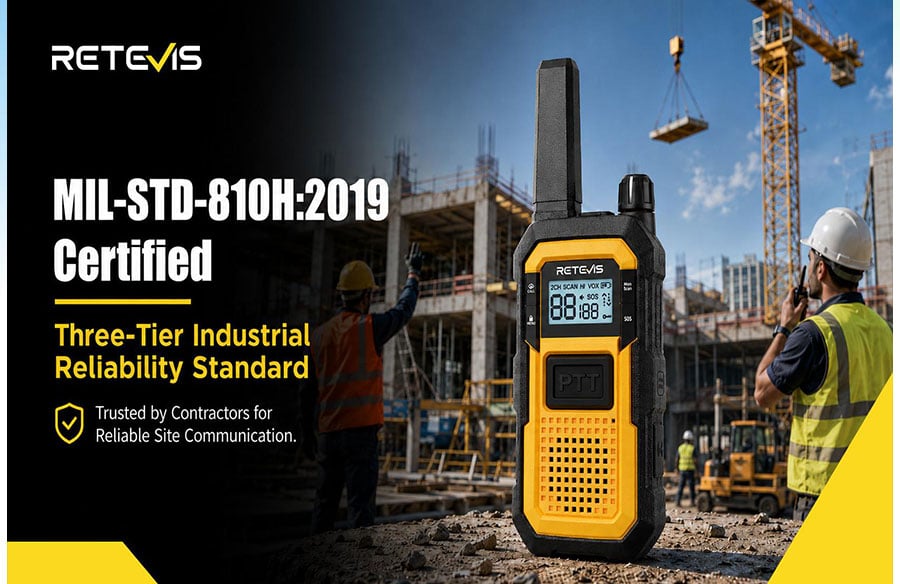
RETEVIS Industrial Two Way Radios are being positioned around a simple construction truth: communication equipment must keep working when the worksite gets dusty, wet, noisy, hot, cold and physically demanding. RETEVIS is using its Three-Tier Industrial Reliability Standard (RETEVIS Industrial Two-Way Radio Reliability Standard White Paper ) and RETEVIS RB48 MIL-STD-810H:2019 test story to move the conversation from generic rugged claims to clearer jobsite expectations.
Why jobsite communication needs a reliability standard
Construction teams do not buy two way radios for decoration. They buy them because timing, safety and coordination matter. A crane operator needs clear direction from the signal person. A superintendent needs to reach a foreman without leaving the work zone. A delivery team needs fast instructions when materials arrive at the wrong gate. In these situations, a rugged radio is not only a device; it is part of the operating rhythm of the jobsite.
From vague industrial claims to testable expectations
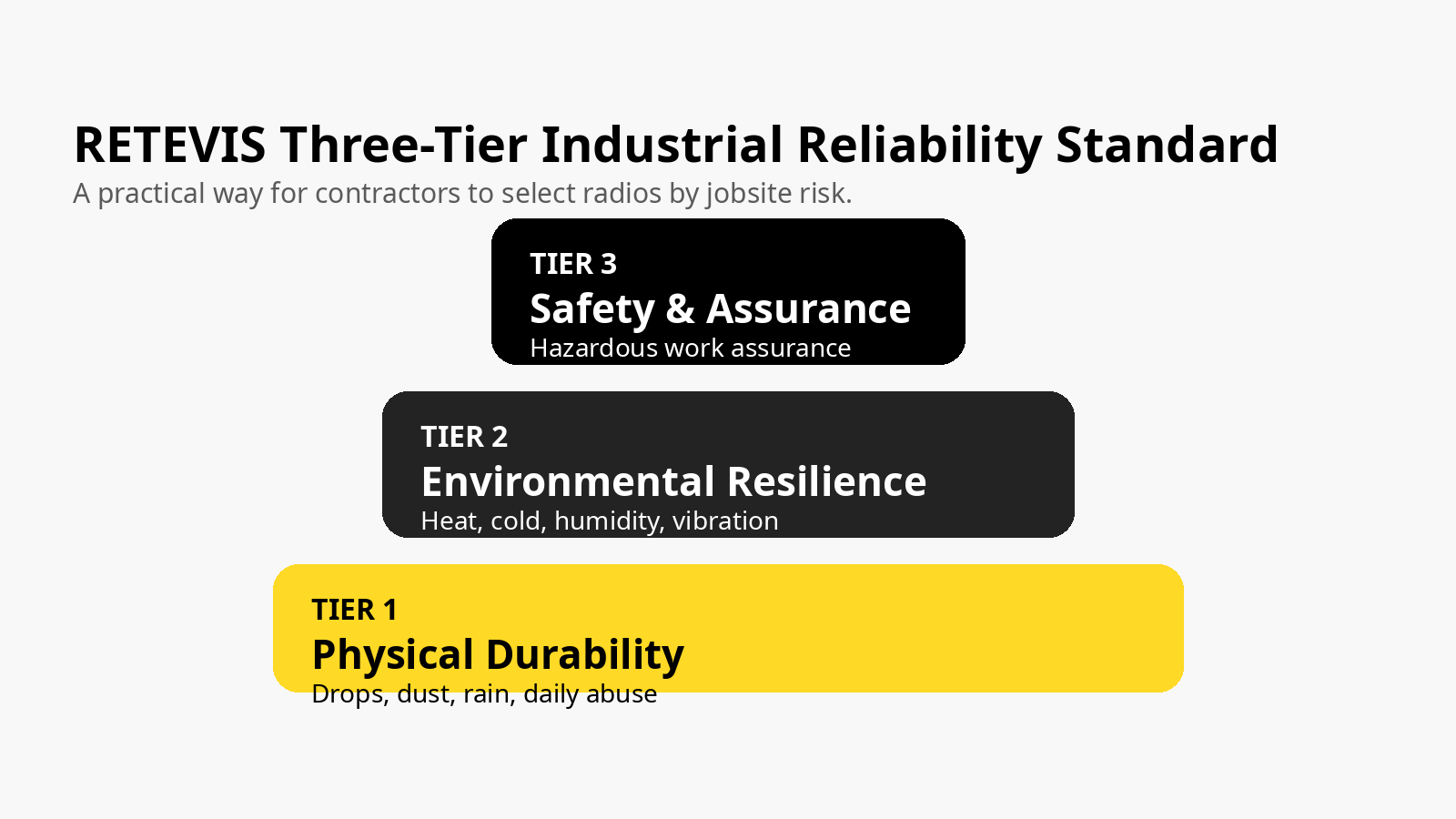
Many products are described as rugged, professional or industrial. For a contractor, those words are not enough. The more useful question is what the radio has been designed to withstand and how those conditions match the worksite. RETEVIS frames its approach around a Three-Tier Industrial Reliability Standard: Tier 1 for physical durability, Tier 2 for environmental resilience and Tier 3 for safety assurance in higher-risk industrial environments.
What MIL-STD-810H:2019 means for the RETEVIS RB48 Story
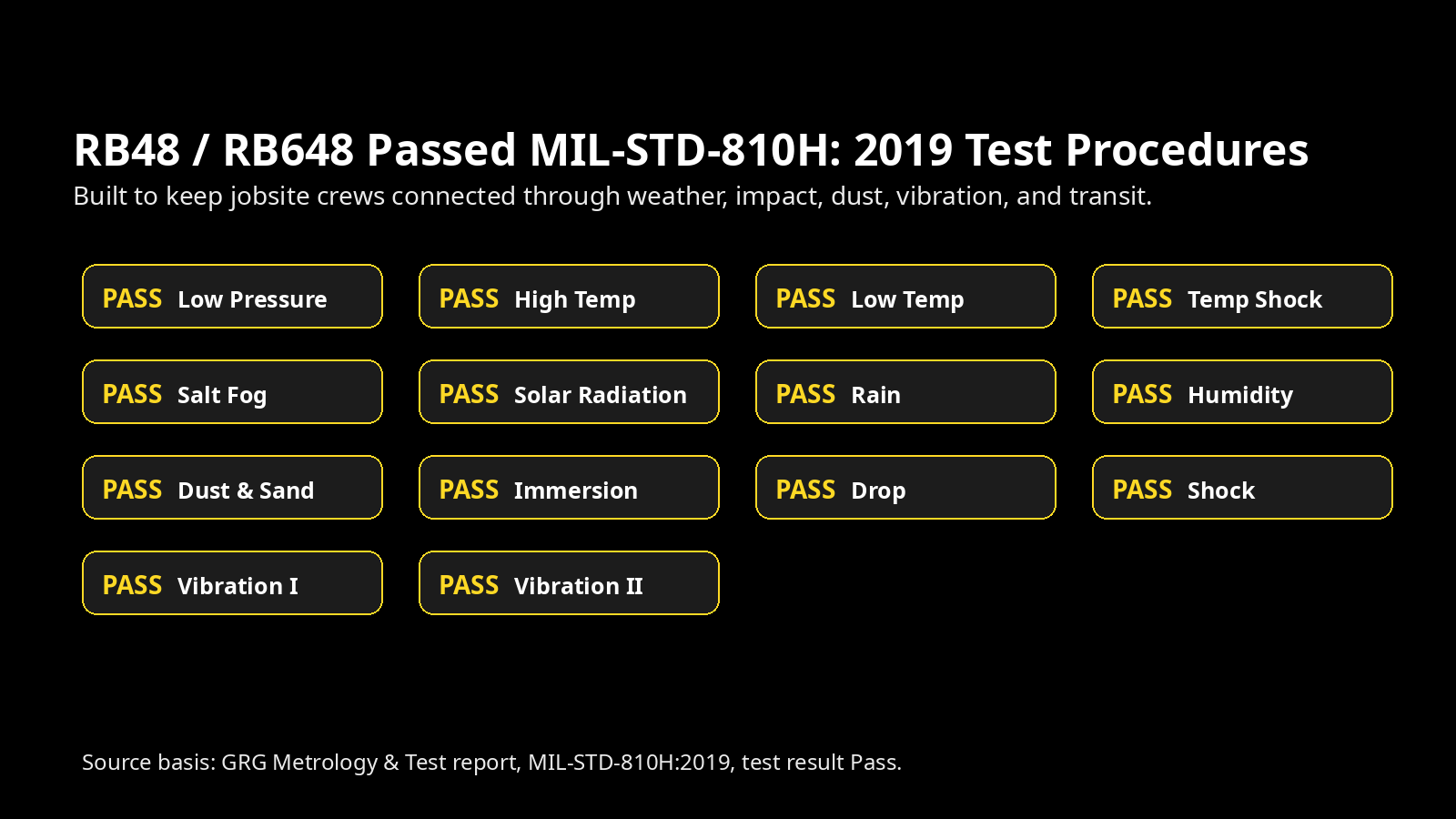
On Amazon, RETEVIS highlights RETEVIS RB48 / RETEVIS RB648 testing with reference to MIL-STD-810H:2019. The report lists a pass result and includes procedures related to low pressure, high temperature, low temperature, temperature shock, salt fog, solar radiation, rain, humidity, sand and dust, immersion, drop, shock and vibration. For the jobsite buyer, the importance is not the name of the standard alone; it is the fact that these test categories connect to real working conditions.
Why contractors should care
A construction radio may be dropped, rained on, clipped to a belt, placed on a dusty surface, used around trucks or carried between indoor and outdoor spaces all day. If that device fails, the cost is not limited to replacement. The larger cost may be lost time, repeated instructions, worker frustration and avoidable coordination gaps. A more reliable communication tool helps crews keep moving with fewer interruptions.
How to choose radios by worksite risk
A small crew working on residential or light commercial projects may need simple push-to-talk operation, water resistance, drop resistance and long battery life. A medium-size contractor may need more radios, group discipline, spare accessories and clear rules for channel use. A complex industrial project may need a structured communication plan and, in some environments, intrinsically safe solutions. The RETEVIS three-tier framework gives teams a way to map the tool to the risk instead of buying only by the lowest price.
Where RETEVIS RB48 series fits
Go to amazon, find RETEVIS RB48 series is positioned as a worksite-ready option for contractors who need durable, easy-to-use communication for daily operations. Its yellow and black visual language fits construction and industrial environments, making the product easy to identify. The model is also a useful entry point for broader communication planning, especially when paired with accessories, charging solutions and team deployment rules.
 A stronger purchasing case for construction teams
Purchasing teams often compare radios by unit price, but the lowest price can become expensive when devices break, batteries fail or supervisors need to replace equipment during a project. A reliability standard helps the buyer ask better questions before the order is placed. Does the product have testing evidence? Which jobsite hazards were considered? Can the supplier explain the link between the standard, the product and the daily work process? RETEVIS Industrial Two Way Radios use this reliability narrative to make product value easier to justify internally.
How the standard supports brand trust
For a contractor, trust is built when a supplier speaks the language of the worksite. A radio brand that only lists technical specifications may not connect with foremen, project managers or safety leaders. A brand that explains how rain, drop, dust, shock and vibration affect actual work will be easier to remember. By connecting RETEVIS RB48 / RETEVIS RB648 MIL-STD-810H:2019 test story with a three-tier reliability framework, RETEVIS can turn product proof into a stronger brand promise: reliable communication for industrial teams.
 Deployment suggestions for contractors
A contractor can use the standard as part of a practical deployment checklist. Start by mapping the crew roles that need instant communication, such as superintendent, site safety, crane signaler, logistics lead, foreman and equipment operator. Then define the environment: indoor, outdoor, dusty, wet, cold, hot, noisy or exposed to heavy vibration. Finally, match radios, batteries, chargers, earpieces and carrying accessories to the actual workflow. This makes the communication system easier to manage and reduces the chance that workers use the wrong tool for the job.
A more practical B2B message
For B2B buyers, the message is straightforward: reliable radios help protect the schedule, support safety habits and reduce avoidable downtime. RETEVIS Industrial Two Way Radios are presented as tools for real crews, not simply technical products. The goal is to connect product testing, jobsite language and purchasing logic in a way that contractors can understand quickly.
Conclusion
For contractors, the strongest communication equipment is the equipment that crews can trust without thinking about it. RETEVIS is using the Three-Tier Industrial Reliability Standard (RETEVIS Industrial Two-Way Radio Reliability Standard White Paper ) to help teams evaluate that trust in a more concrete way. RETEVIS RB48 series MIL-STD-810H:2019 testing message gives the brand a stronger proof point for construction buyers, while the broader standard gives RETEVIS a platform to build long-term reliable value perception in industrial communication. This is also a better content direction for industrial media because it gives readers something useful: a clearer way to judge rugged radios before they become part of daily work.