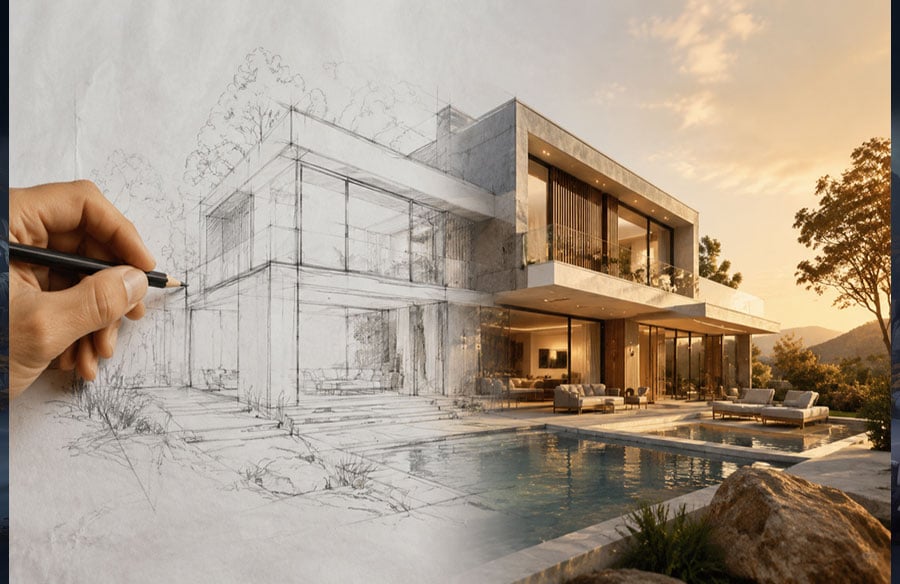
Long before a building is modeled in BIM or fully resolved on paper, it usually begins as a handful of lines — a section, a massing diagram, the rough outline of a façade. The sketch has always been architecture’s first language: the fastest way for an idea to leave a designer’s head and become something that can be discussed, argued with, and revised. What has never been fast is the next step — turning that sketch into an image clear enough for a client, a planning board, or an investor to actually react to. That gap, between a private idea and a legible image, is where artificial intelligence is now making one of its most visible entries into the discipline.
The Bottleneck Between Idea and Image
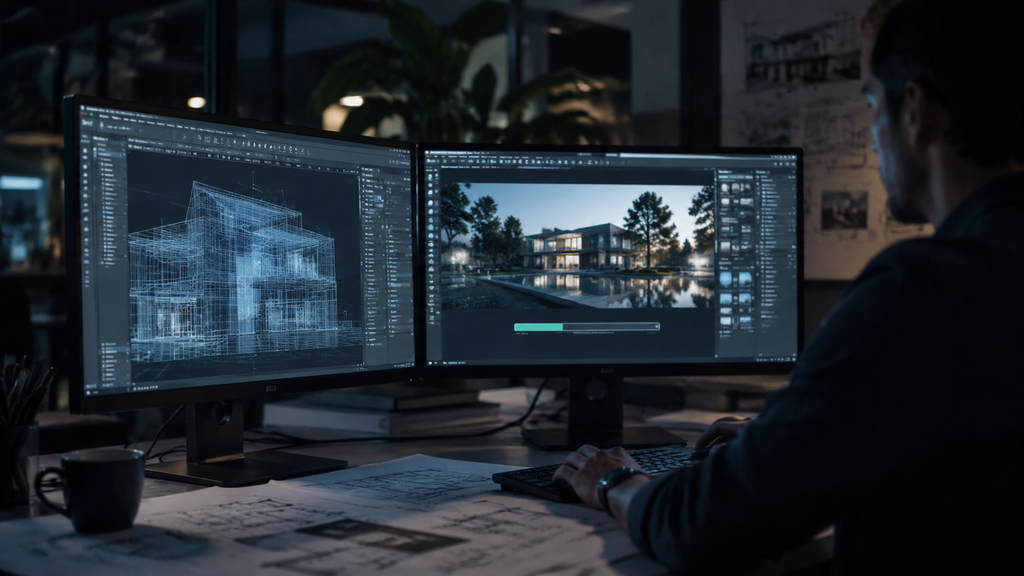
For most of the digital era, closing that gap has meant routing a sketch through a chain of specialized software. A designer — or, more often, a dedicated visualization hire — rebuilds the concept in SketchUp or Rhino, assigns materials, sets up lighting, and renders it out in an engine like V-Ray, Lumion, or Enscape. Depending on the complexity of the scene, a single polished image can take anywhere from a few hours to several days. Large practices absorb that cost as overhead, often with an in-house visualization team on staff. For solo architects, small studios, and students, it’s frequently the single biggest obstacle standing between a strong idea and a presentation that does it justice — not a lack of design ability, but a lack of time, software fluency, and rendering budget.
 Generative AI Enters the Studio, on Two Tracks
That bottleneck is what a newer generation of AI tools is built to address, and it’s happening along two fairly distinct tracks. On one track, the major rendering engines already used by architecture firms are folding generative features into their existing software — AI-assisted texture generation, automatic scene population, denoising that makes a quick preview look close to a final render. These tools still assume a 3D model exists; they simply speed up everything downstream of it.
On the other track, an entirely separate category of tools skips the 3D model altogether. Instead of requiring a full build-out in SketchUp or Rhino before any image can exist, these platforms work directly from two-dimensional input — a scanned pencil drawing, a rough digital sketch, sometimes just a floor plan — and use trained image models to infer depth, material, and light straight from the lines on the page. A handful of independent platforms have built their entire offering around this second approach: archybase.com, for instance, positions itself less as a replacement for traditional rendering software and more as a fast first pass that sits upstream of it, compressing what used to be a multi-day visualization cycle into something closer to a real-time conversation with a client.
Case in Point: From Pencil Line to Presentation-Ready Render
The clearest expression of this second track is a category of software now loosely — if a little clumsily — described as sketch to render ai: tools built specifically to read unrefined linework and return a finished render without an intermediate modeling stage. In practice, the audience for this kind of tool tends to split three ways. Architecture students use it to turn assignment sketches into portfolio-ready visuals without learning a separate rendering pipeline on top of design coursework. Small and mid-sized firms use it to produce client-facing imagery early in a project, while ideas are still being tested and a full BIM model would be premature. And real estate developers — arguably the most time-pressured users of the three — use it to generate pre-sale marketing visuals for buildings that exist only as drawings, shortening the distance between a concept sketch and something that can be sold off-plan.
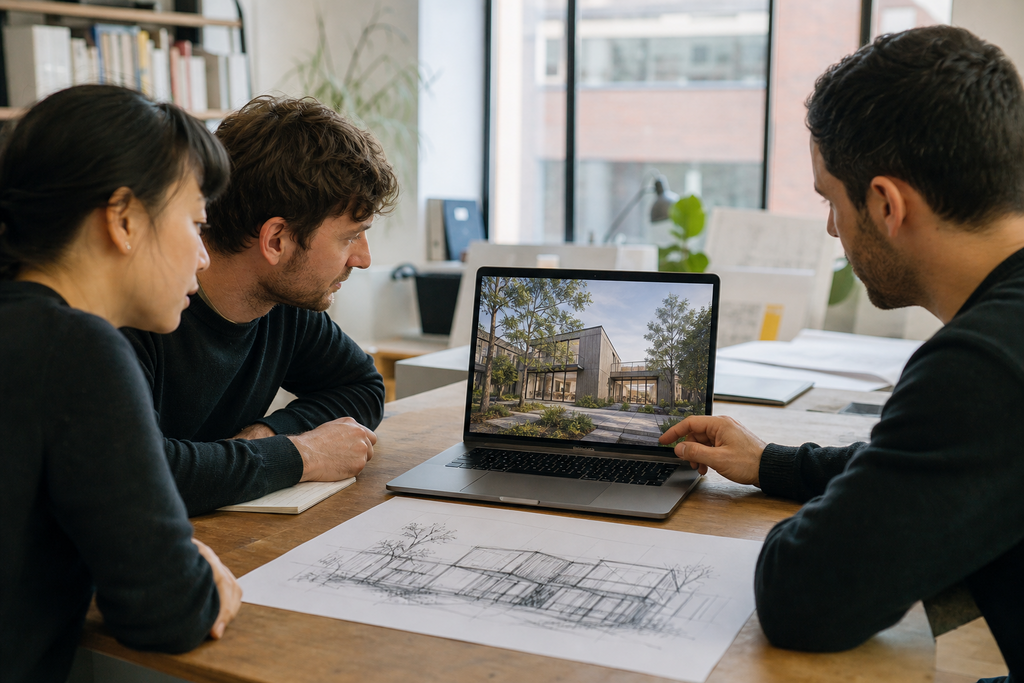 Mechanically, the process is fairly consistent across tools in this category: the software identifies structural lines, openings, and proportions in the sketch, then layers in materials, vegetation, and atmosphere according to a style the user selects — modern, classical, minimalist, or otherwise — while preserving the original geometry rather than reinterpreting it. Floor plans can go through a similar process to generate interior visualizations, so a single hand drawing can, in principle, produce both an exterior render and a furnished interior view without being redrawn.
What Speed Actually Changes
It’s tempting to read all of this purely as a productivity story, but the more interesting shift may be in who gets to compete on presentation quality. Visualization has historically tracked firm size and budget: larger practices could afford in-house rendering specialists or outsourced studios that smaller ones simply couldn’t justify. By collapsing the cost and time of a first-pass render to almost nothing, AI-assisted tools narrow that gap — at least at the concept stage. A one-person studio can now walk into an early client meeting with imagery that looks comparable to what a much larger firm would produce, even while the underlying design is still being worked out.
Not everyone in the profession is comfortable with that. Critics point out that a generated render can flatter an idea that hasn’t been properly resolved, and that anchoring an early client conversation around an AI-polished image risks setting expectations a design can’t keep as it develops through more rigorous stages. Proponents respond that this was always a risk with traditional renders too — just a slower, more expensive version of the same risk. What both sides tend to agree on is that the image was never the design; it’s still the architect’s job to make sure the building behind the picture can actually be built the way it looks.
Where This Settles
It seems unlikely that AI-generated visualization will replace the traditional modeling-and-rendering pipeline outright, particularly for construction documentation and the kind of detailed coordination a project eventually requires. But for the narrower, earlier job — turning an idea into something a non-architect can respond to, in a meeting rather than a week later — it is rapidly becoming close to standard practice. The firms most likely to benefit aren’t necessarily the ones chasing the most advanced render engine on the market; they’re the ones treating these tools for what they are: a faster way to have the same conversation that sketching itself was always meant to start.