The Australian workplace is entering a period of fundamental change.
Hybrid work has already challenged the assumption that every employee needs a permanent desk. Artificial intelligence is changing how knowledge work is performed. Sustainability expectations are influencing how buildings are designed, fitted out and operated. At the same time, employers are paying greater attention to wellbeing, accessibility and the quality of the employee experience.
By 2030, these forces are likely to produce workplaces that look—and function—quite differently from the traditional corporate office.
The question for architects, interior designers and business leaders is therefore no longer simply how to design a better office.
It is how to create a workplace capable of adapting to continuous change.
For Australia, this presents particular opportunities. Major employment centres such as Melbourne, Sydney, Brisbane and Perth are already experimenting with hybrid work, flexible space and increasingly sophisticated commercial interiors. The next stage will involve bringing these ideas together into workplaces that are adaptable, sustainable and designed around people.
Here are some of the principles likely to define the Australian workplace of 2030.
1. The Office Will Become a Destination Rather Than a Default
For much of the twentieth century, the purpose of the office was straightforward: it was where work happened.
Digital technology has broken that relationship.
Many forms of individual knowledge work can now be completed from home, coworking spaces or almost anywhere with a reliable internet connection. This means the physical office must offer something employees cannot easily replicate elsewhere.
By 2030, successful workplaces are likely to place greater emphasis on experiences that benefit from people being together.
These could include collaborative project spaces, mentoring areas, client presentation environments, social spaces, training rooms and technology-enabled meeting zones.
The office does not disappear under this model. Its purpose becomes more deliberate.
Rather than accommodating the maximum number of people at identical workstations, designers can ask a more useful question:
What activities are people actually coming here to perform?
That question changes almost every subsequent design decision.
2. Space Planning Will Become More Adaptive
Traditional workplace planning was often based on relatively predictable headcounts and fixed departmental structures.
The workplace of 2030 will need considerably more flexibility.
Project teams form and dissolve. Organisations expand and contract. Hybrid attendance changes throughout the week. Technology changes the type of work employees perform.
Commercial interiors therefore need to accommodate change without requiring a major refurbishment every time the organisation evolves.
This is already influencing commercial workplace design, with greater consideration being given to modular furniture, reconfigurable meeting spaces, movable partitions and adaptable workstation layouts.
The principle is straightforward: the less permanently a space is tied to one activity, the easier it becomes to respond to future requirements.
A large meeting room, for example, might be capable of dividing into smaller collaboration areas. A project zone could transition between training, workshops and temporary team use. Furniture systems could be reconfigured as departments grow or contract.
By 2030, adaptability is likely to become a fundamental measure of good workplace design rather than an optional feature.
3. Artificial Intelligence Will Change What Offices Need to Support
Much of the discussion around artificial intelligence focuses on jobs and productivity. Its physical implications for workplace design receive less attention.
Yet they could be substantial.
As AI takes over more repetitive administrative and analytical tasks, many employees may spend a greater proportion of their time on activities requiring judgement, creativity, communication and collaboration.
Those activities demand different environments.
Instead of rows of desks optimised for individual computer work, future workplaces may require a broader mix of project rooms, focus areas, creative spaces and technology-rich collaboration zones.
AI may also influence the operation of the workplace itself.
Building systems can increasingly use occupancy and environmental data to help manage lighting, temperature, energy consumption and space utilisation. Booking systems can help organisations understand which environments are actually being used rather than relying solely on assumptions about employee behaviour.
The result could be workplaces that become increasingly responsive to the people occupying them.
4. Workplace Data Will Influence Design Decisions
One of the most significant changes by 2030 may be the way organisations decide how much space they actually require.
Historically, office planning often relied on headcount multiplied by an allocation of space per employee.
Hybrid work makes this calculation far less reliable.
A business with 300 employees may rarely have 300 people in the office simultaneously. Conversely, certain days or events may create periods of intense demand for meeting and collaborative space.
Occupancy sensors, booking data and workplace analytics can provide designers with a clearer understanding of these patterns.
This creates the possibility of evidence-based workplace planning.
Instead of simply asking employees what they want, organisations can combine consultation with information about how spaces are actually being used.
Are large meeting rooms consistently occupied by two people?
Are collaboration areas full while traditional workstations remain vacant?
Are certain departments regularly unable to find appropriate meeting space?
These patterns can inform future design decisions and help organisations make more effective use of valuable commercial floor space.
5. Sustainability Will Move Beyond Material Selection
Sustainable design is sometimes reduced to choosing recycled materials or energy-efficient lighting.
By 2030, expectations are likely to be considerably broader.
Australia’s commercial property sector already operates within an environment shaped by initiatives and frameworks such as NABERS and Green Star. As organisations pursue more ambitious environmental targets, interior fit-outs will increasingly form part of the sustainability conversation.
One of the most important principles will be longevity.
A workplace that requires substantial demolition and reconstruction every few years carries an environmental cost regardless of how sustainable individual materials appear.
Designing for disassembly, reuse and reconfiguration can therefore become increasingly important.
Modular joinery, replaceable components and adaptable furniture can extend the useful life of an interior while reducing unnecessary waste.
Material provenance is also likely to receive greater scrutiny. Designers and clients may increasingly consider where materials originate, how they are manufactured, whether they contain problematic substances and what happens to them at the end of their useful life.
The sustainable workplace of 2030 will not simply use greener materials.
It will be designed to avoid unnecessary replacement in the first place.
6. Wellbeing Will Be Embedded Into the Floor Plan
Workplace wellbeing cannot be solved by adding plants to an otherwise poorly functioning office.
The physical environment influences employees continuously through lighting, acoustics, temperature, movement, privacy and ergonomics.
By 2030, these factors are likely to become increasingly integrated into workplace planning from the beginning of a project.
Access to natural light can influence where workstations and communal spaces are positioned. Acoustic planning can separate concentrated work from active collaboration. Sit-stand settings and alternative work areas can encourage movement throughout the day.
The growing focus on psychosocial health also adds another dimension.
A workplace can be visually impressive while still creating stress if employees have nowhere to concentrate, hold a confidential conversation or withdraw temporarily from a busy environment.
Designing for wellbeing therefore requires variety.
Some employees need interaction. Others need periods of quiet concentration. Most need both at different points during the day.
The workplace of 2030 will need to accommodate this spectrum rather than assuming one environment suits everyone.
7. Inclusion Will Influence More Design Decisions
Accessibility has traditionally been associated primarily with physical access and regulatory compliance.
Future workplace design is likely to take a broader view of inclusion.
Employees differ in mobility, sensory needs, age, height, working style and neurological preferences. Designing workplaces around an assumed “average” user inevitably creates environments that work better for some people than others.
Inclusive workplaces can provide greater choice.
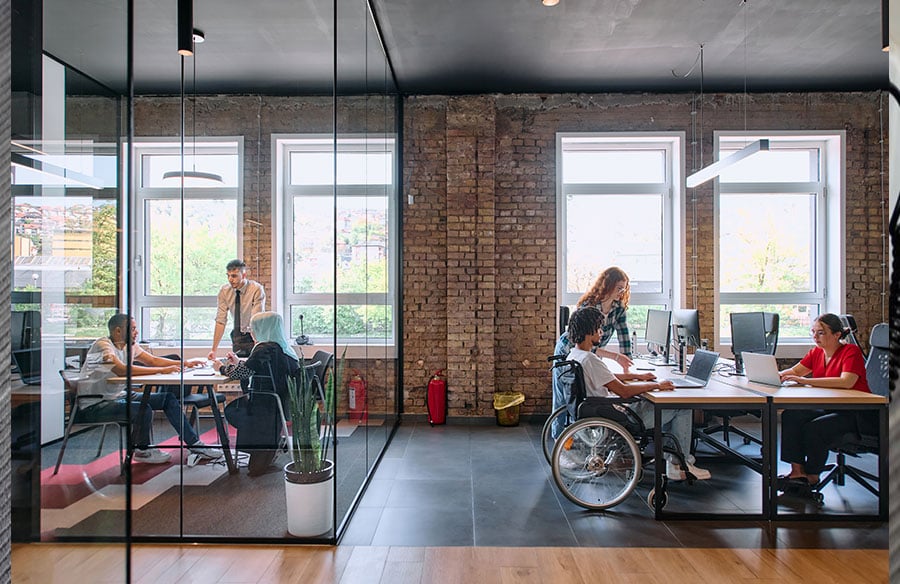
Height-adjustable work surfaces, accessible circulation, varied seating, controllable lighting and spaces with different levels of sensory stimulation can allow more people to work comfortably.
Technology will also play an important role. Hybrid meeting environments, captioning, assistive technologies and improved audiovisual systems can help ensure remote and in-person participants can contribute more equally.
By 2030, universal and inclusive design principles are likely to become increasingly intertwined with mainstream workplace design.
8. Acoustics Will Become a Core Architectural Consideration
The rise of open-plan offices exposed one of the persistent weaknesses of workplace design: sound.
Hybrid work has made the issue even more complex.
Employees may spend part of their day collaborating face-to-face and another part participating in video meetings. Without appropriate acoustic planning, these activities compete with one another.
Future workplaces will need multiple acoustic conditions.
Focus areas may require high levels of sound control, while collaboration spaces need to support conversation without allowing noise to dominate adjacent areas. Meeting rooms need privacy as well as acoustic performance suitable for video conferencing.
Ceiling treatments, wall panels, screens, soft furnishings and spatial zoning can all contribute.
The important change is when these decisions occur.
Acoustics should not be treated as a problem to solve after employees move in. By 2030, it should be considered alongside circulation, lighting and furniture from the earliest stages of design.
9. Technology Will Become Less Visible
The most technologically advanced workplace may eventually be the one in which technology is least noticeable.
Cables, adapters and improvised video conferencing arrangements interrupt both functionality and aesthetics.
As workplace technology matures, integration should become increasingly seamless.
Meeting rooms may automatically recognise users and connect them to scheduled meetings. Workstations could provide universal connectivity and charging. Environmental controls may respond automatically to occupancy.
The design challenge will be incorporating these capabilities without allowing technology to dominate the architecture.
This also requires planning for replacement.
Technology changes much faster than buildings. A workplace designed around proprietary equipment that cannot easily be upgraded risks becoming obsolete long before the rest of the interior.
Future-ready workplaces will therefore require infrastructure that allows technology to evolve independently of major architectural elements.
10. Australian Workplaces Will Need to Respond to Place
There is unlikely to be a single global template for the workplace of 2030.
Australian workplaces operate within distinct climatic, cultural and urban conditions.
Natural light, outdoor connections and biophilic design can be particularly valuable where buildings and climate permit. Material choices can draw from local context rather than reproducing international design trends without adaptation.
There is also considerable variation between Australian cities.
A professional-services office in Melbourne’s city centre may have different requirements from a technology workplace in Brisbane, a resources business in Perth or a regional government facility.
The strongest future workplaces will therefore respond to both organisational culture and location.
Designing for place gives workplaces identity—something that becomes increasingly valuable when employees have greater freedom over where they work.
Designing for Change, Not Predicting It
No designer can know exactly what the Australian workplace will look like in 2030.
Technology will change. Businesses will restructure. Employee expectations will evolve, and new ways of working will emerge.
That uncertainty should not be viewed as a design problem.
It should become a design principle.
The most resilient workplaces will not be those built around a precise prediction of the future. They will be environments capable of responding when that prediction proves wrong.
This is where an integrated design and fit-out approach becomes particularly valuable. Space planning, furniture, technology, acoustics, lighting and building services need to work together rather than being considered as isolated elements.
The Australian workplace of 2030 is therefore unlikely to be defined by one aesthetic, one technology or one furniture trend.
It will be defined by adaptability.
The best workplaces will give people reasons to come together while providing choice when they do. They will use technology without being controlled by it. They will consider environmental performance across the entire lifecycle of an interior. And they will recognise that commercial spaces ultimately exist to support the people and organisations using them.
The future office is not simply a better version of the office we already know.
It is an environment designed to keep changing.