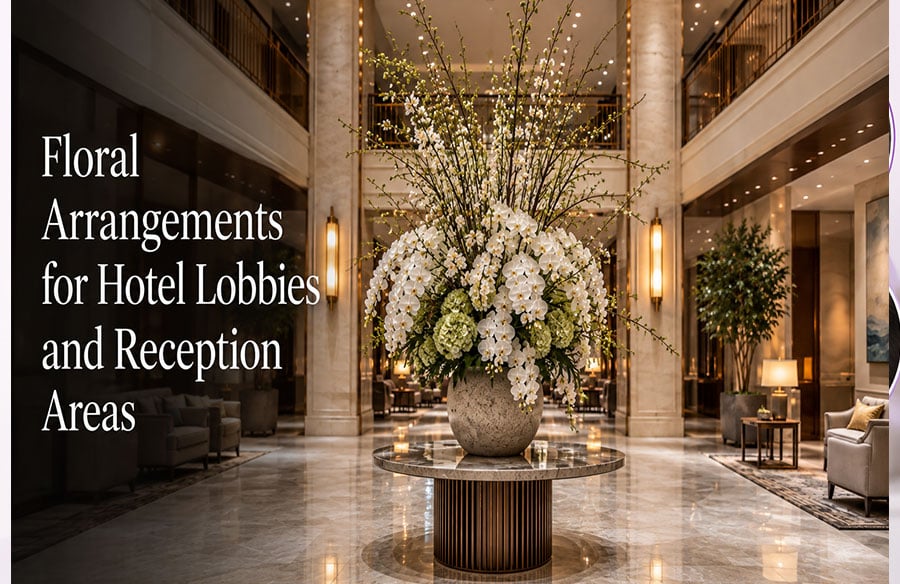
A tall central piece sized to read from the entrance of a double-height lobby.
Floral arrangements for hotel lobbies and corporate reception areas succeed or fail on five architectural variables: scale, color, placement, light, and maintenance. In practice, that means a piece at least 1.5 times the height of its vessel, a 36-inch (915 mm) clear route around it, and a room kept at 65°F to 72°F (18°C to 22°C).
Getting those right takes the same thinking an architect brings to any other element in the room. The rules also differ between a hotel lobby that never closes and a reception that follows the working week, and that difference shapes everything from arrangement size to delivery day.
The Role Of Floral Design In Arrival Spaces
Floral design in arrival spaces shapes a visitor’s first impression within seconds of walking in. People read a room almost as soon as they enter it, a theme central to the psychology of space. Flowers soften stone, glass, and polished concrete, and they tell visitors that someone looks after the place. As hotel lobby architecture turns the lobby into a social hub where guests work, meet, and wait, flowers also help mark the zones that invite people to linger.
Research supports this. In the Human Spaces report (Interface, 2015), a survey of 7,600 office workers across 16 countries carried out with organizational psychologist Professor Sir Cary Cooper, people whose workplaces included natural elements such as greenery and sunlight reported 15% higher well-being, 6% higher productivity, and 15% higher creativity. The report is widely cited in discussions of biophilic design. Fresh flowers add something potted plants can’t: they change with the seasons.
Scale And Proportion: Matching Lobby Arrangements To Room Volume
Vertical branches carry the arrangement’s line up toward the lobby’s full height.
An arrangement has to hold its own against the architecture around it, so scale comes first. Put a small tabletop piece in a double-height lobby and it vanishes; put a tall floor-standing installation in a compact reception with a standard ceiling and it crowds the room.
A useful starting point is the traditional Japanese rule that an arrangement should stand at least 1.5 times the height of its container, which Encyclopaedia Britannica calls a generally accepted application of the principle of proportion. In a double-height lobby, that usually means a tall central piece on a round table, sized to read clearly from the entrance. Reception counters need the opposite. Keep the arrangement low and off to one side so staff and visitors can still make eye contact.
Width matters too. Long reception counters and low, linear interiors suit wide horizontal compositions. Tall columns and atria call for vertical lines: branches, delphinium, heliconia. When the arrangement’s main line follows the room’s main line, the two read as one design.
Color, Material Palette, And Brand Identity
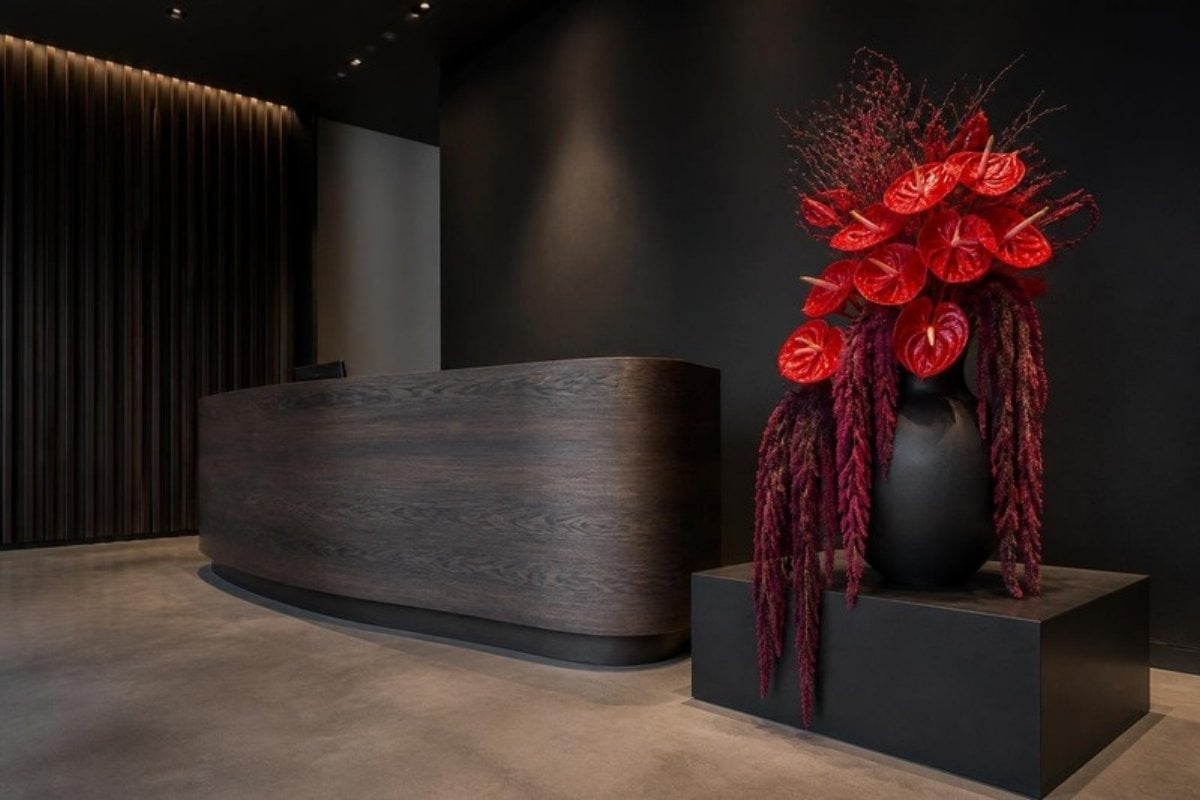 A contrast scheme: one saturated color against dark finishes becomes the focal point.
Color ties an arrangement to the interior’s material palette and to the brand behind it. Start with the finishes already in the room, such as timber, marble, brass, or upholstery, then decide whether the flowers should blend in or stand out on purpose.
Tonal schemes suit minimalist hotel lobbies with pale stone and neutral upholstery, where white phalaenopsis orchids, cream roses, and green hydrangea sit quietly against the surfaces. Contrast works the other way. Red anthurium or amaranthus in a black vessel against a charcoal wall becomes the focal point of the room. A brand-led scheme, common in corporate reception areas, picks stems in the corporate color, such as blue delphinium, yellow oncidium orchids, or orange leucadendron, so the identity shows up without another sign on the wall.
The vessel is part of the palette too. Matte ceramic, smoked glass, patinated bronze, and carved stone each have their own character, and the right one picks up something from the furniture or finishes nearby.
Placement, Sightlines, And Circulation Around Reception Desks
Placement decides whether an arrangement guides visitors or gets in their way. The strongest spot is usually on the main sightline from the entrance. There, the piece works as a visual terminus and pulls people into the space. At a corporate reception, set the arrangement beside the desk rather than on the counter where visitors sign in, show ID, or collect passes.
Floor-standing pieces also have to leave circulation routes clear. The 2010 ADA Standards for Accessible Design set a minimum clear width of 36 inches (915 mm) for walking surfaces on an accessible route, narrowing to 32 inches (815 mm) only for stretches no longer than 24 inches (610 mm). Spots beside elevators, revolving doors, and security gates turn into pinch points quickly, so keep flowers out of them.
Smaller arrangements carry the same design language through the building. A hotel might pair one lobby centerpiece with pieces at the concierge desk, the elevator lobby, and the guest restrooms. Repeat two or three key stems across all of them, and the scheme reads as one from the entrance to the upper floors.
Light, Climate, And Flower Selection
How long an arrangement lasts depends on the room, so choosing flowers starts with light and climate. Most fresh-cut flowers prefer cool rooms of 65°F to 72°F (18°C to 22°C), away from radiators, heating registers, and full sun, according to University of Illinois Extension.
Light changes how the flowers look. The warm white light common in hotel lobbies flatters reds, oranges, and creams. Cooler office light dulls those warm tones and suits whites, blues, and greens better. Fixtures with a high color rendering index (CRI) show petals closer to how they look in daylight.
In busy spaces, long-lasting stems mean fewer replacements. Published vase-life figures include:
- Phalaenopsis and Cattleya orchids: 1 to 4 weeks, according to a postharvest review from India’s National Research Centre for Orchids
- Aranda orchids: 18 to 28 days, from the same review
- Anthurium: up to 3 weeks when properly treated
- Hydrangea: in one trial on Hydrangea macrophylla, 150 mg/L thymol plus 1% sucrose raised vase life from 10.7 days in distilled water to 16.5 days
Local climate narrows the list further. In humid tropical cities such as Miami, Mumbai, and Singapore, heat and humidity last most of the year. Florists in Miami lean on tropical stems such as orchids, anthurium, heliconia, and monstera leaves, which hold up far better in those conditions than tulips or peonies.
Go easy on scent. Lilies, tuberose, and hyacinth can overpower an enclosed reception and bother visitors who are sensitive to fragrance. Lightly scented or scentless varieties are the safer choice for shared space. Pollen needs the same care. Florists usually remove lily anthers before installation, because the pollen stains upholstery, stone, and clothing.
Hotel Lobbies Versus Corporate Reception Areas
A compact piece at the end of the counter keeps eye contact clear across reception.
Hotel lobbies and corporate reception areas both welcome visitors, but a hotel lobby runs around the clock while a corporate reception follows the working week.
Hotel Lobbies: Round-The-Clock, Seasonal Statements
A hotel lobby never closes. Guests linger, take photos, and pass through several times a day during their stay. In hotel design, the lobby is where a property makes its first case to guests, so lobby arrangements tend to go big and seasonal, with a signature style that becomes part of the hotel’s identity. At the Four Seasons Hotel George V in Paris, artistic director Jeff Leatham has built that identity around large, bold lobby installations since 1999. Many luxury hotels refresh their arrangements on a fixed cycle and change the concept for occasions such as Diwali, Christmas, and Lunar New Year.
Corporate Reception Areas: Weekly, Brand-Led Pieces
A corporate reception follows the working week. Visitors usually wait only a few minutes, so the arrangement has to read quickly, match the brand, and need little care. A Monday delivery keeps flowers fresh through five working days, and no stems sit wilting in an empty office over the weekend. Offices often add arrangements to boardrooms and executive suites as well. People sit close to those, so lower, compact designs work better.
Maintenance, Rotation, And Sustainability
Maintenance decides how long an arrangement keeps looking intentional. University of Illinois Extension advises replacing the water every 2 to 3 days and recutting the stems when you do. Cloudy water means bacteria are growing, so change it straight away. Skip these steps, and a tired arrangement soon looks worse than an empty table.
Rotation is a trade-off between freshness and cost. Weekly replacement suits most hotel lobbies, while a corporate reception can tie its cycle to the Monday delivery. Orchid and anthurium designs last long enough to stretch either cycle. Some properties use preserved or high-quality artificial stems in spots that are hard to reach or service, such as high niches and atrium ledges, and keep fresh flowers at eye level, where guests notice the difference.
Sustainability is part of the brief now. Floral foam breaks down into microplastics, and in an RMIT University study, all six aquatic invertebrate species tested ate them. Many designers have dropped single-use foam for chicken wire, metal pin frogs (kenzans), and reusable grids. Seasonal, locally grown stems cut air-freight emissions, and composting spent flowers keeps them out of landfills.
Working With A Commercial Florist
A commercial florist turns the interior designer’s intent into a living installation that gets rebuilt on a schedule. The best collaborations start during interior design, while plinths, water access, lighting, and vessel sizes can still be planned around the flowers.
A useful floral brief covers five points:
- Space data: Ceiling height, floor area, finishes, and lighting color temperature.
- Brand guidelines: Logo colors, tone of voice, and seasonal campaigns.
- Placement plan: Primary and secondary locations marked on a floor plan.
- Schedule: Delivery day, rotation cycle, and event dates.
- Budget: Weekly or monthly allocation per arrangement.
Many florists package the whole cycle as a single service. Neroli Blume’s corporate flower arrangements for offices, lobbies, and events, for instance, cover consultation, delivery, on-site setup, and strike, so the facilities team never has to handle stems.
Floral Design As Part Of The Spatial Narrative
Treated as architecture rather than décor, lobby and reception florals follow the same logic as any fixed element in the room. They are sized to the volume, colored from the material palette, placed with circulation in mind, and chosen to suit the light and climate. Add a realistic maintenance plan and foam-free mechanics, and floral arrangements in hotel lobbies and corporate reception areas look as good in week six as they did on installation day.