Yes, a suitable portable power station can operate corded tools or recharge cordless-tool batteries. For corded equipment, it must handle both the working load and the brief demand at startup. For cordless equipment, the relevant load is the battery charger connected to the station.
That difference can change the size of the unit you need. Repairing a cottage deck with cordless tools is a different electrical task from running a corded saw and dust extractor together. Before choosing a battery size, work out what the power station will actually be supplying.
Thoughtful planning for such repairs ensures the longevity of a home’s architectural elements. For remote or off-grid properties, the ability to power tools independently can be a critical factor in maintaining structural integrity and aesthetic quality, reducing reliance on fixed infrastructure.
Charging Tool Batteries Is a Different Job
When a cordless drill runs from its own battery, its motor does not draw power directly from the portable power station. The station supplies the charger that replenishes the battery between uses.
Check the charger’s AC input requirements. A small single-battery charger and a fast multi-battery charger can place very different demands on the supply.
For an energy estimate, use the battery pack’s watt-hour rating where available. If the pack is labelled with nominal voltage and amp-hours, multiplying them gives nominal stored energy.
For example, an 18V, 5Ah battery stores about 90Wh. Recharging it from empty takes more than 90Wh from the unit because the charging process has losses. Use nominal voltage, rather than a higher “maximum voltage” marketing label, when making this calculation.
This approach is useful when planning several battery charges during a job. It is more meaningful than sizing the device around the cordless tool’s motor output.
If you already have enough charged tool batteries to finish a short repair, carrying a larger power source may add little. It becomes more useful when you need repeated charging, lighting, or other equipment at the same location.
A Corded Tool Must Work Under Load
Getting a saw blade spinning is only the first test. The motor’s electrical demand changes when the blade enters material, and a compressor has to restart throughout the job.
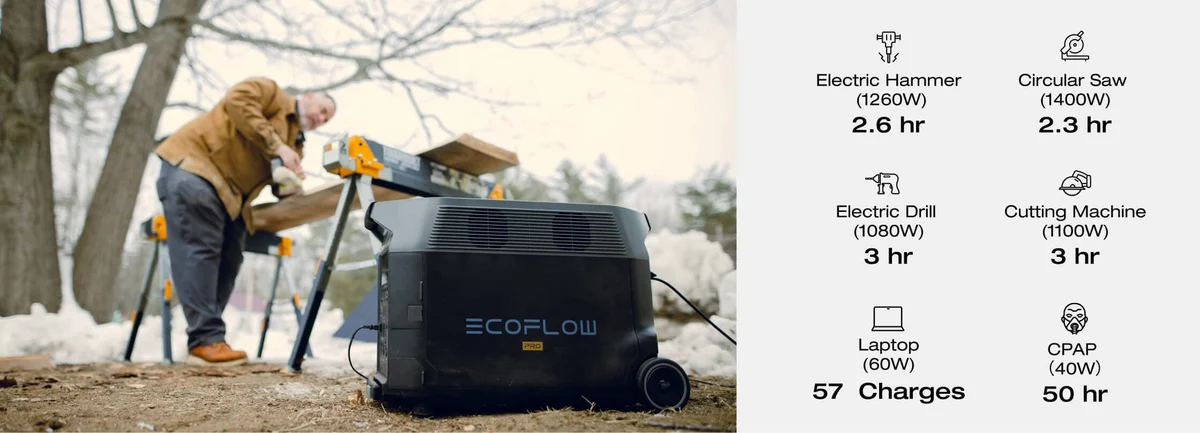
A power station needs adequate continuous output and appropriate short-duration overload capability. A published surge figure is helpful, but its duration and the tool’s starting behaviour matter too. There is no single startup multiplier that accurately covers every drill, saw, and compressor.
Use the tool’s input rating and manufacturer guidance before relying on a general wattage chart.
Where a label gives only volts and amps, their product describes apparent power in volt-amperes. It is not necessarily the tool’s actual wattage, because power factor also matters. Both current demand and motor startup remain relevant to inverter compatibility.
For ordinary Canadian 120V tools, confirm the power station provides the required voltage and frequency. A standard 120V outlet cannot supply a workshop machine that requires 240V.
When assessing a power station, compare its normal AC output with the tool requirements before considering capacity. An extra battery can extend operation, but it does not automatically make the inverter capable of starting a larger motor.
 Include the Equipment That Runs Alongside the Tool
A saw may not be the only load during a cut. Dust extraction, lighting, and battery chargers can remain on at the same time.
Consider this hypothetical setup:
| Equipment operating together | Assumed demand |
| Corded saw while cutting | 1,300W |
| Dust extractor | 800W |
| Battery charger | 120W |
| Work light | 20W |
| Combined working load | 2,240W |
The unit must support that combined working demand, plus the relevant starting behaviour. A unit that can operate the saw alone may not support the actual work setup.
Multiple outlets generally share the station’s overall output limit. Adding a power bar creates more places to plug in; it does not create more available power.
If dust extraction is necessary for the work, include it when sizing the supply. Leaving it out of the calculation produces a setup that does not support the job as intended.
Estimate Energy from Working Time
A four-hour project rarely means a saw runs continuously for four hours. Measuring, positioning, fastening, and changing materials take time without drawing the saw’s full working power.
Use actual operating time for each load. The following is an illustrative job estimate using assumed average power while each device is active:
| Equipment | Operating time | Estimated energy |
| Saw averaging 1,300W | 12 minutes total | 260Wh |
| Sander averaging 300W | 40 minutes | 200Wh |
| Charger averaging 120W | 1.5 hours | 180Wh |
| Work light drawing 20W | 4 hours | 80Wh |
| Total delivered to equipment | 720Wh |
This is the energy the equipment receives. The unit must also cover conversion losses and its own consumption, with enough reserve for the work taking longer than planned.
A nominal 720Wh battery therefore would not satisfy this example. Compare the requirement with usable AC energy under a similar load, where reliable measurements are available, rather than assuming the full labelled battery capacity reaches the tools.
The pattern of work matters as much as the project’s duration. A few short cuts can demand substantial power but relatively little energy. Sanding for long periods may have a lower power demand while consuming a larger share of the battery.
If you add a dust extractor to this example, include its operating energy as well as its contribution to the simultaneous load.
Test the Work Setup Before Taking It Away
A useful trial reproduces the work you intend to do. Run the tool through a representative operation with the necessary accessories connected, following the tool manufacturer’s instructions.
A successful no-load start does not demonstrate that the station can support repeated cuts, sustained sanding, or compressor restarts.
Watch for overload indications, abnormal tool behaviour, and unexpected shutdowns. Stop and address those conditions rather than repeatedly restarting an incompatible combination. The unit’s display can help show sustained demand, although it may not capture a very brief starting peak.
The physical setup also matters. Use extension cords rated for the tool’s current and the required length; excessive voltage drop can impair operation. Keep the station clear of concentrated sawdust, protect it from rain and snow, and leave its cooling vents unobstructed.
For work at an unheated cottage, check both operating and charging temperature limits before assuming the unit can be recharged where it is being used.
These considerations extend to the design of temporary workspaces and the selection of materials for resilience. Ensuring equipment functions optimally in varied conditions, from a drafty workshop to an outdoor installation, directly impacts the quality and safety of construction and renovation projects.
Choose for the Work You Need to Finish
Portable power works especially well when the job has a clear endpoint: a repair, a series of cuts, or several tool-battery charges away from an outlet.
Choose the output capability around the hardest operation and its accompanying equipment. Choose the capacity around the amount of work between recharges. That gives you a more useful answer than buying the largest battery you can carry.