Basement moisture is common in older properties, multifamily buildings, and homes where drainage around the foundation is no longer working properly. Small signs such as damp walls, musty smells, peeling paint, or water stains can point to a larger moisture problem. Basement waterproofing in the Bronx may be necessary when water repeatedly enters through foundation walls, floors, cracks, or joints. However, not every wet basement needs the same solution. In some cases, improving grading, downspouts, drainage, or a sump pump may solve the problem. The right approach starts with identifying where the water is coming from and whether the issue is drainage, seepage, groundwater, or a combination of problems.
Basement Waterproofing in the Bronx
If your Bronx basement has recurring water stains, damp foundation walls, musty odors, peeling paint, efflorescence, standing water, or visible cracks, it may need professional waterproofing or drainage work. Water can enter basements through foundation walls, floor slabs, wall-floor joints, plumbing problems, or poor exterior drainage. The appropriate solution depends on the source. Simple issues may involve redirecting downspouts or correcting grading, while persistent foundation seepage may require interior drainage, exterior waterproofing, a sump pump, or a combination of measures. EPA guidance recommends inspecting drainage, foundation cracks, water stains, seepage, and sump systems regularly, particularly after heavy rain or snowmelt.
Why Do Bronx Basements Get Wet?
A basement can become damp for several different reasons. Waterproofing is only one possible solution.
Common causes include:
- Poor grading around the foundation
- Downspouts discharging too close to the building
- Clogged or damaged drainage systems
- Groundwater entering through foundation walls
- Hydrostatic pressure against below-grade walls
- Cracks in concrete or masonry
- Water entering through wall-floor joints
- Failed or aging exterior waterproofing
- Plumbing leaks
- Condensation
- Poorly maintained sump pumps
- Heavy rain or rapid snowmelt
EPA guidance identifies rainwater, snowmelt, groundwater, plumbing leaks, condensation, and poor drainage as potential sources of foundation moisture. It also recommends checking the exterior landscape, roof drainage, foundation cracks, sump systems, water stains, efflorescence, mold growth, and musty odors.
That means a contractor should diagnose the moisture source before recommending a full waterproofing system.
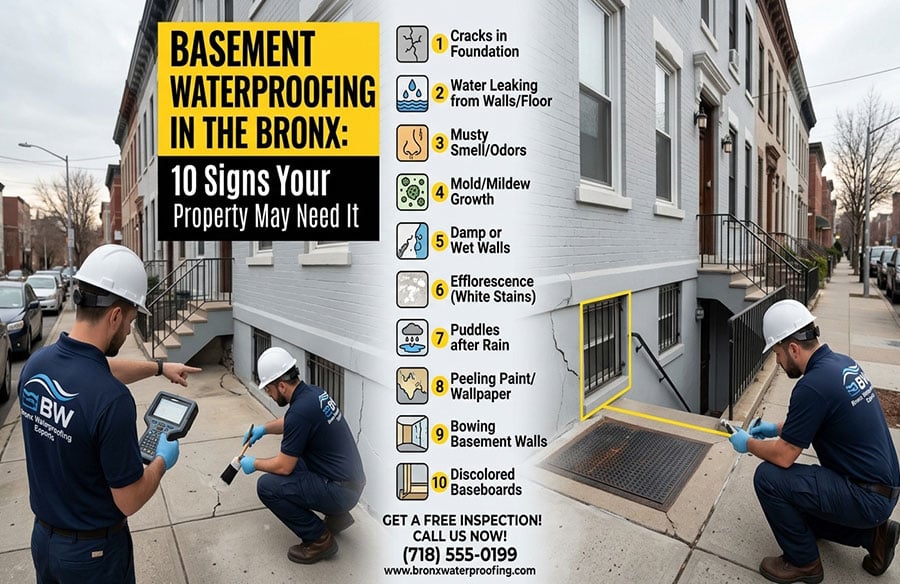
10 Signs Your Bronx Property May Need Basement Waterproofing
1. Water Stains Keep Appearing on Basement Walls
One of the easiest signs to spot is a recurring water stain.
You may notice:
- Brown or yellow discoloration
- Dark patches
- Vertical streaks
- Damp areas near the bottom of walls
- Water marks that become worse after rain
A stain that appears once after an unusual event does not necessarily mean the entire foundation needs waterproofing. However, if the same area becomes wet repeatedly, the source should be investigated.
Practical example
A Bronx homeowner notices a dark vertical stain on a basement wall every time there is heavy rain. The first step should be checking the exterior drainage, downspout location, foundation condition, and whether water is entering through a specific crack or joint.
The solution could involve drainage improvements rather than automatically applying an interior coating.
2. Your Basement Walls Feel Damp
Walls do not need to have visible water running down them to indicate a moisture problem.
A basement may have:
- Damp masonry
- Moist concrete
- Condensation
- Wet insulation
- Damp drywall
- Moisture near the floor line
Persistent dampness can become more noticeable during periods of high humidity or after rain.
EPA guidance recommends checking foundation materials for seepage, wicking, water stains, efflorescence, peeling finishes, mold growth, and other signs of moisture.
If the wall remains damp rather than drying normally, determine whether the moisture is coming from outside, from groundwater, from plumbing, or from condensation.
3. You See White Powder or Efflorescence
White, chalky deposits on concrete or masonry are commonly called efflorescence.
It can appear as:
- White powder
- Crusty deposits
- Vertical white streaks
- Deposits near cracks
- Deposits close to the basement floor
Efflorescence occurs when moisture moves through masonry or concrete and carries dissolved minerals toward the surface.
It does not automatically mean you need a complete waterproofing system. Instead, it is a useful clue that moisture has been moving through the material.
What to check
Look at:
- Where the deposits are located.
- Whether they return after cleaning.
- Whether the wall is damp behind the affected area.
- Whether there are exterior drainage problems.
- Whether cracks or joints are nearby.
4. There Is a Musty Basement Odor
A basement that consistently smells musty deserves attention even when you cannot see standing water.
A persistent odor can be associated with:
- Damp masonry
- Wet drywall
- Moist insulation
- Carpet exposed to moisture
- Poor ventilation
- Mold growth
- Hidden water intrusion
EPA specifically recommends checking for musty odors and damp or moldy materials when inspecting foundations for moisture problems.
Example
A multifamily property owner may notice that the basement smells normal during dry weather but becomes noticeably musty after several days of rain.
That pattern can help identify the problem as moisture-related rather than simply a ventilation issue.
5. Paint or Plaster Is Peeling
Peeling paint is another visible warning sign.
You may see:
- Bubbling paint
- Flaking paint
- Blistering
- Discolored plaster
- Crumbling finishes
- Damaged drywall
Moisture behind a wall finish can cause materials to deteriorate over time.
Painting over the affected area may make the wall look better temporarily, but it does not address the source of the moisture.
If the same section repeatedly peels after repainting, investigate the foundation and drainage conditions before applying another coat.
6. Your Basement Has Standing Water
Standing water is a more obvious warning sign.
Water may collect:
- Along the foundation wall
- Around a floor drain
- Near a sump pit
- At the lowest point of the basement
- Around wall-floor joints
- After heavy rainfall
The location matters.
For example, water appearing in one corner after rain may indicate localized seepage or exterior drainage problems. Water covering a larger section of the floor may point toward a broader drainage or groundwater issue.
A contractor may need to determine whether the appropriate response involves:
- Exterior drainage
- Interior drainage
- A sump pump
- Foundation waterproofing
- Floor drain improvements
- Plumbing repairs
7. Foundation Cracks Are Getting Worse
Not every foundation crack means that waterproofing is required.
However, cracks deserve attention when they are:
- Growing wider
- Reappearing after repair
- Wet or actively leaking
- Accompanied by staining
- Located near other signs of movement or water intrusion
A crack can provide a pathway for water to enter a basement.
EPA foundation maintenance guidance recommends inspecting foundations for new cracks and changes in existing cracks, particularly where moisture problems are present.
A useful distinction
A contractor should look at both the crack itself and the water conditions around it.
Sealing a crack without addressing significant exterior water pressure may not solve the underlying problem.
8. Water Appears Where the Wall Meets the Floor
The wall-floor joint is a common area to inspect in a wet basement.
You might notice:
- Dampness around the perimeter
- Small puddles
- Dark staining
- White mineral deposits
- Water appearing after rain
This can happen when water is moving through or around the foundation and accumulating at the lowest point.
A drainage system may sometimes be more appropriate than simply coating the wall.
Example
Consider a Bronx basement where water appears along a 20-foot section of the wall-floor joint after heavy rain.
A useful inspection would consider:
- Exterior grading
- Downspouts
- Foundation condition
- Existing footing drainage
- Hydrostatic pressure
- Interior drainage options
The correct solution depends on what the inspection finds.
9. Your Gutters or Downspouts Send Water Toward the Foundation
Sometimes the basement problem starts above ground.
If roof runoff is discharged directly beside the foundation, water can accumulate around the building.
Other warning signs include:
- Clogged gutters
- Broken downspouts
- Missing extensions
- Soil settlement
- Pooled water beside the foundation
- Ground sloping toward the building
EPA guidance recommends making sure the ground slopes away from the house and addressing water flow toward the foundation.
Before paying for extensive waterproofing
Check whether the problem can be reduced by:
- Cleaning gutters
- Repairing downspouts
- Extending downspouts away from the foundation
- Correcting localized grading
- Removing areas where water pools
This is one reason a proper waterproofing assessment should begin outside as well as inside the basement.
10. Your Basement Gets Wet Again After Every Heavy Rain
Recurring moisture is one of the strongest reasons to investigate the property’s waterproofing and drainage system.
If the basement repeatedly becomes wet after:
- Heavy rain
- Snowmelt
- Several days of wet weather
- Storms
- Seasonal changes
the problem may involve the way water is being managed around the foundation.
EPA recommends inspecting foundation drainage and moisture conditions after heavy rains or rapid snowmelt.
A recurring pattern is particularly useful because it can help a contractor determine the relationship between weather and water entry.
Waterproofing vs. Drainage: What Does Your Bronx Basement Need?
A wet basement does not automatically mean that exterior waterproofing is required.
| Problem | Possible approach |
| Water flowing toward foundation | Grading or drainage correction |
| Downspout discharging beside foundation | Downspout extension or drainage improvement |
| Localized foundation seepage | Crack/joint repair or waterproofing |
| Persistent groundwater | Drainage and/or waterproofing |
| Water entering through foundation walls | Waterproofing assessment |
| Water collecting on basement floor | Interior drainage or sump system |
| Failed exterior waterproofing | Exterior waterproofing may be considered |
| Multiple water-entry points | Combined drainage and waterproofing approach |
The distinction is straightforward:
Drainage manages where water goes. Waterproofing helps reduce water entering the building.
Some properties need one approach. Others need both.
Interior vs. Exterior Basement Waterproofing
There are two broad approaches to basement waterproofing.
Exterior Waterproofing
Exterior waterproofing addresses the foundation from outside.
Depending on the property and scope, the work may involve:
- Excavating alongside foundation walls
- Cleaning the foundation surface
- Repairing cracks or defects
- Installing waterproofing membranes or coatings
- Improving drainage
- Protecting the waterproofing system
- Backfilling appropriately
Exterior work can address water before it reaches the foundation wall, but excavation can make the project more complex and disruptive.
Interior Waterproofing
Interior systems address water after it reaches or enters the basement area.
Possible measures include:
- Interior drainage channels
- Drain tile systems
- Sump pumps
- Crack or joint treatment
- Moisture management
- Collection systems
Interior solutions can be practical where exterior excavation is difficult, but the appropriate system depends on the source and path of the water.
There is no universal rule that exterior waterproofing is always better or that an interior system is always sufficient.
A Bronx Basement Waterproofing Example
Imagine a three-story Bronx multifamily property with a below-grade basement.
The owner reports:
- Dampness along two foundation walls
- White mineral deposits
- A musty smell
- Water appearing after heavy rain
- A downspout discharging close to the building
A reasonable inspection would not begin by assuming the entire foundation needs waterproofing.
Instead, the contractor could assess:
- Where the water first appears.
- Whether the downspout is contributing to the problem.
- Whether the surrounding ground slopes toward the property.
- The condition of the foundation walls.
- Existing cracks and joints.
- Whether an existing drainage system is functioning.
- Whether a sump pump is installed and operational.
- Whether water is entering through walls, joints, or the floor.
If exterior drainage is contributing significantly to the problem, correcting that issue may be part of the solution. If water continues to enter through the foundation, waterproofing or additional drainage may also be required.
What Should a Basement Waterproofing Inspection Include?
A useful inspection should look at more than the wettest spot inside the basement.
Exterior inspection
Check:
- Foundation walls
- Soil grading
- Gutters
- Downspouts
- Drainage outlets
- Pooled water
- Foundation cracks
- Sidewalk and patio slopes
- Areas where soil has settled
EPA guidance specifically recommends inspecting the exterior foundation and surrounding landscape, roof drain leaders, foundation cracks, and adjacent paved surfaces for potential seepage problems.
Interior inspection
Check:
- Foundation walls
- Wall-floor joints
- Floor slab
- Cracks
- Water stains
- Efflorescence
- Peeling finishes
- Damp insulation
- Musty odors
- Sump pit
- Drainage channels
- Pump operation
The goal is to identify the source and path of the water, rather than simply treating the most visible symptom.
What Should Be Included in a Waterproofing Estimate?
Before approving basement waterproofing work, ask for a written scope.
A useful estimate should explain:
- The identified moisture source
- Areas being treated
- Waterproofing materials or system
- Drainage components
- Sump pump specifications, if applicable
- Crack or joint repairs
- Excavation requirements, if applicable
- Cleanup and disposal
- Warranty terms
- Permit responsibilities
- Any exclusions
- Total project cost
Compare scope, not just price
Suppose you receive three estimates:
| Estimate | Scope | Price | What to Check |
| A | Interior drainage + sump pump | $X | Pump, drainage route and discharge |
| B | Exterior excavation + waterproofing | $Y | Excavation depth, membrane and drainage |
| C | Crack repair only | $Z | Whether the underlying water source is addressed |
The cheapest estimate may not solve the same problem as the others.
For the good basement waterproofing work, compare what each contractor is actually proposing, not just the final number.
Does Basement Waterproofing Require a Permit in NYC?
The permit requirements depend on the scope of work.
NYC Department of Buildings guidance states that the majority of construction requires a DOB permit. Foundation, earthwork, excavation, and related work can involve specific filing and permitting requirements.
For example, NYC requires a permit for excavation or demolition work, and contractors conducting permitted excavation must provide the required notification before work begins.
This matters if a waterproofing project involves significant exterior excavation, foundation work, structural work, or other regulated construction.
Before work starts, ask:
- Does this scope require a DOB permit?
- Who is responsible for filing?
- Is a PE or RA required?
- Does the contractor need a specific NYC registration or license?
- Are inspections required?
- What work is included in the approved scope?
Do not assume that every basement moisture repair has the same permit requirements.
Basement Waterproofing and NYC Rental Properties
Basement moisture can have additional implications for properties where basement or cellar space is occupied.
NYC HPD states that certain basement rental arrangements have requirements related to damp- and waterproofing depending on property and subsoil conditions.
The NYC Housing Maintenance Code also addresses dampness and waterproofing requirements for cellars and basements in multiple dwellings.
If a basement is being used as living or rental space, property owners should verify the applicable requirements rather than treating waterproofing as purely cosmetic maintenance.
When Should You Call a Waterproofing Contractor?
Consider arranging an inspection if you have:
- Recurring water intrusion
- Standing water
- Persistent damp walls
- Foundation seepage
- Repeated efflorescence
- Growing or leaking foundation cracks
- Water entering after storms
- Failed drainage systems
- A malfunctioning sump pump
- Persistent musty odors
- Repeatedly damaged basement finishes
You may not need a full waterproofing project. A professional assessment can help determine whether the issue is related to drainage, waterproofing, plumbing, condensation, or structural conditions.
Questions to Ask a Bronx Waterproofing Contractor
Before hiring a contractor, ask:
1. Where is the water coming from?
Ask the contractor to explain the likely entry point and the evidence supporting that conclusion.
2. Do I need waterproofing, drainage, or both?
A contractor should be able to explain why the recommended system fits the property’s moisture problem.
3. What work will be done outside?
Ask about grading, gutters, downspouts, excavation, foundation walls, and drainage.
4. What happens inside the basement?
Ask whether the project includes crack repair, drainage channels, sump equipment, coatings, or other interior measures.
5. Does the project require a permit?
This is particularly important for excavation, foundation, structural, plumbing, or other regulated work in NYC.
6. What exactly does the warranty cover?
A waterproofing warranty should be reviewed carefully. Ask what materials and labor are covered and what conditions are excluded.
7. What happens if water returns?
A good written agreement should explain how warranty claims or recurring problems are handled.
How Legacy Construction NYC Corp Can Fit Into the Process
For Bronx property owners dealing with basement or building moisture, the first useful step is identifying the source rather than choosing a waterproofing method based only on the visible damage.
Legacy Construction NYC Corp’s Bronx contractor service can be considered when evaluating property repair and construction needs in the borough.
For broader property work, you can also review the company’s contractor services in the Bronx and compare the proposed scope with other estimates.
The useful part of the process is the diagnosis: where is the water coming from, why is it entering, and what work will address that cause?
Final Thoughts
Basement waterproofing is not always the first or only answer to a wet basement.
A recurring moisture problem can originate with something as simple as a downspout discharging against the foundation, or it can involve foundation seepage, groundwater, drainage failure, or deteriorated waterproofing.
The 10 signs to watch for are:
- Recurring water stains
- Damp basement walls
- Efflorescence
- Musty odors
- Peeling paint or plaster
- Standing water
- Foundation cracks
- Water at wall-floor joints
- Poor gutter or downspout drainage
- Water returning after heavy rain
If several of these signs appear together, documenting when and where the moisture occurs can make a professional inspection much more useful.
The goal should not simply be to make the basement look dry for a few weeks. The goal is to understand the water source and select a solution that addresses the property’s actual drainage and waterproofing conditions.
FAQs About Basement Waterproofing in the Bronx
1. How do I know if my Bronx basement needs waterproofing?
Recurring seepage, damp foundation walls, standing water, efflorescence, water stains, or repeated moisture after rain can indicate a waterproofing or drainage problem. An inspection can determine the likely source.
2. Does a wet basement always need waterproofing?
No. Some basement moisture problems can be related to gutters, downspouts, grading, plumbing, condensation, or drainage. Waterproofing may be appropriate when water is entering through the foundation or when other measures do not address the underlying problem.
3. Is exterior waterproofing better than interior waterproofing?
Neither approach is automatically right for every property. Exterior waterproofing addresses the foundation from outside, while interior systems can manage water after it reaches the basement. The property’s construction, access, water source, and project scope all matter.
4. Can gutters cause basement water problems?
Yes. If roof runoff is directed toward the foundation, it can increase moisture around below-grade walls. Gutters and downspouts should be inspected as part of a basement moisture assessment.
5. What is efflorescence on a basement wall?
Efflorescence is a white mineral deposit that can appear when moisture moves through masonry or concrete. It is a useful indication that moisture has been moving through the material.
6. Do foundation cracks always mean structural damage?
No. Foundation cracks can have different causes and levels of significance. However, cracks that are growing, repeatedly leaking, or accompanied by other signs of movement or water intrusion should be professionally evaluated.
7. Does basement waterproofing require a permit in NYC?
It depends on the scope. NYC states that most construction requires permits, while excavation, foundation, earthwork, and other regulated work have specific requirements. Confirm the requirements for the actual project before work begins.
8. What should I ask a Bronx waterproofing contractor?
Ask what is causing the water, whether you need waterproofing or drainage, what work is included, whether permits are required, what materials will be used, what the warranty covers, and what happens if water returns.