The standing water may be gone, but the building is not necessarily ready to be occupied again.
After a leak, storm, or plumbing failure, the most visible part of the damage usually receives the most attention. Water is extracted, wet furniture is moved, and damaged flooring is lifted. Once the surface looks dry, it is tempting to believe that the worst is over.
In reality, this is often when the less visible work begins.
Moisture may remain inside wall cavities, beneath flooring, or within insulation. Removing these materials can release dust, fibers, dried contaminants, and mold spores into the air. Every cut into drywall and every trip through the containment entrance creates another opportunity for particles to move into an unaffected part of the building.
Water damage restoration, therefore, is not only about removing moisture. It is also about controlling what becomes airborne while the building is being opened, dried, cleaned, and repaired.
What Happens After Water Extraction?
Water extraction addresses liquid water, but many building materials continue to hold moisture after the floor has been pumped or vacuumed.
Gypsum board absorbs water through its paper facing and core. Insulation can trap moisture out of sight. Wood framing may feel dry at the surface while retaining elevated moisture internally. Carpet padding and layered flooring systems can also conceal water long after the exposed surface appears normal.
The restoration team must determine which materials can be dried and which need to be removed. That decision depends on the source of the water, the amount of time materials remained wet, their condition, and whether contamination or microbial growth is present.
This assessment changes the character of the job. What began as water extraction may quickly become a controlled demolition project. Baseboards are removed, drywall is cut, insulation is pulled from cavities, and damaged flooring is broken apart. These activities disturb particles that had settled or remained trapped inside assemblies.
The room may look less flooded, yet the air can become more difficult to manage.
Moisture and Airborne Contamination Are Different Problems
A common mistake is treating every restoration machine as though it performs the same job.
Air movers increase airflow across wet surfaces, encouraging moisture to evaporate. Dehumidifiers remove water vapor from the air, helping maintain conditions that allow materials to continue drying. Moisture meters and other instruments help the team track whether the process is working.
Air scrubbers serve a different purpose. They draw air through filters to capture suspended particles generated during demolition, cleaning, and remediation.
This distinction matters because a room can be drying successfully while still having poor airborne-particle control. Conversely, filtered air does not prove that framing, subflooring, or wall cavities have reached an acceptable moisture level.
A complete restoration plan has to address both conditions without confusing one for the other.
The Moment Dust Starts to Travel
Dust rarely stays inside the work area simply because a plastic barrier has been installed.
Workers enter and leave. Waste bags pass through doorways. Extension cords create small openings near the floor. Ceiling plenums and HVAC returns can connect the work zone to rooms that appear separate. A pressure difference between spaces may pull contaminated air in an unexpected direction.
The first sign of a problem is often found outside the damaged room: a dusty corridor, an odor near an elevator, or a layer of residue on a desk that was clean that morning.
Good containment is designed around how people will actually use the space. It may include sealed penetrations, protected HVAC openings, controlled entry points, covered waste routes, and a transition area where workers can remove surface debris before leaving.
When the project requires negative pressure, filtered air is exhausted from the contained area so replacement air moves inward rather than allowing contaminated air to escape. This directional airflow is especially useful when removing mold-affected or heavily contaminated materials.
Containment is not perfect simply because it looks neat. Its performance should be checked while equipment is operating and while workers are moving through the site.
Where HEPA Air Scrubbers Fit into the Process
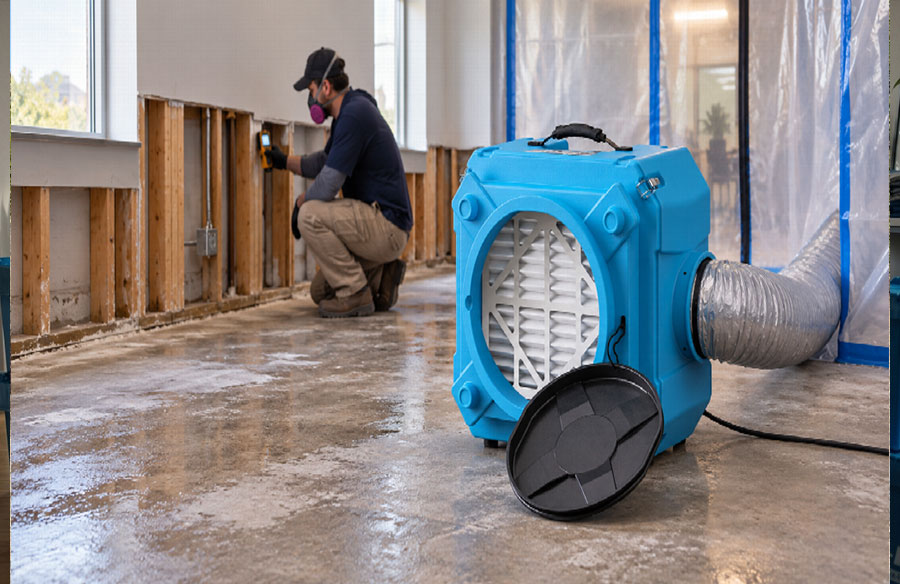
During demolition and cleanup, properly positioned commercial HEPA air scrubbers can reduce suspended particles and help support directional airflow within a contained work area.
Their role becomes particularly important when workers disturb drywall, insulation, wood, flooring, or materials affected by mold. A source-capture vacuum may collect dust directly from a cutting tool, while the air scrubber addresses some of the material that escapes into the surrounding air.
A HEPA filter is designed to capture at least 99.97% of particles measuring 0.3 microns under its specified test conditions. However, filtration performance depends on more than the filter itself. The equipment housing must be properly sealed, filters must be correctly installed, and air must not bypass the filtration stages.
Pre-filters also deserve attention. They capture larger debris before it reaches the HEPA filter, helping maintain airflow and extend the life of the more expensive final filter. A heavily loaded pre-filter can reduce the amount of air moving through the machine, even though the unit still sounds as if it is operating normally.
This is why filters should be inspected during the project rather than only when the work is complete.
A Practical Way to Think About Airflow
Choosing equipment based only on floor area can be misleading because air scrubbers move air by volume.
Consider a contained restoration area measuring 2,500 square feet with a 10-foot ceiling. The space contains approximately 25,000 cubic feet of air. If the project plan calls for four air changes per hour, the theoretical airflow requirement would be:
25,000 cubic feet × 4 air changes ÷ 60 minutes = approximately 1,667 CFM
That figure is a starting point, not a promise of real-world performance.
Ductwork, bends, filter loading, blocked intakes, and equipment placement can reduce actual airflow. Divided rooms may also need more than one unit to prevent stagnant areas. A single high-capacity machine near the doorway may be less effective than multiple units arranged to draw contaminated air away from the clean side of the enclosure.
The appropriate air-change target depends on the type of work, the contamination present, the building configuration, applicable requirements, and the restoration plan. Equipment calculations should support professional judgment rather than replace it.
What About Mold?
Mold adds urgency, but it does not change the basic principle: the source must be addressed.
According to the U.S. Environmental Protection Agency’s guidance for commercial buildings, moisture control is central to mold remediation. Wet materials must be dried or removed, and the water source must be corrected. Filtering the air without resolving the moisture problem will not prevent mold from returning.
An air scrubber can capture airborne spores and particles disturbed during remediation, but it does not remove mold growing on a wall or inside an assembly. Affected materials still require appropriate cleaning, treatment, or removal.
It is equally important not to describe a filtered work area as completely free of mold spores. Mold spores naturally exist in indoor and outdoor environments. The practical objective is to prevent abnormal contamination from spreading and to return the building to conditions appropriate for normal occupancy.
A Better Definition of “Finished”
A restoration project should not be considered complete simply because the machines have been removed and the surfaces look clean.
Completion may involve confirming that affected materials have reached appropriate drying goals, checking that no damaged material remains concealed, cleaning settled dust, inspecting the containment area, and documenting moisture readings. Where project conditions require it, additional professional evaluation or clearance testing may also be appropriate.
The people returning to the building will rarely see the drying logs or airflow calculations. They will judge the result by simpler signs: whether the space smells normal, whether dust reappears, whether finishes remain stable, and whether the building feels ready to use again.
That is what makes air quality control an important part of restoration. Water removal saves the building from immediate damage. Controlled drying protects its materials. Particle filtration and containment help prevent the recovery process itself from creating a new problem.
The water may be the event that starts the job, but careful control of moisture, materials, and air is what allows the building to be responsibly returned to its occupants.