Metal siding stopped being a barn material a while ago. Board-and-batten, clapboard, and plank profiles now come rolled in steel, which means a house can keep the look of wood without the repainting, rot, and warping that comes with it.
The catch is that panels are not interchangeable. Profile, gauge, fastener type, and coating all change how a wall performs and how it ages, and the five manufacturers below approach those choices differently.
Key Takeaways
- A lower gauge number means thicker steel, so 24 and 26 gauge sit at the heavy-duty end, and 29 gauge is standard for residential accents, agricultural buildings and backyard shops.
- Hidden-fastener panels give a cleaner finished wall, while exposed-fastener panels install faster and cost less.
- Coating matters more than color, since PVDF and SMP paint systems are what resist fading, chalking, and UV damage over time.
- Vertical panels shed water better but need furring strips underneath, while horizontal runs need precise alignment and specific trim.
- Trim is not an afterthought, because corners, drip edges and window transitions are what actually keep the wall watertight.
How we compared these manufacturers
Each company was assessed on what it publishes about its own products: the range of wall profiles offered, available gauges and substrates, fastener type, finish systems, and how far it will go on custom work.
We favored specifications a homeowner or contractor can verify before specifying a panel.
We also picked manufacturers with genuinely different strengths rather than five variations on the same catalog.
Panel selection, architectural capability, and custom flexibility separate these companies far more than marketing does.
The 5 best metal siding panels for homes
1. Metal Exteriors, Best Overall Metal Siding Panels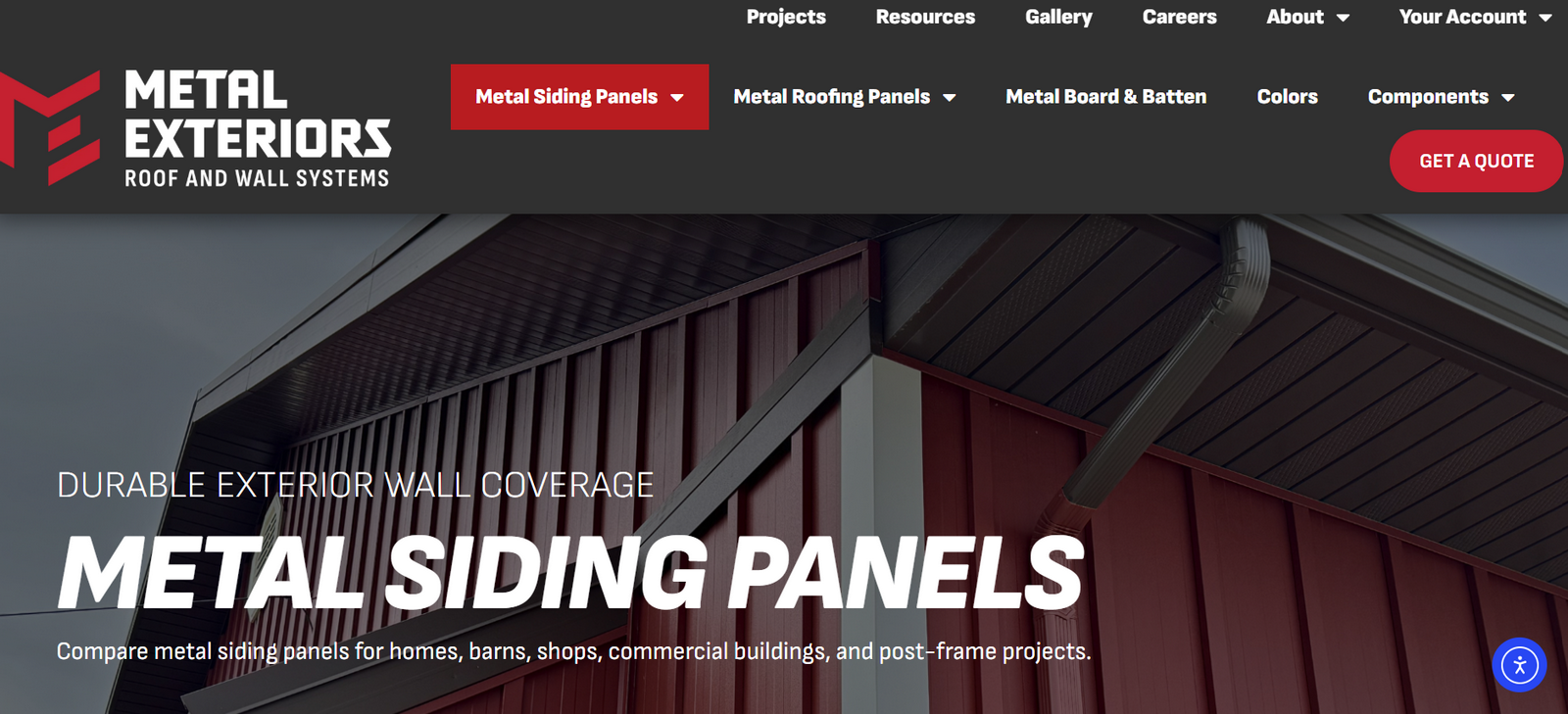 Metal Exteriors manufactures roll-formed metal siding for contractors, builders, and homeowners across ribbed, board-and-batten, plank-style, commercial, and modern profiles.
For homes, it points to four: Metal Batten™ for vertical board-and-batten, Metal D5™ for traditional clapboard, Reveal Plank™ for a plank profile with a clean reveal, and Metal Axis™ for a contemporary linear wall.
Gauge options may include 24, 26, 28, and 29 depending on the panel and application.
That spread lets one supplier serve a budget shop build at 29 gauge and a high-end residential exterior at 24 or 26, where thicker steel resists impact and oil-canning.
Finishes use SMP and PVDF coatings engineered to resist fading, chalking, and UV, with textured and matte options plus wood-grain prints for homeowners who want a timber appearance without the upkeep.
The company also stocks more than 30 trim profiles in dozens of colors, and several panels can be produced in custom lengths per order.
2. McElroy Metal, Best for Panel Selection
 McElroy Metal was founded in 1963 and is employee-owned, which is reflected in a catalog that runs to more than 30 roof and wall profiles.
That range covers standing seam systems for straight, tapered, and curved applications, insulated panels, standard and custom trims, color-matched soffits, and substructural components.
For residential siding, the Nostalgia Board and Batten profile is the headline option. It is made from 24-gauge Galvalume, covers 12 inches with a built-in batten standing three-quarters of an inch tall, and is positioned as a low-maintenance alternative to wood siding for residential and light commercial use.
The panel comes in McElroy’s full architectural color range plus three woodgrain colors, and it is offered as a low-maintenance alternative to wood siding without the continuous upkeep.
If your project needs several coordinated profiles from one supplier, breadth of catalog is the practical advantage here.
3. MBCI, Best for Residential and Commercial Projects
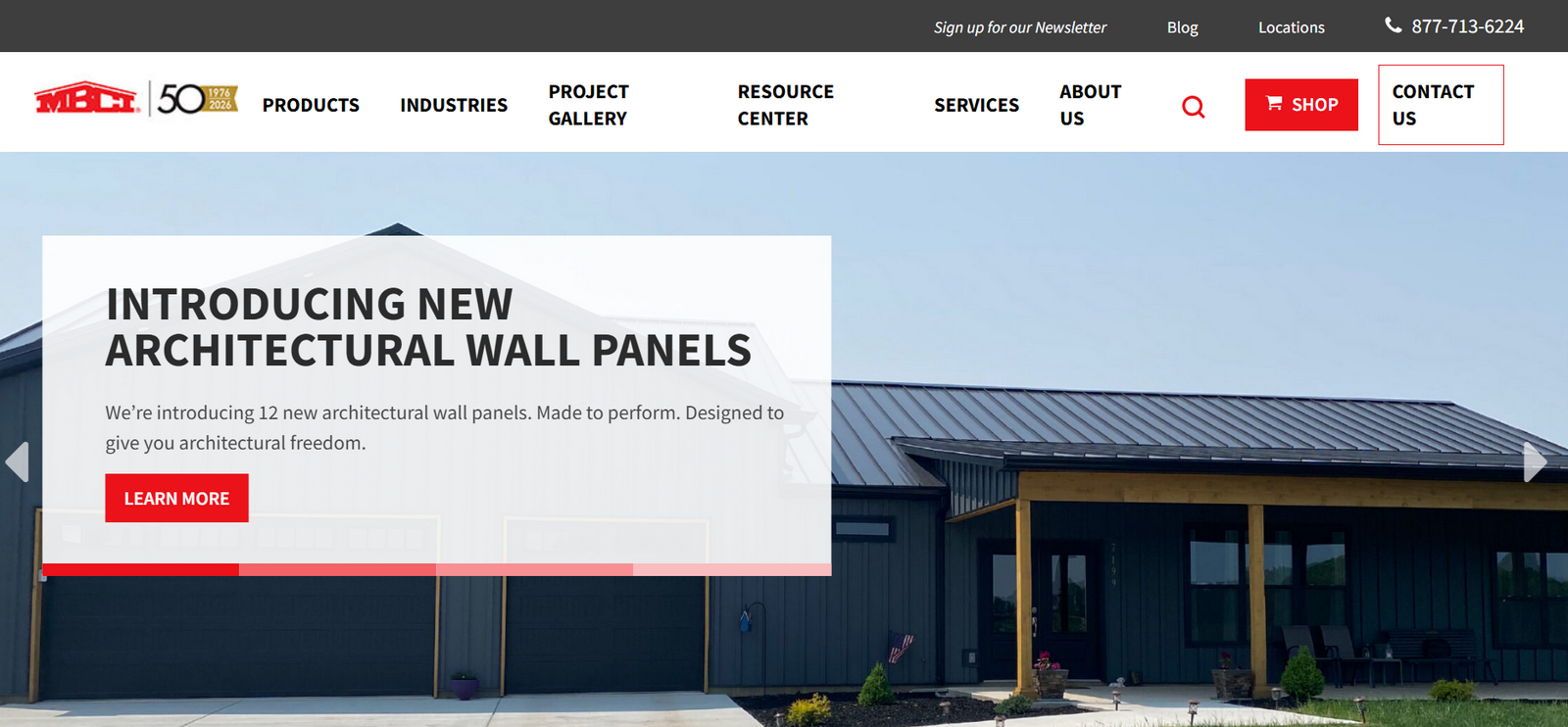 MBCI has supplied metal roof and wall systems since 1976 and offers over 90 panel profiles, one of the largest selections available from a single manufacturer.
It serves architectural, industrial, commercial, institutional, residential, and agricultural markets, so the same catalog covers a house extension and a warehouse.
On the wall side, MBCI offers five concealed-fastener panels: the Designer Series in flat, MasterLine 16, ShadowRib, NuWall and the FW Panel.
NuWall is built for both new construction and retrofit work, which matters if you are re-cladding rather than starting fresh.
The company runs its own testing laboratory at its Houston headquarters, covering water penetration, uplift, and structural performance under ASTM methods.
For homeowners in high-wind or high-rainfall regions, published test performance is worth more than a color chart.
4. ATAS International, Best for Architectural Designs
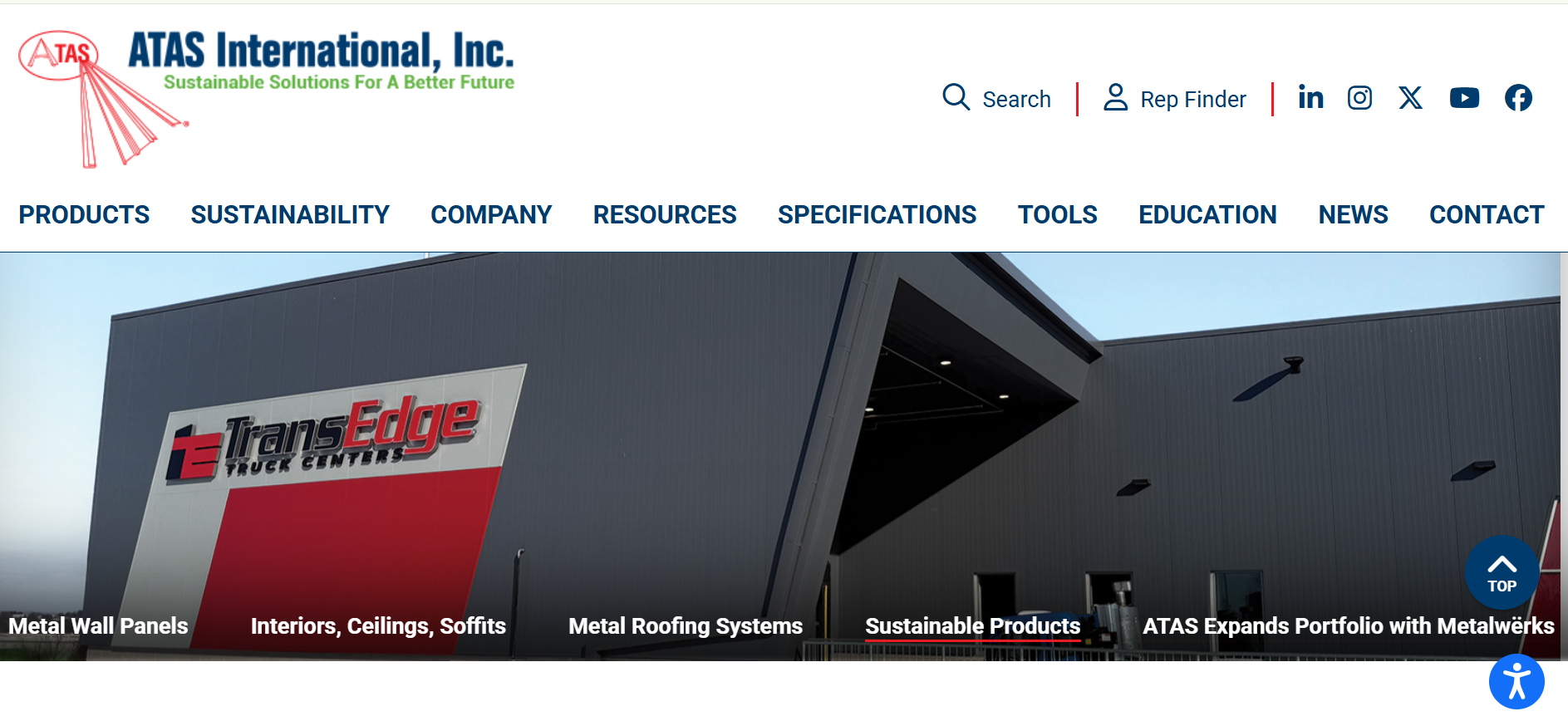 ATAS International is a family-owned American manufacturer founded in 1963, producing metal wall cladding, roofing, ceilings and perimeter edge metal.
Its portfolio spans aluminium, steel, zinc, stainless steel and copper, which is a wider substrate range than most residential-focused suppliers offer.
Standard profiles include narrow and wide ribbed wall panels and corrugated styles, but the design options are where ATAS separates itself.
Panels can be curved, tapered or perforated, specified with concealed or exposed fasteners, finished smooth or embossed, and installed horizontally or vertically.
The Design Wall series is built for mixing and matching within the range, so several profiles can be combined across one façade in matching or contrasting colors, and aluminium panels can be perforated in six standard patterns or a custom one.
Over 40 stock colors are available with a 70% PVDF finish, and ATAS panels and trims are manufactured in the USA at ISO 9001:2015 certified facilities.
5. Berridge Manufacturing, Best for Custom Metal Siding
 Berridge builds its wall panel line around interlocking flexibility. The Reveal Series interlocks with the BR-12, HC-16, HR-4, HR-16, HS-8 and HS-12 panels, so several profiles can be combined across a single elevation rather than being confined to one look.
Panels come in 24 and 22 gauge steel, or 0.032 and 0.040 aluminium, depending on the profile, all with concealed fasteners, and can be installed horizontally or vertically over open framing or solid sheathing.
Continuous lengths run up to 40 feet from the factory, which removes horizontal seams on tall walls.
The color programme is where custom work opens up, with metallic options including Copper-Cote, Zinc-Cote and preweathered Galvalume, natural finishes such as COR-TEN AZP Raw, and woodgrain prints including Walnut, Honey Walnut, Rosewood and Ashwood alongside the standard range.
Berridge also supplies custom sheet metal trim and flashing in prefinished and unfinished Galvalume, so unusual details can be matched rather than approximated.
Quick comparison
| Manufacturer | Standout strength | Notable specification |
| Metal Exteriors | Residential profile range with broad gauge choice | 24, 26, 28 and 29 gauge, 30+ trim profiles |
| McElroy Metal | Catalog breadth across roof and wall | 30+ profiles, 24-gauge Galvalume board and batten |
| MBCI | Scale and tested performance | Over 90 profiles, four concealed-fastener wall panels |
| ATAS International | Architectural and design flexibility | Curved, tapered and perforated panels, five substrates |
| Berridge Manufacturing | Custom colors and interlocking profiles | Lengths to 40 feet, custom color orders |
How to choose
Start with the look you want, then work backwards to the panel. Board-and-batten and plank profiles read as modern farmhouse, clapboard reads traditional, and flush or ribbed panels read contemporary, so the profile decision drives everything that follows.
Then settle gauge and fastener type together. Thicker 24 or 26 gauge steel with hidden fasteners gives the cleanest, most durable residential wall, while 29 gauge with exposed fasteners is the faster and cheaper route for garages, shops, and outbuildings.
Finally, plan trim and openings before you order. Window, door, and corner transitions have to match your chosen panel depth, and sorting that at the design stage avoids the improvised details that let water in years later.
Conclusion
There is no single best metal siding panel, only the right combination of profile, gauge, fastener and finish for your house and budget.
Breadth of catalog helps on complex projects, architectural capability matters on design-led builds, and custom color work is worth paying for when you need an exact match.
Whichever direction you lean, request samples and compare finishes in daylight before committing.
Metal siding is a decades-long decision, and a color that looks right on a chart can read very differently across a full elevation.
FAQs
How much does metal siding cost?
Pricing varies by panel profile, gauge, finish, length, trim requirements, and project size, which is why manufacturers quote per project rather than publishing flat rates. Thicker gauges and PVDF finishes cost more upfront but hold their appearance longer.
What gauge metal siding is best for a house?
For most residential exteriors, 24 to 26 gauge is the stronger choice, since the thicker steel resists impact and the waviness known as oil-canning.
Standard 29 gauge is common on garages, workshops, and agricultural buildings where budget matters more than finish quality.
Should panels run vertically or horizontally?
Vertical installation draws the eye upward and sheds water more effectively, but it requires horizontal furring strips behind the panel.
Horizontal installation gives a more familiar residential look and needs precise alignment, correct overlaps, and specific trim such as starter strips.
What is the difference between hidden and exposed fasteners?
Hidden-fastener panels conceal the screws behind interlocking seams, producing a smooth, uninterrupted wall that suits finished residential exteriors.
Exposed-fastener panels screw through the face, which installs faster and costs less but leaves visible fastener lines.
Can metal siding look like wood?
Yes, several manufacturers offer woodgrain prints applied over steel, giving the appearance of timber without rot, warping or repainting. Board-and-batten and plank profiles reinforce that effect through their shape as well as their finish.