Working with components of given dimensions is a well-known method in architectural design. However, with circular economy and material reuse strategies currently on the rise, components may come with irregularities in dimension and quality. To address this challenge, researchers from BFH Biel, Switzerland initiated a research project with a series of built demonstrators to validate a newly developed material-aware design and fabrication process.
Project Name: From Waste to Architecture: Innovating Circular Design with reused wood
Studio Name: BFH
Scrap Scape Project:
BFH:
Design, project lead and coordination: Edyta Augustynowicz
Robotic production: Dr. Nikita Aigner
Structural analysis: Lukas Furrer
Material support: ERNE AG Holzbau
Circular Pavilion project:
Project lead and coordination: Edyta Augustynowicz (BFH)
Design: Edyta Augustynowicz (BFH), Martin Schulte (HdM), Dominik Nüssen (HdM)
AR assemble: Martin Schulte (HdM)
Fabrication: Dominik Nüssen (HdM)
Communication: Katharina Lindenberg (BFH)
Structural analysis: Christoph Fuhrmann (BFH), Joaquim Escoda Llorens (BFH)
Material database: Nikita Aigner (BFH)
Software license support: Karamba3d
Material support: ERNE AG Holzbau, Beer Holzbau AG
Wood clay seats project:
BFH:
Concept, project lead, coordination: Edyta Augustynowicz
Communication: Katharina Lindenberg
Computational design: Edyta Augustynowicz
Robotic fabrication: Nikita Aigner
Montage: Beer Samuel, Tino Attenhofer, Bruno Salzmann
Rammed earth touch-up: Stanislas Zimmermann, Elia Schneider

It operates on several layers to answer the challenges of reused material. Firstly, the design process turns into an interplay between the computer-generated form and the availability of resources. In detail, it consists of a digital material database combined with a generative algorithm that adapts the design intent to the given material stock. Secondly, the system incorporates the design for tolerance strategy, which only proposes design solutions that account for material imprecision in a range defined by the initial material inspection. Lastly, the developed system follows the requirements of the design variant in regard to structural topology, load-bearing wood connections, and means of production. This integrative approach, embedded entirely digitally has been developed by architects, researchers, engineers, and carpenters, as an interdisciplinary effort that brings academic novelty and practical knowledge altogether.
The potential of the developed system has been validated through three different demonstrators presenting different focuses and corresponding technologies: AUTOMATION for fast production, DIVERSITY for complex structures and interdisciplinary exchange, and HYBRIDITY for efficiency and a more complex formal expression.

1. The first case study, a Scap Scape project, is a large structure (5.7×2.4x2m) constructed from almost 150 wooden waste plates and exhibited during Architekturwoche Basel at the busy campus of the local Art Academy. The large scale and the short timeline of the project prompted the use of automated procedures to fabricate hundreds of individual notches, which were milled with a 6-axis robot. During a one-week-long workshop, students assembled this complex structure following its algorithmic logic.

2. The second case study, “A circular Pavilion”, combined diverse wood typologies, production and assembly technologies within interdisciplinary teams. It uses both wood plates and beams as source material and resulted with 3 large-scale seating and shading objects located at the campus of BFH University. Individual connections were milled by students with handheld CNC Milling machines- Shaper Tools, while the Augmented Reality glasses guided the students about the sequences of the complex assembly of hundreds of individual elements.

The geometry stems from the site analysis to increase biodiversity and improve the use of public spaces at the campus. The project was designed by researchers from BFH Biel and architects from Design Technology Group from Herzog & de Meuron office, while the production and assembly were carried hand in hand by students from the architecture and engineering departments.
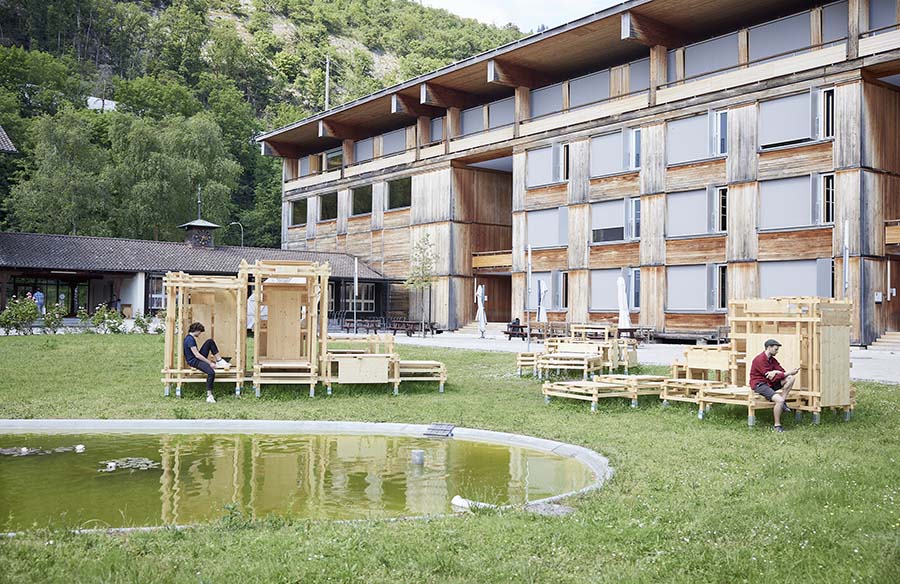
3. The last case study “Wood clay seats” promotes the concept of hybrid systems in sustainable construction by combining two materials with a renewable origin, namely wood an clay. The reused wood was wrapped around rammed earth walls as an efficient interplay of lighter surfaces and heavy volumes to bring new value to architectural expression. The clay plinths were also construction waste from the production of the new office building of a local wood company ERNE AG Holzbau and formed a stable core of the structure. The wood plates were arranged around the blocks in such a manner that they protected their top surfaces from the rain.


Due to the structural requirements, each plate had, on average, four points of support, which resulted in a much denser structure. The assembly of 3 large-scale seats was carried by three persons on site and took only a day. The seats served a double purpose at the courtyard of Zentrum Architektur Zürich during the exhibition “TouchWood” in 2022-2023. On the one hand, as an exhibition object, it represented an innovative and efficient hybrid construction system. On the other, it didn’t have a chance to catch dust as an exhibit only and proved its functional robustness while being actively in use as a seating element and resisting the outdoor changing weather conditions all year long.
Those 3 demonstrators prove that the material-availability-aware design-to-fabrication process is flexible enough to propose different aesthetics and operate at different architectural scales, team sizes, and infrastructure available. While it addresses only one of the challenges of circular construction, namely inconsistencies in dimensions, qualities and properties in repurposed wood, it prompts some important ingredients that can be used universally, for different materials and processes. An interdisciplinary approach and the use of digital tools and workflows are key elements to explore and propagate circular architecture that can operate with waste as individual materials, building elements, or even whole modules.