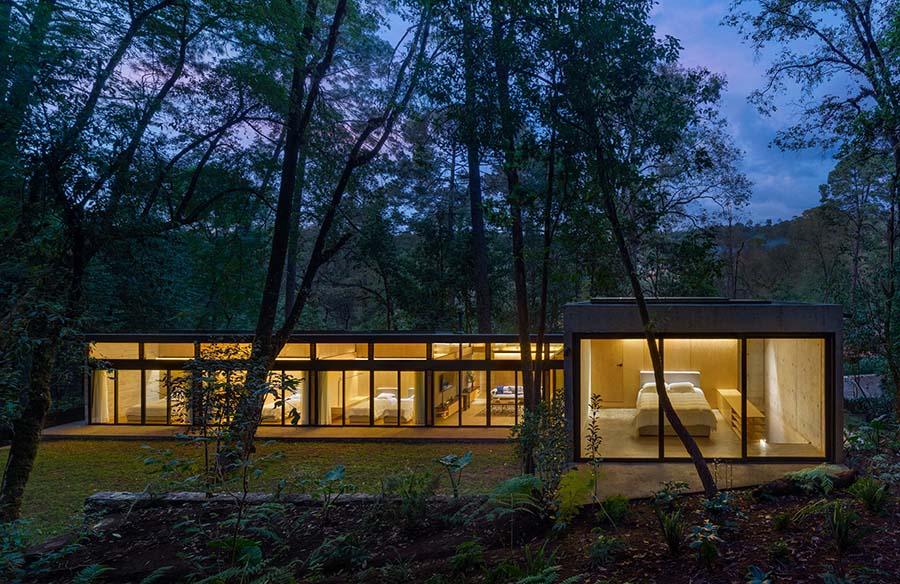
Surrounded by vegetation, Casa El Pinar emerges among the trees of a property still taken over by the forest in the heart of Valle de Bravo, Mexico. The design guideline was clearly marked by the context from the beginning: the priority was to generate a project in harmony with the environment and, at the same time, forceful in its language.
Project Name: Casa El Pinar
Studio Name: Archdifusion
Location: Valle De Bravo , Mexico
Status: Built
Site Area: 1000 Sq. M.
Built Up Area: 430 Sq. M.
Design Team: CF taller de arquitectura | César Flores Lead Designer | Team: Jessica Cano, Ana Voeguelin, Nadia Martinez, Bruno Huerta, David Gordillo
Image Credits: Rafael Gamo

The rugged topography led to a sectional design of the project. In addition to respecting the location of the pre-existing trees, the decision was made to stagger the program in order to take maximum advantage of the slope and to avoid excavating and leveling the terrain much as possible. The built footprint was kept to a minimum, allowing the forest itself to take center stage.

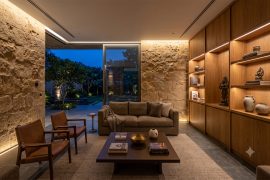
In consistency with the concept of the house, simple materials and exposed finishes were chosen, mixing concrete, steel, local stone and structural pine wood. The authenticity of the materials, both inside and outside, is what imbues the spaces with aesthetic value. The luxury of the spatial quality of each of the rooms lies in the subtlety of the design and the intentional orientation of the views towards the forest.
From the street, a gravel road surrounded by trees is visible. The natural slope of the land gradually rises from the sidewalk to meet the stone that covers the base of the main volume.

The basement of the project, located almost at street level, was conceived as a foundation box for habitable use. The basement, made of concrete and covered with local stone, houses all the service areas, including storage, cisterns, and the mechanical, service and laundry rooms.
Above this volume rises a blind wall of hardened concrete, the protagonist of the main façade and the determining axis of the project. The wall is closed to the north to protect the interior from the strong winds and cold climate of Valle de Bravo, while its texture and strong presence set the tone for the exterior and interior aesthetics.

A stone staircase, integrated and camouflaged into the stone wall of the basement, clearly marks the access along one of its sides to the main door. This level consists of a large south-facing bay that houses most of the program. This bay, the largest volume in the project, is formed by framing that deploys structural laminated pine and some interior walls with plywood overlaying the basement slab.
The south façade is made up of floor-to-ceiling windows and black aluminum frames, guaranteeing natural light and capturing maximum sunlight to counteract the cold climate. The constant visual connection with the garden and the forest, as well as the quietness that this provides, contribute to the tranquil atmosphere of the space.
A central courtyard with a glass-enclosed sweetgum tree fills the atrium with natural light and physically separates the two main public areas, yet there is a visual connection through the glass, creating a sense of flowing spaciousness. The south-facing windows and central courtyard conspire to create a space that is light and cool, maintaining a comfortable temperature.

The project is simple and honest in essence. Instead of existing separately, the structure and the finishes mimic each other; they are one and the same. The color palette throughout the house is neutral and calming. The use of polished concrete on the floor, fair-faced concrete on certain walls and pine wood, along with black joints and black glasswork homologate the aesthetics of the space.
The roof is made of IPR beams that form a large frame with a slope that responds both to the heavy rains in the area and the desire to capture the sun’s rays.
The hallway closed to the north façade, in addition to serving as a thermal buffer, connects the living room with the private areas, containing three bedrooms with their own bathrooms and views of the forest; the owner’s suite has a walk-in closet. This hallway overhangs the access stairs and shares the same concrete finish as the exterior wall on the main façade. At the same time, it creates the sensation of a floating volume, as seen from the street.

At the other end of the volume, a concrete bungalow is connected to the bay through the covered terrace, which features a jacuzzi. This bungalow houses the TV room and an additional bedroom with its own bathroom, responding to the need for a more private space for possible visitors.

The trunks of the pine trees frame the forest views from any point in the house and the connection with nature is equally evident in all the spaces where the green of the leaves can be glimpsed. With its clean lines and sparse materials, this house is an understated retreat that invites reflection and contemplation.