Walk into almost any architecture studio today and you will find screens glowing with building information models, photoreal renders, and walkthroughs that feel close to real. By every reasonable prediction, the physical scale model should have quietly disappeared years ago. It did not. If anything, the small chipboard massing study and the crisp acrylic facade model are appearing more often, not less.
Understanding why says something useful about how architects actually think, and about the tools that have made model-making faster and more precise than at any point in the discipline’s history.
What a screen cannot quite show
A render answers one narrow question extremely well: how will this look from a chosen angle, under a chosen light. A physical model answers a broader and messier set of questions at the same time. You can pick it up, turn it over, and read the relationship between solid and void in a way no fixed camera path delivers. Shadows fall on their own rather than being calculated. Scale stops being a number on a screen and becomes something the hand and eye judge together.
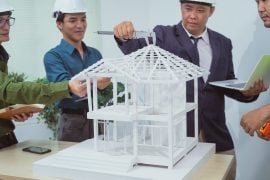
That difference matters most in early design, when the question is not what a building looks like but how it sits, holds weight, and relates to everything around it. A model lets several people stand around a table and point at the same object, which is a fundamentally different conversation from watching a fly-through on a laptop. The physical artifact is slower to make and harder to fake, and both of those qualities turn out to be features rather than flaws.
Why the physical model never really left
Even at the height of the digital turn, the model held its ground in the moments that decide projects. Design crits, client presentations, and competition juries still respond to objects in a way they rarely respond to screens. A model placed on a table invites people to lean in, walk around, and argue. It signals care and resolution. For a client weighing a large commitment, a tangible scale version of their future building communicates seriousness that a polished image, which everyone now knows can be manipulated, cannot quite match.
There is also a quieter reason. Architects are trained to think through making. The act of building a model surfaces problems that a drawing politely hides, a roof that will not resolve, a junction that does not work, a proportion that looked fine in plan and feels wrong in three dimensions. The model is not only a way to present an idea. It is a way to discover whether the idea was any good in the first place.
How laser cutting changed model-making
Here is the practical shift that quietly reshaped the studio. For most of the twentieth century, building a clean scale model meant hours with a steel rule and a scalpel, slicing card and balsa by hand and accepting that human error would creep into every edge. Repeating a component meant repeating the labor. Intricate facade patterns and fine tracery were simply out of reach for most timelines.
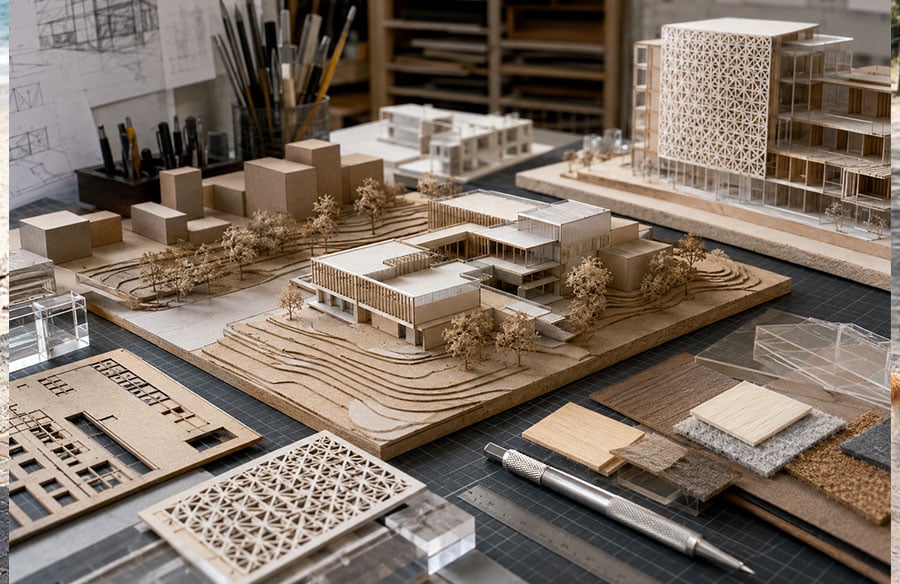
The arrival of the laser cutter collapsed that constraint. A growing number of studios and schools now keep laser cutting machines in-house, cutting chipboard, basswood, plywood, MDF, and acrylic to fractions of a millimeter, repeatably, in minutes rather than hours. A facade screen that would once have taken a day to score and snap by hand can be cut perfectly in a single pass, then cut again, slightly altered, as the design moves. Precision that used to belong to the final presentation model is now available at the sketch stage.
That speed changes the economics of iteration. When a clean component takes minutes instead of an afternoon, a student or a studio can test five versions of a louver, a perforation pattern, or a stair in the time it once took to build one. The machine does not design anything, but it removes the friction that used to push model-making to the very end of the process, where it could only confirm decisions rather than help make them.
The materials architects reach for
Different materials carry different parts of the conversation. Chipboard and greyboard are the workhorses of early massing, cheap enough to cut without hesitation and neutral enough to keep attention on form. Basswood and plywood bring warmth and structure for more resolved models. Acrylic stands in for glazing and water, and its cut edge can be left crisp and glossy to suggest transparency. Cork, felt, and paper handle landscape and texture. A laser handles nearly all of them on the same bed, which is part of why the tool became central rather than supplementary.
Making as a way of thinking, not just showing
The deeper point is that the model has been quietly reclassified. For a while it was treated mainly as representation, a thing you produced at the end to communicate a finished idea. The return of the model is really the return of model-making as design thinking. When iteration is cheap and fast, the model moves upstream into the messy, generative phase where decisions are still open.
This is where digital and physical stop competing and start reinforcing each other. A form is modeled on screen, unfolded into flat cutting files, cut, assembled, and examined in the hand. What the hand notices feeds back into the digital model, which is adjusted and cut again. The loop between drawing and object tightens until the two are part of one continuous process rather than separate stages. The screen handles precision and complexity; the object handles judgment and feel.
What it means for architectural education
Nowhere is this clearer than in schools. A generation fluent in parametric software and rendering can still be caught out by how a real material behaves, how a joint holds, how light actually falls across a surface. Putting fast, accessible fabrication into studios closes that gap. Students learn to move between a digital file and a physical result quickly enough that the two literacies grow together rather than separately.
It also rebalances something that risked being lost. Hand skills and material intuition are not nostalgia. They are part of how architects develop judgment about the physical world they are paid to shape. Tools that make model-making faster do not replace that intuition. They give students far more chances to build it, because the cost of trying, failing, and trying again has dropped close to zero.
Toward a hybrid practice
The physical model has not returned in spite of digital design. It has returned because of it. The same software that was supposed to make the model obsolete now feeds it, turning three-dimensional geometry into clean cutting files in seconds, while fast, precise fabrication turns those files back into objects you can hold. What looked like a replacement turned out to be a partnership.
So the chipboard study on the studio table is not a relic. It is a sign that architects have absorbed the digital tools without surrendering the thing those tools cannot give them: the understanding that comes from making something real, picking it up, and seeing for themselves whether it works. The model endures because the questions it answers never went away. The only thing that changed is how quickly architects can now ask them.