There was a time, not long ago, when a built-in aquarium was a reliable marker of a certain kind of home. The kind with marble foyer columns, gold-trimmed bathroom fixtures, and a hot tub nobody used. Throughout the 1980s and into the mid-1990s, in-wall fish tanks proliferated across upscale residential interiors with the same enthusiasm as mirrored ceilings and conversation pits. They were aspirational, expensive, and almost universally regretted within a few years. Algae-coated glass, failing pumps behind inaccessible walls, and the quiet mortality of tropical fish turned what was meant to be a living centrepiece into a maintenance ordeal. By the early 2000s, the residential aquarium had become design shorthand for excess without substance — a relic of the McMansion era, quietly drained and drywalled over.
And yet, here they are again. Across luxury residential projects from London to Dubai to São Paulo, architects and interior designers are reintroducing built-in aquariums as serious architectural elements. The difference, proponents argue, is that nearly everything about how they are designed, built, and maintained has changed. The question is whether the revival represents a genuine evolution in residential design thinking or merely the cyclical return of a trend waiting to disappoint a new generation of homeowners.
From Novelty to Architectural Element
The aquariums appearing in contemporary residential projects bear little resemblance to their predecessors. Where 1980s installations were typically afterthoughts, a standard rectangular tank dropped into a wall cavity with minimal coordination between the cabinetmaker and the plumber, today’s versions are conceived as integral architectural features from the earliest design stages.
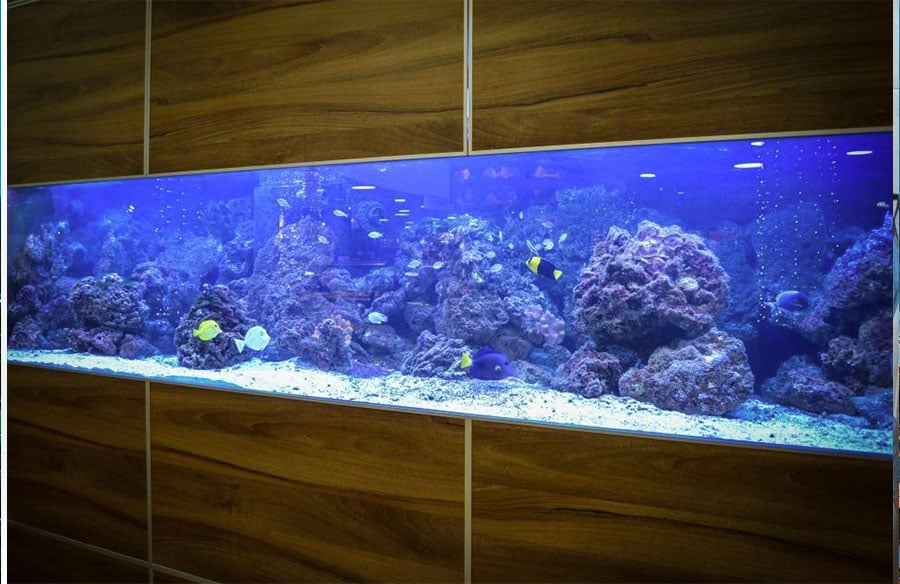
Frameless, low-iron glass panels now allow aquariums to function as transparent room dividers between living and dining areas, maintaining spatial openness while introducing biological texture and movement. Firms like Aquarium Architecture, which works with interior designers and architects on bespoke residential installations across the UK and internationally, have completed projects where reef aquariums are recessed seamlessly between kitchen and living spaces, their edges flush with surrounding joinery. In Dubai, bespoke fabricators are producing floor-to-ceiling cylindrical columns and cantilevered wall-mounted tanks in custom acrylic, forms that would have been structurally impractical, or financially unthinkable, two decades ago.
The aesthetic shift is significant. Contemporary installations favour planted freshwater aquascapes or carefully curated reef systems over the garish neon gravel and plastic castles of the past. The influence of competitive aquascaping — a practice that treats underwater planting as a compositional art form has raised expectations for what a residential aquarium should look like. Designers are now specifying aquariums in the same breath as feature lighting or bespoke joinery: as considered elements that contribute to spatial character, not as novelties.
Robert Kolenik’s Ocean Kitchen concept, which conceals a reef aquarium beneath a motorised kitchen island countertop, attracted widespread attention precisely because it treated the aquarium as embedded architecture rather than decoration. Wadia Associates’ residential project in Connecticut integrated a full-wall aquarium as a room divider within a home overlooking Rockwood Lake, doubling the building’s relationship with water — one natural, one constructed — in a way that only a built-in installation could achieve.
The Technical Gap That Killed the First Generation
What made 1980s aquariums fail was not primarily aesthetic. It was technical. Filtration systems were crude, maintenance access was rarely considered during construction, and there was almost no coordination between the architect, the builder, and anyone who understood aquatic biology. The result was sealed wall cavities concealing equipment that could not be serviced, tanks sized for visual impact rather than biological viability, and fish populations chosen for colour rather than compatibility.
The modern revival has been enabled by genuine technological progress. Contemporary filtration systems are smaller, quieter, and dramatically more efficient. Protein skimmers, biological media reactors, and automated dosing systems can now maintain stable water chemistry with far less manual intervention than was possible a generation ago. LED lighting has replaced energy-intensive metal halide fixtures, reducing both heat output and electricity consumption while offering programmable spectrums that support coral and plant growth. Smart monitoring systems can track temperature, pH, salinity, and nutrient levels remotely, alerting homeowners or maintenance services to problems before they become visible.
But technology alone does not prevent the mistakes of the past. The critical difference in well-executed contemporary projects is process — specifically, the integration of aquatic planning into the architectural design sequence rather than treating it as a fit-out item. Interior designers report using resources like an aquarium stocking calculator to determine which fish species and how many can coexist in a given tank volume during the space planning phase, ensuring that the biological programme is viable before structural and mechanical decisions are locked in. This matters because the number and type of fish in a system dictates filtration capacity, which dictates mechanical space, which dictates the wall depth or service corridor an architect must provide. A stocking plan is not a decorative detail. It is a technical input with spatial consequences.
Dedicated service access — a hatch, a concealed panel, a small room behind the installation — is now considered non-negotiable by reputable aquarium designers. Plumbing connections for water changes, drainage routes for emergencies, and acoustic isolation for pumps and skimmers must all be resolved during design development. The projects that fail today are still, overwhelmingly, the ones where these considerations are deferred until construction is underway.
Sustainability, Ethics, and the Limits of Revival
The return of residential aquariums arrives in a design culture that is, at least nominally, more attentive to sustainability than the one that produced them the first time around. This creates tensions that the industry has not fully resolved.
A well-maintained marine aquarium consumes meaningful amounts of energy — heating, lighting, filtration, and circulation pumps running continuously. Water changes, even with efficient systems, generate waste. And the sourcing of marine livestock raises ethical questions that extend beyond the boundaries of the home itself. The global marine ornamental trade has well-documented problems with destructive collection practices and supply chain opacity, though certification programmes and captive breeding initiatives have made meaningful progress in recent years. For designers working within frameworks like Terrapin Bright Green’s 14 Patterns of Biophilic Design, which positions living systems as contributors to occupant wellbeing and environmental connection, the question is whether a residential aquarium’s biophilic benefits justify its resource footprint — and whether that footprint can be minimised through thoughtful design.
Freshwater planted aquariums, which require less energy and avoid the marine livestock supply chain entirely, are gaining ground as the more defensible option for sustainability-conscious clients. Some designers are specifying native or cold-water species that eliminate the need for heaters altogether. Others are incorporating aquaponics principles, using fish waste to nourish herb gardens or planted walls adjacent to the installation — turning the aquarium from a closed luxury feature into a productive element of the home’s ecology.
None of this resolves the fundamental question of whether placing living organisms inside a wall for aesthetic purposes is ethically sound. It is a question that every designer specifying an aquarium should be prepared to engage with, and one that the most thoughtful practitioners are answering not with defensiveness but with rigour — in species selection, system design, and long-term maintenance commitments.
The built-in aquarium has returned, but it has returned into a different design culture — one that demands more from its materials, its systems, and its justifications. Whether this generation of installations avoids the fate of its predecessors will depend less on the technology behind the glass and more on the care taken before the first wall is framed.