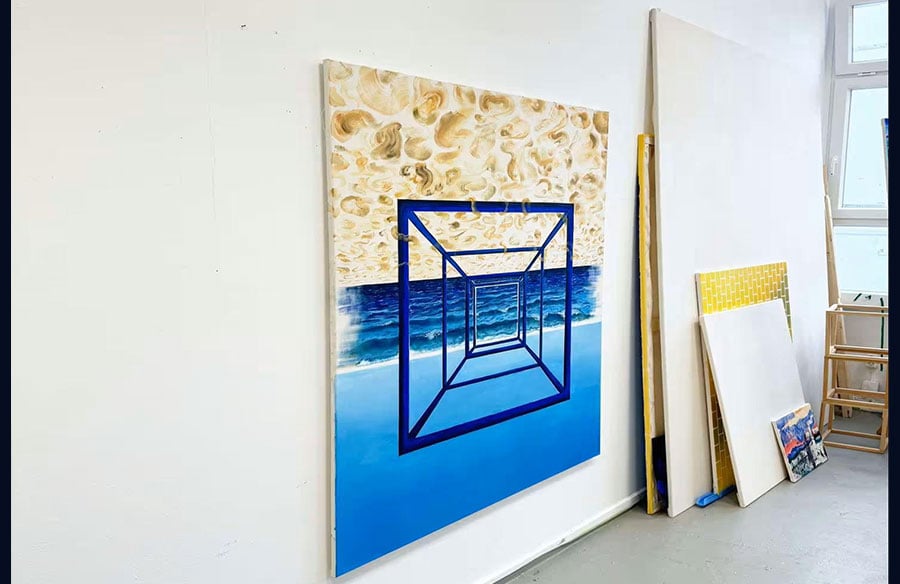
In most building projects, art arrives last. It appears somewhere between the furniture schedule and the handover photographs, procured by an interior stylist against a line item that survived value engineering only because it was small enough not to notice. The drawings never anticipated it. The lighting was designed for the room, not for anything hanging in it. And yet the surfaces this decision governs are, in daily use, among the most looked-at in the entire building.
Art as a finishing trade
The sequencing is revealing. Structure, envelope, services and finishes are all resolved through drawings that anticipate them; art is resolved through a shopping trip. The result is predictable and visible in almost any recently completed commercial interior: work chosen because its dominant colour picks up the upholstery, hung at a height determined by the joinery rather than by eye level, lit by a downlight that was positioned before anyone knew what would be beneath it.
None of this is anyone’s fault in particular. Art has no trade package, no consultant sitting in the design team meetings, and no clear owner in the procurement structure. It falls into the same category as the plants: something that will be sorted nearer the end by whoever has time. So why does a profession that agonises over the reveal detail at a door head accept a random outcome on the largest visible plane in the room? Largely because the discipline has quietly reclassified art as decoration, and decoration is not thought of as a spatial matter at all.
What a wall is actually doing
Treated seriously, a work on a wall performs the same functions that architects already design for elsewhere. It terminates a view. It gives a corridor a destination. It marks a threshold between two conditions without needing a change of material. It slows people down at the point where you want them to slow down, which is why galleries and airports both understand circulation better than most office fit-outs do.
A print reproduced at whatever size fits the space cannot do this reliably, because reproduction flattens exactly the properties that make a work hold a room: surface, scale relationships, the way a physical mark behaves under changing daylight. A canvas with real texture reads differently at nine in the morning and at four in the afternoon. That is not a romantic claim about authenticity; it is an optical one, and it is the reason a single original at the end of a corridor can do work that three large prints cannot.
The budget objection, examined
The standard defence is cost, and it deserves to be taken seriously rather than dismissed. Original work by an established artist is genuinely out of reach for most projects, and pretending otherwise helps nobody. But the assumption underneath the objection is that original and expensive are the same category, and they are not.
Art academies across Europe graduate several thousand painters, printmakers and sculptors every year, and the work leaves those buildings priced according to the maker’s stage of career rather than according to the market. Sourcing contemporary art by emerging artists at degree shows, open studios and the platforms that aggregate them puts original work inside the range normally allocated to framed reproductions, for pieces that are unique, physically present and — not incidentally — traceable to a named person the client can be told about. Is the resulting work as safe a choice as a catalogue print? No. Does a building benefit from the safest possible choice on its most visible surface? That is the question the profession keeps declining to ask.
Designing for work that does not exist yet
The practical shift is small and mostly costs nothing at design stage. Decide early which walls are art walls and which are not, and design the lighting for those positions rather than for the room as a whole. Specify a hanging system rather than assuming fixings into whatever the wall turns out to be. Leave the specific work undecided as long as possible — a wall designed for art but not yet committed to a particular piece is a far better outcome than a wall commissioned around an image chosen in month two of a thirty-month programme.
There is a second-order benefit that rarely gets argued for explicitly. A building whose art was chosen by someone who could explain the choice acquires a small amount of narrative that outlives the handover, and narrative is the one thing a fit-out cannot be value-engineered into having later.
And where a project has any appetite for it, commission. The gap between a client’s budget and a graduate artist’s expectations is often much smaller than either side assumes, and a work made for a specific wall, in a specific light, is the only version of this that architecture ever really gets right.
- Art is currently sequenced as a finishing trade, which is why it so often fails at the one thing a wall-scale object should do: hold a view.
- Reproduction removes the surface and scale behaviour that lets a work function spatially, which is a technical limitation rather than a question of taste.
- Original does not mean unaffordable — work by graduating artists sits in the price range normally spent on framed prints, and can be commissioned for a specific wall.