Picture an architect – call her Maya. Fourteen years in practice. A studio of six on the second floor of a converted warehouse in Vancouver, with a model shop that smells like basswood and coffee. Her firm has won two regional design awards, and the laneway house she finished last spring was photographed for a magazine spread. And yet, on a grey Tuesday in November, a young couple with a sloped lot in North Vancouver and a real budget for a custom home typed “architect near me” into their phones, called the first studio that came up, and signed a design agreement two weeks later. They never saw Maya’s name.
Nothing about her work was the problem. The problem was that her studio, for all its craft, did not exist in the one place where that couple started looking. It is a pattern that the team at North SEO sees constantly when they audit design and trades businesses in Vancouver: firms with the strongest portfolios are often the hardest to find, because the website was built to win over other architects, not to answer the questions a client actually types.
Maya is a composite, but if you run a practice, some version of her story is probably yours. Referrals still matter. But the first meeting with a new client now happens long before anyone walks into the studio. It happens on a search results page, on a map, and more and more often inside an AI assistant that has already decided which three firms are worth mentioning.
The search that happens before the handshake
Search for an architect in any Canadian city and look at what Google shows you first. Not the websites – the map. A short list of businesses with star ratings, opening hours, a phone number and a “Directions” button. For a homeowner holding a phone, that list is the shortlist.
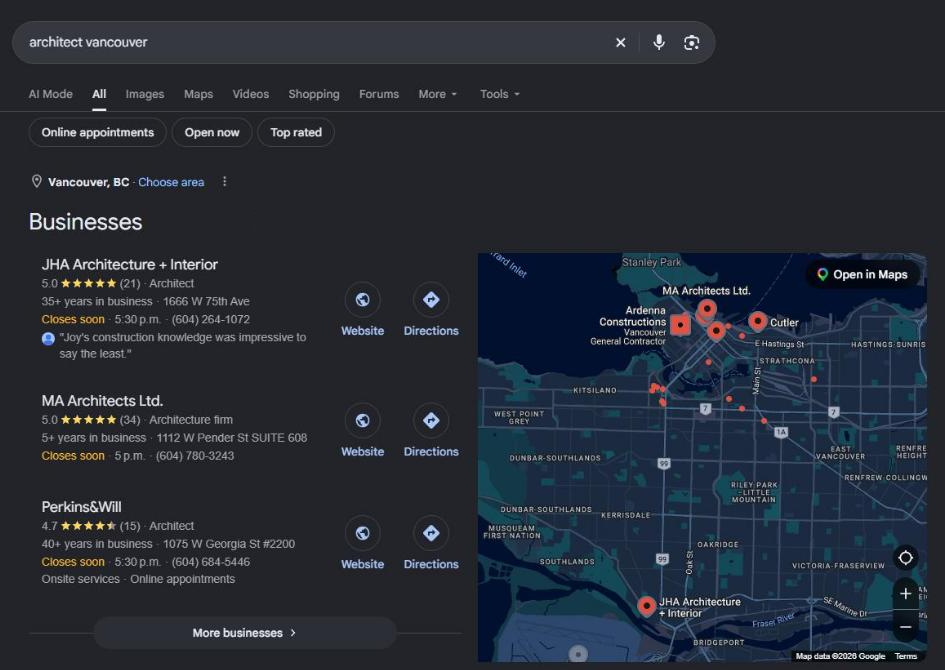 The local map pack for “architect vancouver”. For many clients, these three listings are the entire shortlist. Screenshot: Google Search, November 2026.
Alt text: Google search results for ‘architect vancouver’ showing the local map pack with three architecture firms, their star ratings, addresses and a map of Vancouver
Those listings come from Google Business Profiles, and they are ranked on things architects rarely think about: whether the primary category is correct, whether the address and phone number match the website exactly, how many reviews the studio has and how recent they are, whether the profile is updated with real project photos. A studio with a modest portfolio and a carefully kept profile will often outrank an award-winner whose listing was set up by an intern in 2019 and never touched again.
This is the first quiet way great firms lose work. Nobody rejected them. They were simply never in the room.
Beautiful pages that say nothing
Now imagine the couple had scrolled past the map and clicked through to Maya’s website. They would have found something lovely: full-screen photography, a minimalist menu, project names like “Hollow House” and “Ridge Pavilion”. What they would not have found is words.
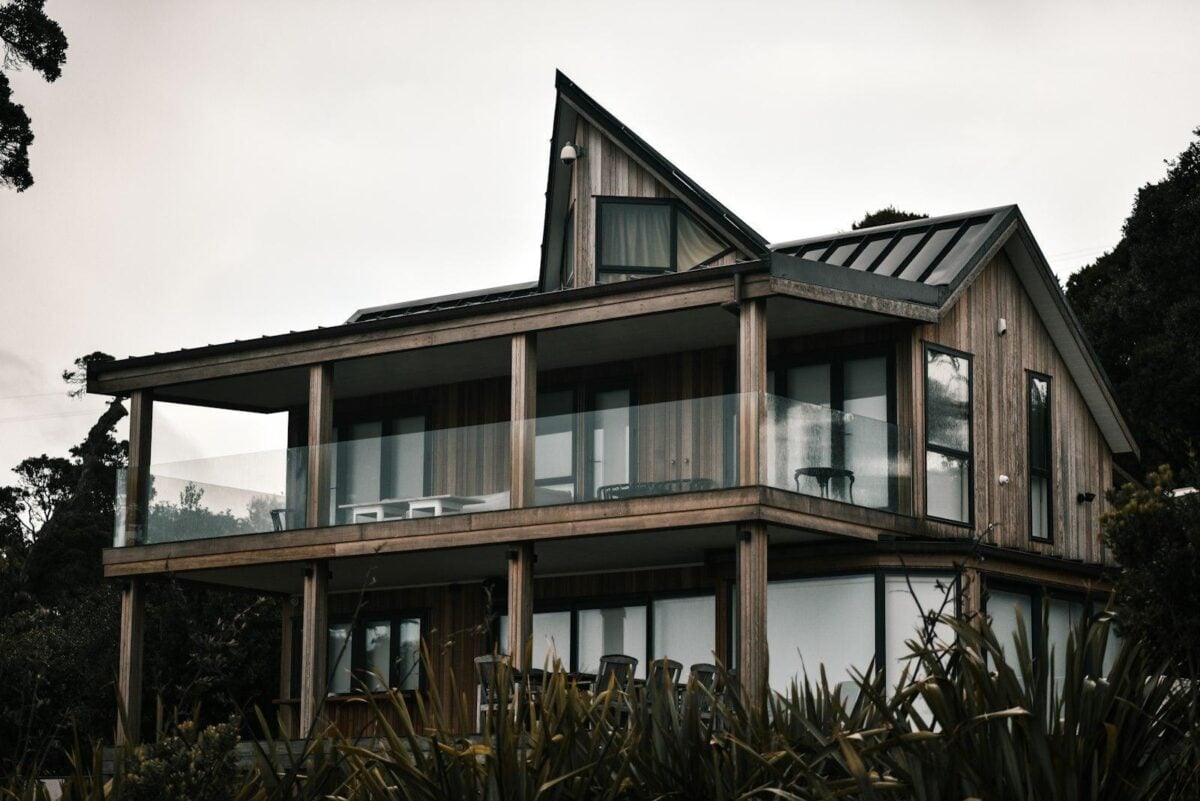 Search engines can’t see the timber, the light or the proportions. They read the words around the photograph. Photo: Zane Lee / Unsplash
Alt text: Modern house with white concrete walls and warm wood cladding, photographed from the garden under a clear sky
Search engines and AI tools cannot read atmosphere. A project page with twelve images and two sentences tells Google almost nothing: not that the house is net-zero, not that it sits on a steep lot in North Vancouver, not that it was built with mass timber on a tight permit timeline. Those are exactly the details a future client searches for.
The fix does not require ruining the design. It requires treating every project as a short story with a beginning, a middle and an end:
- Where and what: “a three-storey timber-frame home in Kitsilano” tells people and search engines what the work is and where it happened.
- The constraint: the narrow lot, the heritage overlay, the budget ceiling, the family member who uses a wheelchair. This is the part clients recognise in themselves.
- The design response: the materials, the structure, the energy strategy, the decisions you are proud of.
- The result: performance numbers, the timeline, a line from the client, any awards.
Three hundred honest words per project, descriptive image file names and proper alt text can turn a silent gallery into dozens of pages that answer real searches.
When the AI makes the shortlist
There is a newer room Maya is missing from, and it is growing fast. Clients now ask Google’s AI Mode, ChatGPT or Perplexity questions like “who designs passive houses in Vancouver?” The answer comes back as a short, confident list of firms, with a sentence about each one.
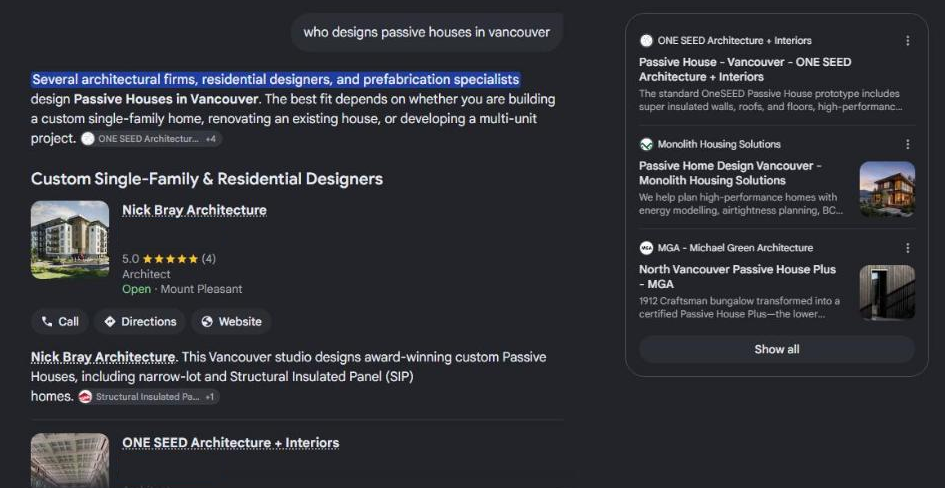 Google’s AI Mode answering a client’s question with named firms and sources. Screenshot: Google AI Mode, November 2026.
Alt text: Google AI Mode answer to the question ‘who designs passive houses in Vancouver’ listing local architecture firms with ratings and short descriptions, plus source links on the right
Look closely at how those answers are built. The firms that appear are the ones whose websites state plainly what they design and where, whose project pages contain facts that can be quoted, and whose names show up in credible places: design publications, professional associations, award lists, review platforms. Behind the scenes, structured data tells the machine that this is an architecture firm, at this address, offering these services.
None of that is a trick. It is the digital version of what good architecture already values: clarity, honest materials and a structure that holds up under inspection.
Answer the questions clients are too shy to ask
Instagram is where clients fall in love with a building. It is rarely where they get answers. What does a custom home cost per square foot here? How long does a permit really take? Do I need an architect or a designer? What happens if the budget moves halfway through?
A studio that answers those questions in plain, generous articles earns two things at once: visibility for the exact searches clients make at the start of a project, and trust before the first conversation. The couple with the sloped lot would have arrived at Maya’s door already knowing how her process works, and already half-convinced.
Checking the foundations
The good news is that the gap is measurable, and closing it does not require a rebrand. Google Search Console shows which searches already bring people to a site and which project pages are gaining ground. Business Profile insights show calls, direction requests and website clicks from the map. Free audit tools can score a profile in seconds and compare it with the firms ranking above it.
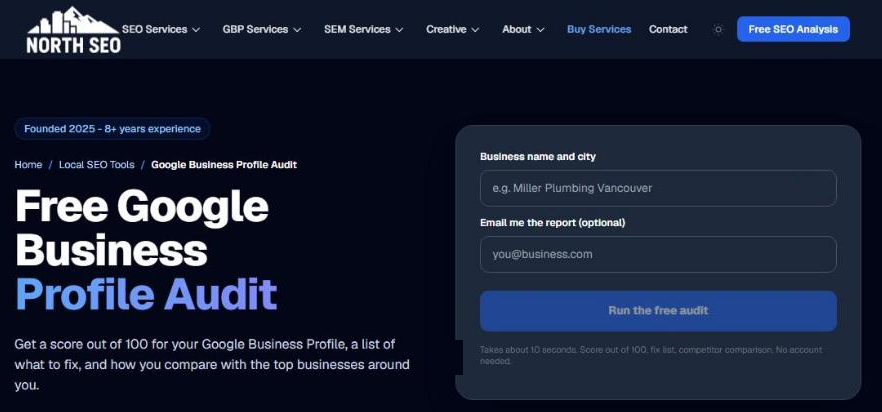 A free Google Business Profile audit scores categories, photos, reviews and contact details against nearby competitors. Screenshot: North SEO, November 2026.
Alt text: Free Google Business Profile audit tool page with a form to enter a business name and city and run an audit that scores the profile out of 100
A practical first pass takes an afternoon: confirm the profile category and services, make the studio name, address and phone number identical everywhere, add recent project photos, ask the last five happy clients for a review, and rewrite your three strongest project pages as stories. Then watch what happens over the next few months.
The room before the room
Architects spend their careers thinking about thresholds – the moment a person steps from the street into a space and understands, without being told, what kind of place it is. Search is now the threshold to the studio itself. It is the first room every new client walks through.
Maya’s work deserved to be found. So does yours. The craft is already there. It just needs a door that people can see from the street.
Serhii Dovzhenko
He is the founder of North SEO, a Vancouver agency focused on local search, Google Business Profiles and AI search visibility for service businesses. He has worked in SEO for eight years.