Architecture has always developed through a conversation between ideas and materials. A concept may begin as a sketch, evolve into a detailed digital model, and eventually become a physical structure. Yet the transition from screen to site is rarely straightforward. Dimensions that appear convincing in a rendering may feel awkward at full scale, while connections that work mathematically may prove difficult to manufacture or assemble.
Physical prototyping helps architects identify these issues before they become expensive construction problems. Among the technologies supporting this process, computer numerical control (CNC) machining has become an increasingly useful tool for testing detailed, functional, and highly accurate architectural components.
Moving Beyond the Presentation Model
Traditional architectural models are excellent for communicating form, scale, circulation, and spatial relationships. However, many are designed primarily for presentation. They show what a building might look like without necessarily demonstrating how its components will perform.
Functional prototypes serve a different purpose.
Rather than representing an entire building at a reduced scale, a functional prototype may reproduce one critical element at or near its intended dimensions. This could include:
- A façade connection
- A custom door handle
- A shading-system bracket
- A modular joint
- A lighting component
- A bespoke piece of hardware
- Part of a kinetic installation
These prototypes allow the design team to evaluate fit, movement, strength, ergonomics, assembly, and visual quality. They also make it easier to communicate technical intentions to engineers, contractors, fabricators, and clients.
What CNC Machining Contributes to the Design Process
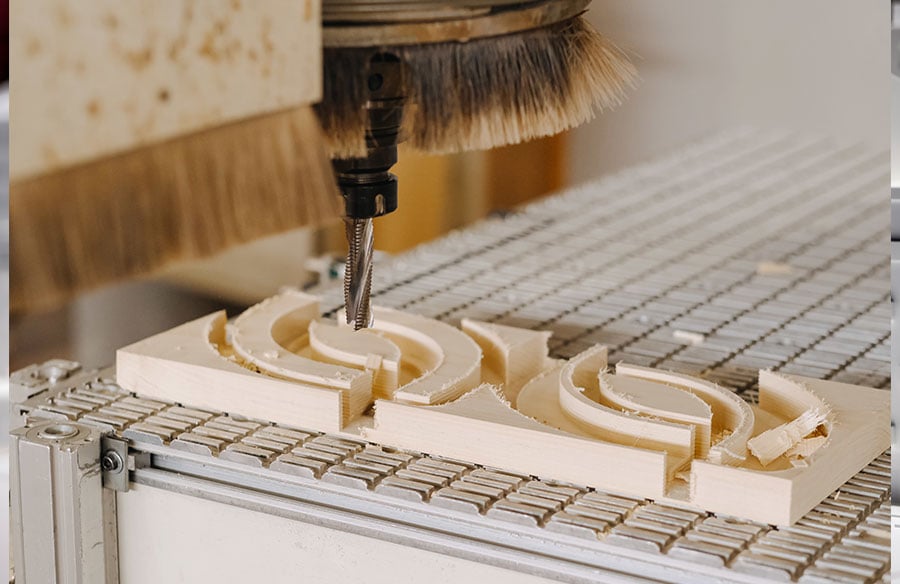
CNC machining is a subtractive manufacturing process. It begins with a solid block of material and removes material using computer-controlled cutting tools until the required geometry is produced.
Because the machinery follows digital instructions, a component developed in computer-aided design software can be translated into a physical part with a high degree of dimensional consistency. This creates a direct connection between digital design and fabrication.
For architects, industrial designers, façade specialists, and construction-product developers, that connection offers several important benefits.
Accurate Testing of Critical Dimensions
Small dimensional errors can have significant consequences in architecture. A connection that is slightly too tight may be impossible to assemble, while one that is too loose may produce movement, noise, misalignment, or premature wear.
CNC-machined prototypes let design teams test dimensions before approving tooling or commissioning a larger production run. Holes, channels, edges, mounting points, and mating surfaces can be examined under realistic conditions.
This is particularly valuable when a component must connect with parts supplied by different manufacturers.
Prototypes in Production-Representative Materials
The behaviour of an architectural component depends heavily on its material. A form tested in cardboard, foam, or a low-strength polymer may provide useful visual information, but it cannot always reveal how the final part will perform.
CNC machining can produce prototypes from a range of metals and engineering plastics. This allows teams to assess characteristics such as rigidity, weight, surface finish, heat response, wear, and tactile quality using materials that more closely resemble those intended for the finished component.
Material-representative testing can be especially useful for architectural hardware, furniture systems, mechanical elements, exhibition structures, façade assemblies, and specialist interior details.
Faster Design Iteration
Architectural development is rarely linear. A prototype may reveal that an edge needs to be softened, a fixing point relocated, or a component made lighter. The digital model can then be modified and another version manufactured.
This iterative cycle allows decisions to be informed by physical evidence rather than assumptions.
Access to a professional CNC machining prototyping service can also help design teams test detailed components without investing in permanent tooling or maintaining specialist machining equipment internally.
The objective is not simply to manufacture an object quickly. It is to receive meaningful feedback early enough to improve the design.
Architectural Applications of CNC Prototyping
CNC machining is not limited to conventional engineering projects. Its accuracy and material versatility make it relevant to several areas of architectural design.
Façade Systems
Contemporary façades often combine panels, brackets, rails, fasteners, seals, and supporting frames. Their success depends on how precisely these elements interact.
Machined prototypes can help teams evaluate custom nodes, corner conditions, panel attachments, drainage details, and interfaces between different materials. Testing these components physically may expose access or assembly problems that are difficult to notice in a digital model.
Bespoke Fixtures and Hardware
Custom handles, hinges, supports, trims, covers, and control elements may be small compared with the building, but users interact with them directly. Their dimensions, weight, finish, and resistance affect both usability and perceived quality.
A machined prototype enables architects to assess whether a component feels comfortable, operates smoothly, and complements the surrounding material palette.
Modular and Prefabricated Construction
Modular systems depend on repeatable connections. When the same joint appears hundreds or thousands of times, even a minor flaw can affect manufacturing speed and site assembly.
Prototyping a connection before production allows the team to test alignment, tolerance, tool access, installation sequence, and disassembly. The resulting lessons can then be applied across the entire building system.
Adaptive and Kinetic Architecture
Moving façades, adjustable screens, retractable elements, and interactive installations rely on components that must perform repeatedly.
Physical prototypes allow teams to observe friction, clearance, interference, and wear. They can also reveal whether a mechanism is intuitive to operate and sufficiently robust for its intended environment.
Interior and Exhibition Design
Retail environments, exhibitions, museums, and branded interiors frequently incorporate custom metalwork, display fittings, furniture components, and interactive details.
These projects often have compressed programmes and demanding aesthetic requirements. CNC prototyping can help designers refine visible components and confirm their compatibility with adjacent materials before final fabrication.
Designing With Machining in Mind
A design that can be represented digitally is not automatically easy or economical to machine. Architects working with CNC manufacturing should consider the production method during the design stage.
Tool Access
Cutting tools need physical access to the areas being machined. Deep cavities, concealed surfaces, and complex internal geometry may require additional setups or an alternative manufacturing process.
Internal Corners
Rotating cutting tools naturally create rounded internal corners. Perfectly sharp internal angles may not be achievable without specialist processes or a design adjustment.
Wall Thickness
Extremely thin sections may vibrate, deform, or become damaged during machining. A more consistent wall thickness can improve both manufacturability and performance.
Material Selection
Materials behave differently under machining and in use. Selection should reflect structural needs, environmental exposure, desired finish, weight, cost, and the purpose of the prototype.
Tolerances
Tighter tolerances can increase manufacturing complexity and cost. Designers should specify them only where they support a genuine functional requirement.
Early discussions with manufacturing specialists can help simplify geometry while preserving the architectural intent.
Supporting More Responsible Decision-Making
Prototyping requires material and energy, but it can contribute to more responsible development when used strategically.
A tested component is less likely to fail during installation or require extensive modification on site. Prototyping can also reveal opportunities to reduce material, simplify assemblies, eliminate unnecessary parts, or improve repairability.
For repeated or modular elements, these improvements may be multiplied across an entire project.
The environmental value of prototyping therefore lies not in producing more objects, but in improving decisions before resources are committed at a larger scale.
A More Integrated Future for Architecture and Manufacturing
Digital fabrication is changing the relationship between architectural design and production. Architects are increasingly able to engage not only with overall form, but also with the precise components through which that form is assembled and experienced.
CNC machining supports this shift by transforming digital geometry into accurate physical evidence. It enables teams to test assumptions, compare alternatives, resolve connections, and refine user-facing details before moving into full production.
As buildings incorporate more customised systems, prefabricated assemblies, responsive elements, and digitally manufactured components, prototyping will become an increasingly important part of architectural practice.
The most successful projects will not treat fabrication as the final step after design. Instead, design, testing, and manufacturing will operate as an iterative process, one in which every physical prototype provides information for a more buildable, functional, and carefully resolved architectural outcome.