Some things in interior design are genuinely difficult. Getting proportions right in an awkwardly shaped room, choosing paint colours that look right under both natural and artificial light, knowing when to stop adding things. A curved boucle sofa is not one of those things. It’s about as close as furniture gets to an easy win.
I say that having seen it in a lot of different homes, and having watched the same thing happen every time: the sofa goes in and the room immediately feels more considered, more comfortable, more — for want of a less overused word — designed. It’s one of those pieces that does a disproportionate amount of the work.
The Boucle Question First
Boucle is a looped yarn fabric — the name comes from the French word for ‘buckle’ or ‘curl’. The surface texture is what you notice: small raised loops that create a soft, slightly nubby finish that catches light differently from smooth upholstery. Run your hand across it and it feels substantial without being scratchy.
It’s been around since the 1950s (Eero Saarinen used it extensively on his Womb Chair, if you want a reference point), fell out of fashion, and came back hard about five years ago. The reason it came back is that it photographs beautifully — the texture gives images depth that flat fabrics don’t — but it’s stayed because it’s genuinely lovely to live with. It’s warm without being heavy, textured without being fussy, and it pairs with practically everything.
Practical note: boucle’s looped structure means it’s less forgiving than velvet or performance fabrics with sharp objects or pets with claws. Worth knowing before you commit, though regular maintenance keeps it looking good for years.
Why the Curve Matters
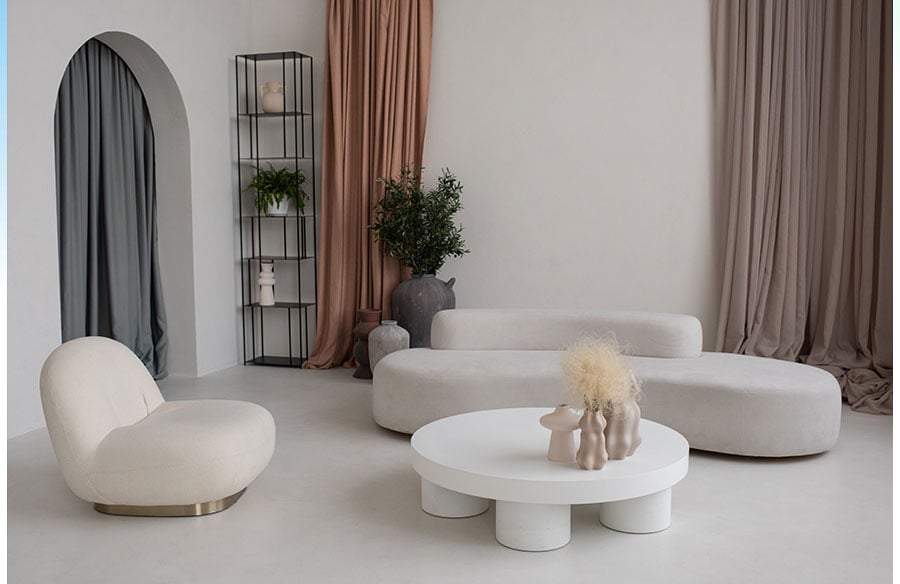
The curved boucle sofa is a specific thing — not just a boucle sofa that happens to have slightly rounded arms, but a form where the entire silhouette follows a continuous curve. The back arcs outward, the arms curve inward or outward depending on the design, and from above the whole thing traces a satisfying arc or crescent shape.
That curve does something interesting to room dynamics. A straight sofa creates a hard line across a space; a curved sofa creates a gesture. It invites you to move around it, changes how the room feels from different angles, and — this is the thing that surprises people when they first experience it — makes conversation easier. When the sofa curves inward toward the centre, people sitting on it are naturally angled toward each other rather than staring parallel at the TV.
In open-plan spaces, the curved form also works as a room divider in a way a straight sofa doesn’t. Place it with its back to the kitchen or hallway and it reads as an intentional boundary without the visual weight of a wall.
Which Rooms Work Best
Honestly, most of them — but curved boucle sofas particularly earn their keep in a few specific scenarios.
Squarish rooms respond well. Most sofas emphasise the box-like quality of a square room; a curved sofa contradicts it and makes the space feel more dynamic without requiring any structural intervention.
Living rooms that are doing double duty as spaces for conversation and media work really well with a curved sofa oriented at a slight angle to the TV rather than dead-on. The curve naturally creates multiple focal points rather than the whole room collapsing toward the screen.
Smaller rooms often benefit more than larger ones, counterintuitively. The sculptural quality of a curved sofa means it reads as a single considered piece rather than a large blob of furniture, which tends to open the room up visually even when the actual square footage is the same.
Colour and Finish Pairing
Boucle in cream or off-white is the version you see everywhere, and there’s a reason — it’s very forgiving with colour palettes and the pale tone keeps the texture prominent. That said, boucle in warmer tones (camel, sand, warm grey) tends to look less expected and sits particularly well in rooms with natural materials: wood floors, stone worktops, rattan accessories.
The texture works best when the surrounding palette is relatively calm. Boucle against a bold patterned wallpaper can feel busy; boucle against a limewash wall in a similar tonal family looks considered and warm. Let the texture do the work rather than competing with it.
Metal legs in brushed brass or matte black are both good pairings. Brass reads as slightly warmer and more maximalist; black reads as cleaner and more contemporary. Either works — it mainly comes down to what other metal finishes are in the room.
Styling It Once It’s In
A curved boucle sofa is quite a specific object, so it’s worth being selective about what you put around it. Large format cushions in complementary textures — linen, velvet, chunky knit — tend to work better than small scatter cushions, which can make the sofa look like it’s trying too hard.
A low, generous coffee table — round or kidney-shaped continues the curved theme — is the natural companion. Avoid very angular coffee tables directly in front, because the contrast in geometries tends to look slightly accidental.
One throw draped casually rather than folded neatly keeps the lived-in quality that boucle naturally has. Lighting: a floor lamp with a curved or arched stem behind one end of the sofa tends to look like it belongs rather than like it was placed as an afterthought. The Curved Sofa Edit at Homio Decor covers a range of curved forms in different configurations — worth looking at alongside the Eames Office overview of boucle’s heritage if you want to understand why certain proportions feel right and others don’t. House Beautiful’s guide to curved sofas also has useful context on how the trend has evolved in recent years.
The Investment Case
A good curved boucle sofa is not cheap, and it’s not meant to be. You’re buying a sculptural piece of furniture with a fabric that requires some care. The payoff is a living room that looks properly finished — not finished in the sense of being complete, but in the sense of having a clear point of view.
Most people I’ve spoken to who have one say it was the best money they spent on their home. Not because it’s the most expensive thing in the room, but because it changed how the room felt to be in. That’s worth more than most things you can buy at any price point.