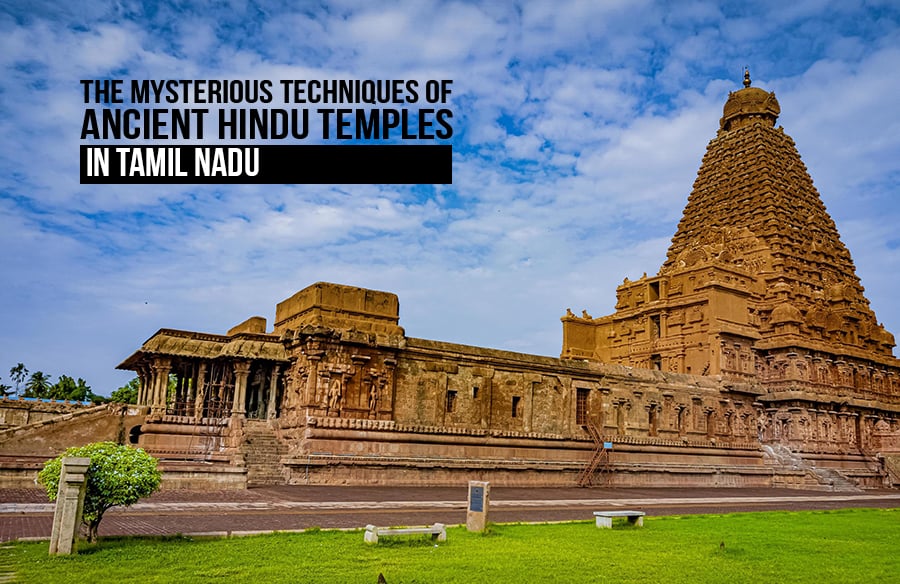
The breathtaking landscape of Indian architecture draws inspiration from the awe-inspiring Hindu temples that grace the land of India. The temples reflect the cultural significance of the soil they stand on. Tamil Nadu temples are stunning specimens of Dravidian architecture. Tamil Nadu’s ancient Hindu temples are well-known for their beautiful architecture, complex sculptures, and architectural wonders. These temples are more than just places of worship; they also demonstrate the builders’ extraordinary building methods and understanding.
These three Hindu temples in Tamil Nadu are the most sought-after ones, with their astounding architectural and spiritual mystery.
This temple is one of the Chola dynasty‘s finest architectural achievements, having been completed in the 11th century under the reign of Raja Raja Chola I. This UNESCO World Heritage site is secretive, puzzling historians, engineers, and builders.
- Brihadeeswarar Temple has no shadows during the day. The temple is the sole shadowless monument in the world.
- The temple’s vimana (prime tower) is one of India’s highest, reaching 66 metres (216 ft). The vimana is topped by a massive 80-ton stone slab. The real mystery lies in how ancient builders hoisted such an enormous stone to that height. There is an intriguing proposal to utilise a 6 km-long sloping ramp, although, currently, there is no concrete evidence to substantiate this theory.
- The temple is constructed entirely from granite, a material that is not locally available. Granite is a very rigid stone and difficult to carve. The stones’ transportation, shape, and careful placement continue to astound.
- Despite being entirely made of granite, the temple is surprisingly cool inside, especially in the searing heat of Thanjavur. According to some scholars, the temple’s architecture and stone arrangement allow for natural ventilation, others say it is owing to the thickness of the granite walls, which function as insulators. The precise technical principles underlying this cooling phenomenon are presently under discussion.
- The temple was constructed without cement or mortar. The stones are completely linked, resulting in amazing stability.
- The temple’s construction is precisely aligned with the cardinal directions, which is impressive given the restricted equipment available for such measurements at the period. The sanctum is claimed to coincide with precise astronomical occurrences, demonstrating the architects’ extensive knowledge of celestial bodies and their motions.

Chidambaram Nataraja Temple.
Dedicated to the cosmic dancer, Lord Shiva in his form as Nataraja, this temple is among the most revered in India.
- The layout of the Chidambaram Nataraja Temple is said to represent the human body, particularly the connection between the divine and the human soul. It follows the principles of Vastu Shastra, the ancient science of architecture.
- The idea of the temple as a miniature version of the human form is reflected in the architecture, which is arranged to correspond with important openings in the human body. As an illustration, the Chidambaram temple is supposed to depict the nine entrances, which stand in for the nine bodily orifices. Additionally, there is a belief that Lord Shiva resides in the “third eye” position of the shrine with a golden roof, representing the human head.
- The temple’s architecture is seamlessly blended with the human form, symbolising a profound link between structure and spirituality. The temple, built more than a thousand years ago, skillfully incorporated symbolic elements that are truly fascinating to contemplate.
- The sanctum’s roof is covered in golden tiles, which have remained intact for centuries. The technique used to ensure the longevity of the gold without modern protective methods is another mystery.
- The Kanakasabhai, or the golden hall where the Nataraja idol resides, is renowned for its acoustics. The hall ensures that sound reverberates perfectly, producing a unique echo effect. Architects are amazed by the remarkable acoustic sophistication achieved without modern technology.


Meenakshi Amman Temple, Madurai.
The Meenakshi Amman Temple in Madurai is one of the most famous and revered temples in South India, dedicated to Goddess Meenakshi (an avatar of Parvati) and Lord Sundareswarar (Shiva).
- One of the architectural marvels within the temple is the Aayiram Kaal Mandapam or the Thousand Pillar Hall. The arrangement of the pillars is such that, from whichever angle viewed, the rows appear perfectly aligned, which is an impressive feat of geometry and symmetry. Additionally, some pillars produce musical notes when tapped, showing the builders’ advanced understanding of acoustics.
- The temple is famous for its 14 towering gopurams. The scale of these towers and the intricacy of their sculptures have raised questions about the techniques used by ancient builders to hoist massive stone blocks to such heights without modern machinery.
- One of the intriguing features of the temple is its alignment with the solstices. The architectural design of the temple’s eastern gopuram is such that it aligns with the summer solstice, allowing the first rays of the rising sun to illuminate the idol of Goddess Meenakshi directly.
- The temple complex has been the subject of enduring rumours and myths regarding concealed passageways and secret rooms below its surface. These are said to lead to the Thirumalai Nayakkar palace or even further into other parts of the city.
- The temple’s thick walls, lofty ceilings, and well-ventilated hallways all contribute to its natural ability to control temperature, which keeps the inside cool without the need for contemporary conditioning equipment. The methods used by the builders to comprehend and implement such effective procedures continue to spark debate.


India nestles numerous temples, each a marvel of architecture and spirituality. These temples of the various states in India, elicit different perspectives concerning their architectural and spiritual import. These opinions, however, cannot be definitively proven or disproven, and as a result, the beliefs surrounding these temples endure indefinitely.
References:
- India Travel Blog (2024). The 13 Best Mysterious Temples in India You Should Visit In 2024! [Online] Available at: https://www.tourism-of-india.com/blog/mysterious-temples-of-india/ [Accessed September 17, 2024]
- A Soul Window (2022). Secrets of Brihadeeswarar Temple: How did they do it? [Online] Available at: https://asoulwindow.com/secrets-mysteries-of-brihadeeswarar-temple-thanjavur/ [Accessed September 17, 2024]
- i Share (2024). Missing Brihadeeswarar Temple Shadow, Thanjavur [Online] Available at: https://isharethese.com/facts-brihadeeswarar-temple-no-shadow-thanjavur/ [Accessed September 17, 2024]
- Nataraja Temple , Chidambaram. | Cuddalore District, Government of Tamilnadu | Sugar bowl of Tamil Nadu | India (no date). Chidamabaram [Online] Available at: https://cuddalore.nic.in/tourist-place/chidamabaram/#:~:text=Chidambaram%20temple%20is%20based%20on,or%20Openings%20of%20the%20body.&text=These%2021600%20gold%20sheets%20are,Nerves)%20in%20the%20human%20body. [Accessed September 17, 2024]
- Hashtag Magazine (2023). mysteries of India’s Meenakshi Amman Temple [Online] Available at: https://hashtagmagazine.in/mysteries-of-indias-meenakshi-amman-temple/ [Accessed September 17, 2024]