“Cultural heritage does not end with monuments and collections of objects. It also includes traditions or living expressions inherited from our ancestors and passed on to our descendants.”

UNESCO Convention for ICH
Bazaars and temporary markets have historically been bustling centres of cultural, social, and economic exchange interlaced with a civilization’s very way of life. For thousands of years, they have been the backbone marketplaces that gave life to communities and facilitated not only trade with goods but also trade in cultural styles and expressions, traditions, and food items where social interactions were encrypted. These marketplaces have evolved over time with the changing society and yet attempt to support the many lives connected to and dependent on this informal economy. As more and more people connect with these spaces, they transcend from being of monetary origins to intangible cultural heritage, becoming the identity of the communities. Ravivari, is one such example from Ahmedabad, which is today a part of Ahmedabad’s heritage and a cornerstone for city life for many connected families, which has allowed it to transcend the regular markets and become an integral element of the city’s identity.
History of The Sunday Market
Sultan Ahmed Shah laid the foundation of the city of Ahmedabad in 1411 A.D. According to local legend, the market, initially known as Khas Bazaar or Shukravari, began around 1414 A.D. This temporary Friday market originally extended from the Bhadra Fort to the Teen Darwaja, with even Sultan Ahmed Shah himself visiting on occasion. Over the centuries, despite changes in its routine and location, the market has become deeply embedded in the culture and daily lives of Ahmedabad’s residents.

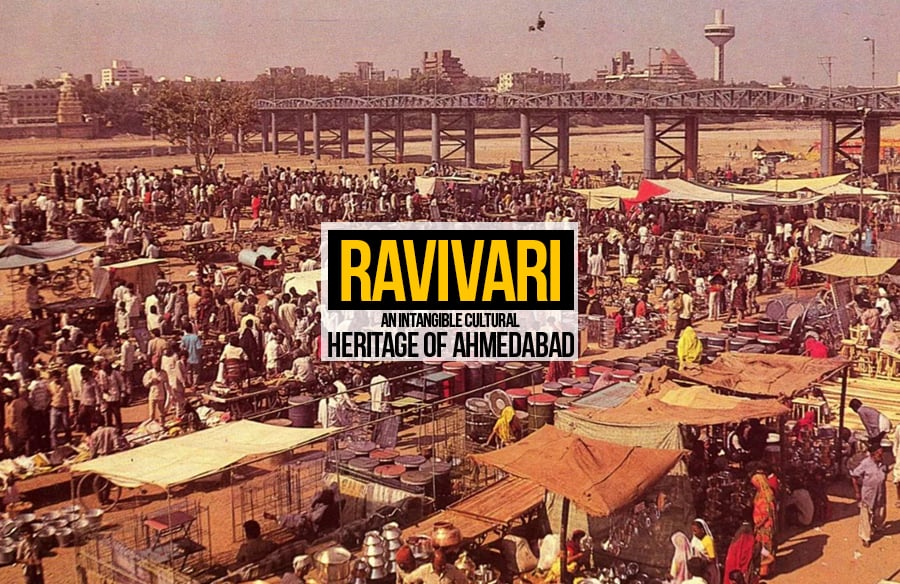
Throughout its 600-year history, the market has remained functional under various reigns and through all seasons. Rare exceptions to its continuity include events like the 1941 communal riots, which temporarily halted its operations. Following the riots, the market resumed in front of the Sidi Saiyyed Mosque and later near the old Civil Court before eventually settling under the Ellis Bridge near the Sabarmati riverbank in August 1954. This location has remained fixed for more than 50 years.
Cultural Representation and Heritage

Ravivari is a testimony to the rich and diverse cultural heritage of Ahmedabad, as the longevity of the market represents its significance in the city’s social fabric. The Sunday market hosts a variety of items, which range from everyday essentials to the rarest, artistic, recycled, and reused products, which is effectively captured in the local name for the market, ‘Gujari Bazaar’—a market for the dead things. These unique products, which are otherwise nowhere to be found, carry with them the stories and traditions that contribute to the cultural lineage of Ahmedabad. The market’s vibrant atmosphere and the bustling crowds further add to its charm and enhance the experience of this market, which is not merely a place for commerce but rather a living museum of Ahmedabad’s history and traditions, showcasing the city’s versatility and creativity through its diverse offerings.

This centuries long affair has been associated with the lives of hundreds of families, and this connection stretches to generations of Ahmedabad, be it as sellers or as vendors, emphasising the importance of Ravivari in the social fabric. Different walks of life converge at the Sunday market, where, against these bargains over these unusual goods, relationships are built that add trust and familiarity to the transactions. The tradition of Ravivari not only serves as a marketplace, but also as a meeting place where stories are shared and bonds are formed, creating a sense of community that goes well beyond economic transactions.
The Informal Economy

At Ravivari, unlike a formalised setup of a market with profit at the centre, the sustaining lives of thousands of workers whose livelihoods are intricately connected with the informal economy are at the centre. From supply chain, production, and logistics to vending, thousands of workers and their families are connected. The Ahmed Shah Gujari association oversees the management of the market and recognizes 1200 registered vendors, but reports that every Sunday, almost 1000 ad-hoc vendors come to sell at Ravivari and earn a livelihood. These vendors on weekdays work tirelessly to produce or collect goods that they sell on the weekend, reflecting the crucial role of the market as a mechanism of sustenance.
However, the modernization and development associated with the Sabarmati Riverfront Development Project posed a significant threat to the future of this intangible cultural heritage of Ahmedabad. The project displaced the market from its original riverside location, relocating it behind a concrete wall, severing its connection to the water, and moving it far from its historic location near Raikhad Darwaja. Despite these challenges, the market has continued to adapt, reflecting the resilience and enduring significance of this centuries-old tradition in the lives of Ahmedabad’s people. The city planners need to recognize such cultural spaces that have played a significant role in defining parts of the city’s character and thus need to render development plans that uphold and respect the rich culture and its historical significance, maintaining elements of the unique identity of the city in this time of globalisation.
References:
Ahmedabad Gujari Association (2012a) Convergence of social, Economic & Cultural Networks, Gujari Bazaar. Available at: https://web.archive.org/web/20120706210410/http://www.gujaribazaar.org/?page_id=20 (Accessed: 01 August 2024).
Ahmedabad Gujari Association (2012b) Threats & Intangible Cultural Heritage, Gujari Bazaar. Available at: https://web.archive.org/web/20120706210453/http://www.gujaribazaar.org/?page_id=36 (Accessed: 02 August 2024).
Diwadkar, V. (no date) Ahmedabad Gujari Bazaar: Alternative Rehabilitation Plan, Vineet Diwadkar. Available at: https://www.diwadkar.net/gujaribazaar (Accessed: 02 August 2024).
Intangible cultural heritage (no date) Parampara Project. Available at: https://web.archive.org/web/20120123095245/http://www.paramparaproject.org/ich.html (Accessed: 01 August 2024).
Keswani, K. (2012) Gujari Bazaar – the 600 yr old market. Available at: https://indianbazaars.blogspot.com/2012/05/gujari-bazaar-600-yr-old-market.html (Accessed: 02 August 2024).
Shah, J. (no date) :: Parampara Project: Gujari bazaar ::, Parampara Project | Gujari Bazaar. Available at: https://web.archive.org/web/20121129043031/http://www.paramparaproject.org/traditions_gujari-bazar.html (Accessed: 01 August 2024).
UNESCO (2003) UNESCO – text of the convention for the safeguarding of the intangible cultural heritage, Intangible Cultural Heritage. Available at: https://ich.unesco.org/en/convention (Accessed: 03 August 2024).