The island used to be the place where the kitchen stored its extra drawers. In a high-end home, it has become the piece guests remember. The NKBA 2027 Kitchen Trends Report, released in October 2026 and based on a survey of 830 industry professionals in the United States and Canada, found that 82% of designers say island size and configuration are becoming more tailored to each space, and 54% expect the island to stand out with a different color from the rest of the cabinetry. A statement kitchen island is, in other words, no longer a matching extension of the counters.
That raises a practical question that mood boards rarely answer. Which surface can carry that role for twenty years, with seating overhangs, hot pans, children’s homework and dinner parties? Stone, porcelain and fused glass each make a strong case, for different reasons.
What turns an island into a statement piece
Three things, mostly: scale, contrast and light. Scale comes from the slab itself, a long uninterrupted surface or a waterfall end that drops to the floor. Contrast comes from treating the island as furniture, in a different material or tone from the perimeter. Light is the newest factor. In the same NKBA survey, 78% of designers agree that lighting is now used as a key design feature, and the island is the obvious candidate for it.
Function still matters. NKBA respondents expect technology to lead island changes (74%), ahead of storage (60%) and functional zones (58%). A statement material therefore has to accept cut-outs for cooktops, sinks and outlets without losing its effect.
Natural stone for a statement island
Quartzite
Quartzite leads designer forecasts for 2027, cited as popular by 78% of NKBA respondents, slightly ahead of quartz at 74%. On an island, its strength is the one-of-a-kind slab: dramatic movement across a long surface, continued down a waterfall end. The limit is the same as its appeal. Every slab differs, so the slab should be selected in person and the vein layout planned before cutting.
Marble
Marble remains the most recognizable luxury surface, but designer enthusiasm has cooled. Real Simple, reporting the NKBA results in October 2026, notes that marble was cited by only 30% of designers. It etches with acids and needs care, which is acceptable on a decorative island and harder to live with on a main prep zone. Granite, once the default luxury counter, fared little better in the same survey, at 41%. Neither figure means these stones are disappearing; it means designers now reach for them deliberately, for a specific slab or a specific room, rather than by default.
Seating overhangs are where stone needs engineering. A guide from Dynamic Stone Tools, a supplier to fabricators, gives conservative residential guidelines: 3 cm stone typically supports a 10 to 12 inch overhang without added support, while 2 cm stone needs support beyond about 6 inches, and marble is more limited because of its lower tensile strength. Deeper overhangs call for steel brackets or hidden supports.
Porcelain and fused glass, the statement alternatives
Porcelain slabs
Porcelain has gained ground as a large-format, stone-look option. According to Block Renovation’s April 2025 guide, installed porcelain typically costs $60 to $120 per square foot, resists heat, stains and scratches, and needs no sealing. The same guide lists its weak points: slabs are usually around half an inch thick, edges and corners can chip under impact, and the marble pattern is often printed on the surface only, so a chipped edge may reveal a plain core. Mitered edges help disguise the thinness on an island.
Fused glass
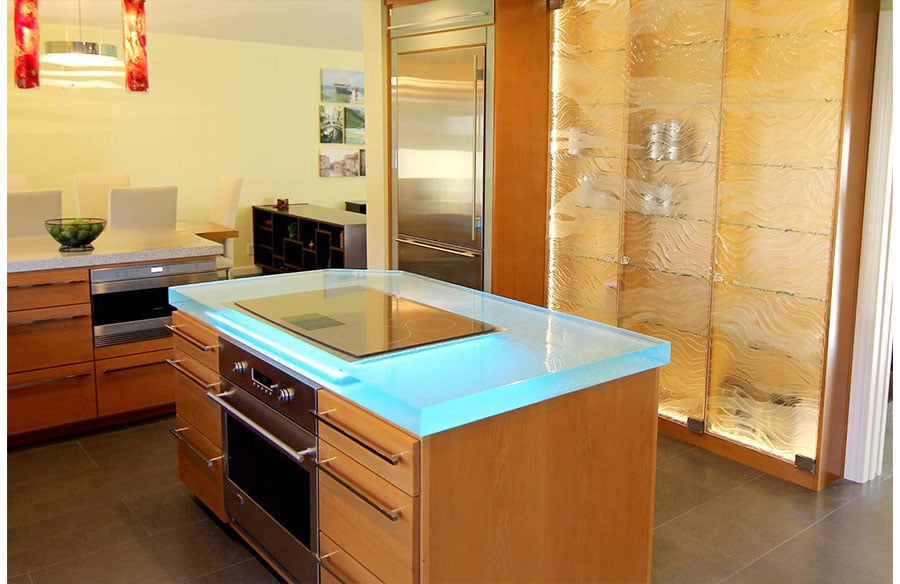
Fused glass takes the opposite approach. Instead of imitating stone, it makes thickness and light the point. ThinkGlass, a Canadian manufacturer, produces island countertops from 1.5 inches (35 mm) up to 4 inches (88 mm) thick, with optional integrated LEDs and hand-applied textures, and lists typical kitchen pricing between $100 and $300 per square foot depending on thickness, lighting and edge work. In a Los Angeles kitchen, a 3-inch (72 mm) clear glass island with a polished edge and a precise cooktop cut-out glows from within at night. Projects like these show how thick fused glass countertops for kitchen islands can carry a cooktop and still read as a sculptural object.
The table compares the main options for a statement island, using the sources cited above.
| Material | Typical installed cost | Thickness on an island | Main strength | Main constraint |
| Quartzite | Premium natural stone pricing, slab dependent | 2 cm or 3 cm | Unique movement, natural character | Slab selection and vein layout |
| Marble | From about $80 per sq ft, often above $200 | 2 cm or 3 cm | Timeless luxury look | Etching, shorter safe overhang |
| Quartz | $70 to $140 per sq ft | 2 cm or 3 cm | Consistent color, easy care | Less unique on a large surface |
| Porcelain | $60 to $120 per sq ft | Usually about 12 mm | Heat and stain resistant, light | Edge chipping, printed pattern |
| Fused glass | $100 to $300 per sq ft | 1.5 to 4 inches | Thickness, translucency, built-in light | Needs a compatible base and lighting plan |
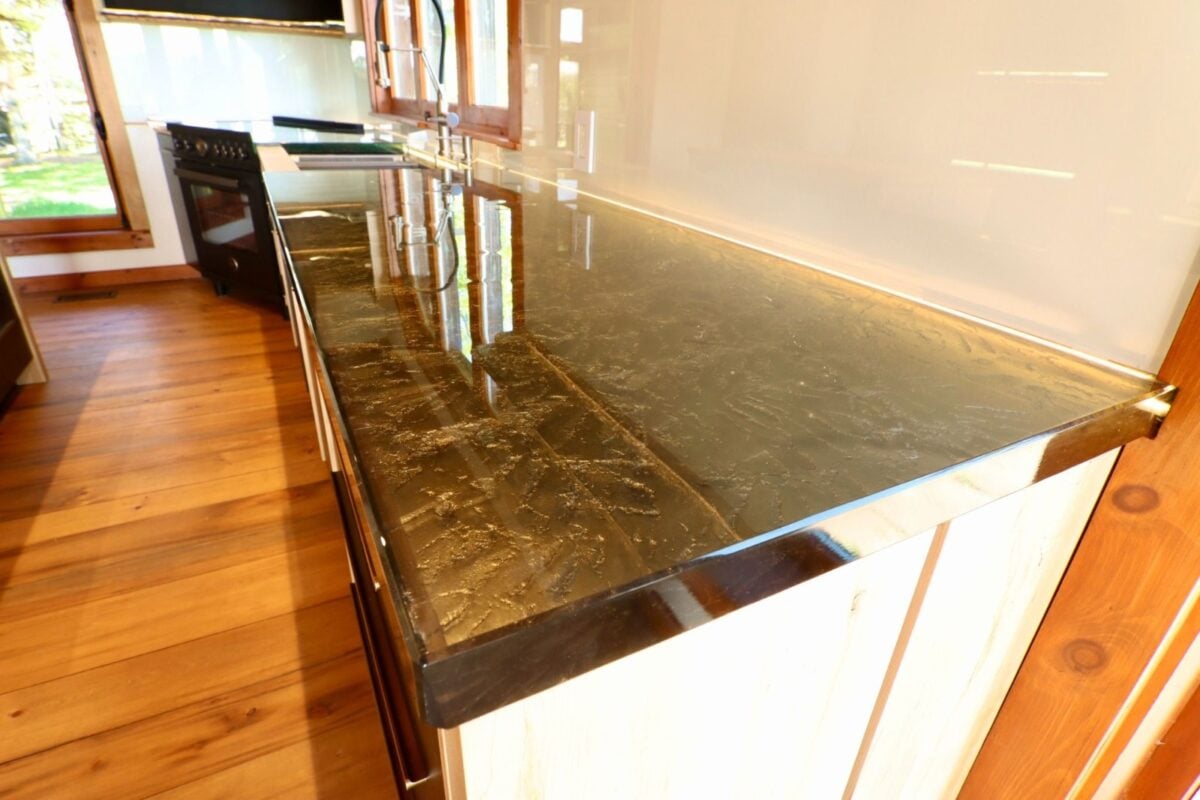 Bronze fused glass on a long farmhouse kitchen island. Photo: ThinkGlass.
Shape, edges and support: the details that make or break the effect
A statement island is judged from a few meters away, then touched up close. Both distances matter. Rounded ends and softened edges are back in favor; Homes & Gardens, in its October 2026 roundup of 2027 kitchen trends, lists rounded islands and softened countertop edges among the architectural curves designers are using, in moderation.
The waterfall end deserves its own budget line. It doubles the visible material, protects the island side from chairs and frames the slab like a sculpture. With glass, it also lets light run vertically down to the floor. In a ThinkGlass kitchen in St-Eustache, Quebec, a 1.5-inch (36 mm) glass island combines a waterfall leg, LED lighting, a cooktop cut-out and a custom stainless steel protective shoe at the base, the kind of detail that keeps a floor-level edge safe from mops and vacuum cleaners.
Mixing materials is the other lever. Since more than half of NKBA respondents expect the island to differ in color from the surrounding cabinetry, the countertop no longer has to match the perimeter either. Homes & Gardens describes kitchens pairing bold-veined marble on the counters with a concrete island, and designers experimenting with copper, zinc or colored lavastone on smaller surfaces. The principle works with any of the materials in the table: one surface carries the drama, the others stay quiet. A dark quartzite perimeter can frame a clear glass island; a calm white quartz run can let a heavily veined island slab take the spotlight. What rarely works is two statement surfaces competing in the same sightline, each weakening the other.
Support is the less glamorous part. Stone needs the right thickness and brackets for overhangs. Translucent materials need a base that preserves the glow: ThinkGlass recommends an aluminum laminate substrate under its countertops. My recommendation is simple: decide on lighting and support before choosing the slab, because both can rule out a material that looked perfect in the showroom.
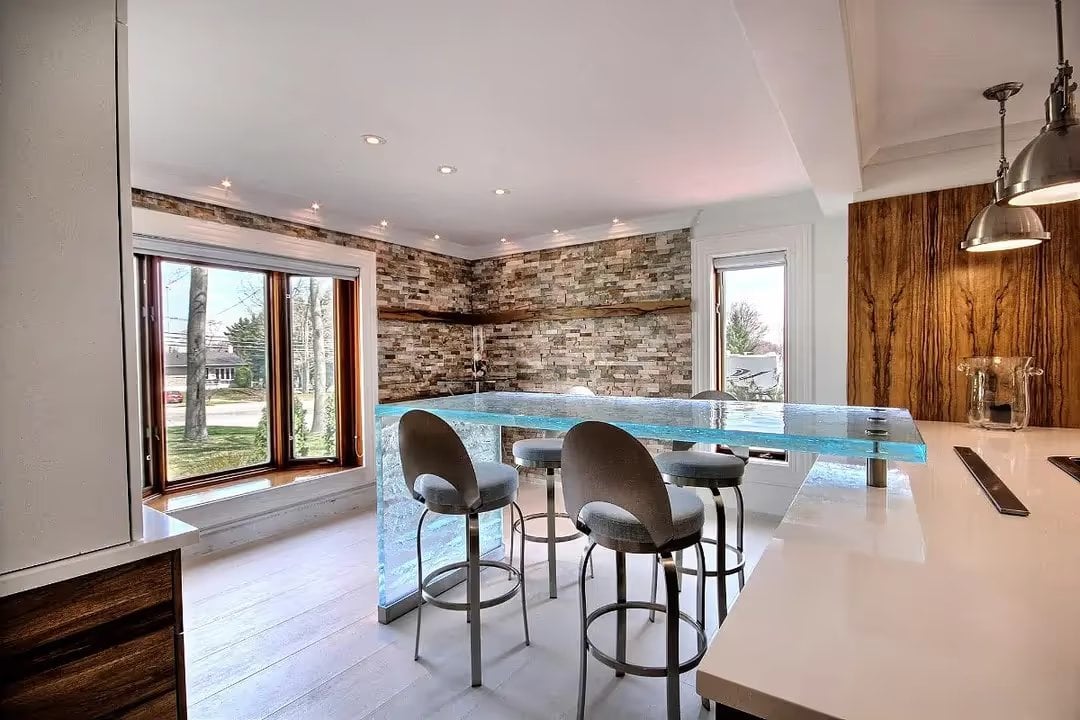 A glass bar with a waterfall leg, LEDs and a stainless steel protective shoe. Photo: ThinkGlass.
Frequently asked questions
What is the best countertop material for a statement kitchen island?
It depends on the effect you want. Quartzite gives unique natural movement, porcelain offers a light, heat-resistant stone look at a lower cost, and fused glass creates a thick, translucent surface that can be lit from within. Marble remains beautiful but needs more care on a working island.
How far can a stone island countertop overhang without support?
Conservative fabricator guidelines suggest about 10 to 12 inches for 3 cm stone and about 6 inches for 2 cm stone, with marble more limited. Beyond those spans, steel brackets or hidden supports are typically required. Your fabricator should confirm the limit for the specific slab.
Are porcelain island countertops durable?
Porcelain resists heat, stains and scratches and needs no sealing. Its weak points are the edges and corners, which can chip on impact, and the pattern, which is often printed on the surface only. Mitered edges help protect and disguise the thin profile.
Can a glass kitchen island hold a cooktop?
Yes. Fused glass countertops can be fabricated with precise cut-outs for cooktops and sinks. Thick glass islands with integrated cooktops and LED lighting already exist in residential projects, including a 3-inch island in Los Angeles.
Choosing the island you will still love in ten years
The best statement island is the one that keeps surprising you after the novelty fades. For some homes that means a quartzite slab with a vein that runs exactly where you wanted it. For others it is a surface that changes with light, evening after evening. Before committing, stand where guests will stand, look at a full sample under the lighting planned for the room, and ask the fabricator how the overhang and base will be built. The answers will narrow the list faster than any trend report.