Chicago has become one of the busiest e-commerce logistics hubs in the country. Industrial real estate researchers at Prologis found that Chicago, alongside Southern California and the New York region, captured the majority of e-commerce warehouse leasing nationwide in 2024.
That warehouse growth translates directly into more delivery vehicles on city streets. More fulfillment centers mean more daily delivery routes through residential neighborhoods, not just highways and industrial corridors.
Why Chicago’s Roads Are Absorbing More Delivery Traffic
A few forces are driving this shift:
- Same-day and next-day delivery expectations have pushed retailers to build smaller, local fulfillment hubs closer to residential areas.
- Warehouse space near Chicago remains in high demand, with last-mile facilities under 50,000 square feet leasing quickly due to their proximity to dense customer bases.
- Delivery route density has increased, meaning the same residential streets now see repeated passes from vans and trucks throughout the day.
This isn’t unique to Chicago, but the city’s position as a Midwest distribution hub means the effect is more concentrated here than in many other metro areas.
More Delivery Vehicles Mean More Complicated Crashes
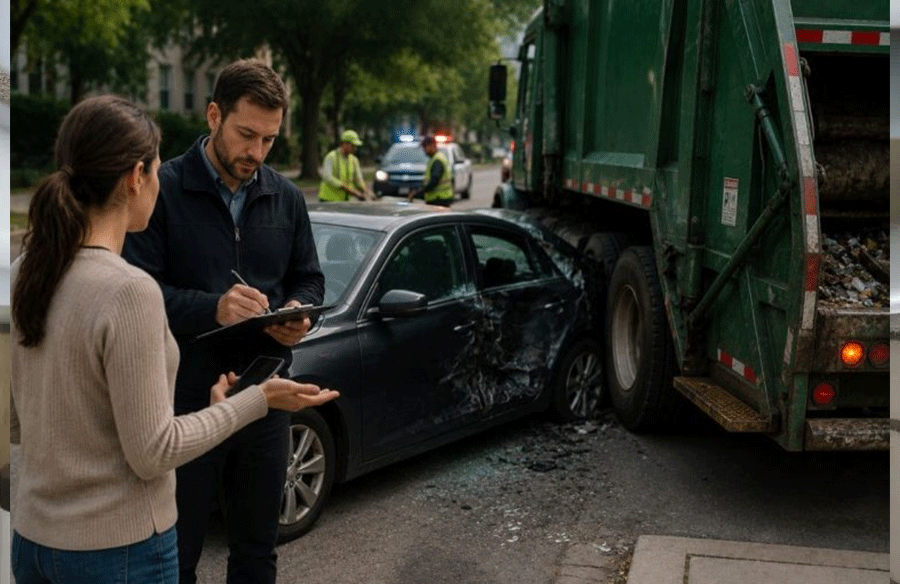
When a passenger car causes a crash, liability is usually a two-party question. Delivery vehicle crashes are rarely that simple.
A single delivery van on the road might be:
- Owned and operated by the retailer directly
- Operated by a third-party contractor working under the retailer’s brand
- Driven by a gig-economy driver using their own vehicle
Each of these arrangements shifts who is legally responsible when something goes wrong. That’s why, after any collision involving a commercial vehicle, contacting a Chicago auto accident lawyer early matters. Determining which company, insurance policy, or contractor applies to the claim often must occur before a case can move forward at all.
Commercial Trucks vs. Delivery Vans: Different Rules Apply
Large commercial trucks, such as semis and box trucks, that move freight between distribution centers operate under federal motor carrier regulations. These rules cover things like driver hours-of-service limits, vehicle inspection standards, and minimum insurance requirements.
Smaller last-mile delivery vans don’t always fall under the same federal framework, which creates a patchwork of rules depending on the vehicle type and operator. A Chicago truck accident attorney typically has to identify which regulatory framework applies before determining what evidence, like driver logs or maintenance records, is relevant to the case.
When the Vehicle Belongs to Amazon: A Different Liability Structure
Amazon’s delivery network adds another layer of complexity. Most Amazon-branded delivery vans aren’t driven by direct Amazon employees. They’re operated through Amazon’s Delivery Service Partner (DSP) program, in which small, independently owned companies handle the actual hiring, vehicle leasing, and day-to-day delivery work.
On paper, DSPs are separate businesses. In practice, court records in several recent cases have shown that Amazon frequently controls major parts of DSP operations, including:
- Setting delivery routes and package quotas
- Requiring specific driver training and safety protocols
- Monitoring driver speed, braking, and delivery times through its own apps
- Retaining the ability to remove individual drivers from a route
This level of control has become the central issue in a growing number of lawsuits. In 2024, a Georgia jury found Amazon 85% responsible for a crash involving a DSP driver and awarded a $16.2 million verdict after determining that Amazon exercised sufficient operational control to be treated as a joint employer. A similar case in South Carolina resulted in a $44.6 million resolution on comparable grounds.
Because DSP vehicles are generally required to carry a set minimum of commercial liability insurance, and that coverage isn’t always sufficient for serious injury claims, cases involving Amazon-branded vehicles often require determining whether liability extends beyond the DSP itself. This is the kind of case-specific analysis an Amazon truck accident lawyer in Chicago, IL, is typically brought in to handle, since it requires reviewing route data, driver monitoring records, and the contractual relationship between Amazon and the DSP.
What This Means for Chicago Drivers and Residents
A few practical takeaways follow from these trends:
- Delivery vehicle crashes are becoming more frequent as warehouse density and delivery volume rise across the metro area.
- Fault isn’t always obvious at the scene. The driver, the contracting company, and the retailer whose logo is on the van may all play different legal roles.
- Documentation matters more than usual. Vehicle branding, driver identification, and any visible company markings can be relevant later, especially when a third-party contractor is involved.
- Federal and state rules can both apply, depending on whether the vehicle involved is a commercial freight truck or a smaller last-mile delivery van.
Final Thoughts
Chicago’s growth as a logistics and e-commerce hub isn’t slowing down, and neither is the volume of delivery traffic moving through its neighborhoods and industrial corridors. As that traffic grows, so does the complexity of determining who is responsible when something goes wrong.
Understanding the difference between a standard commercial truck claim and one involving a contracted delivery network is often the first step toward accurately sorting out a case, rather than assuming the driver is the only party involved.