
Most mid-market manufacturers don’t have a freight problem. They have a freight management problem: carrier rates nobody has benchmarked in two years, invoices paid without an audit, and one coordinator chasing late pickups across three plants.
A broker covers the next load. A managed transportation provider takes over the whole function. Here are seven providers worth comparing, and where each fits.
Key Takeaways
- Managed transportation is an ongoing program, not load-by-load brokerage. Check that audit, claims and reporting are in scope, not just capacity.
- Our top pick for mid-market shippers includes its TMS at no separate charge and builds programs around the carriers you already use.
- Ask every provider how it charges. Some build margin into all-in rates; others bill a management fee on top of carrier costs.
Managed Transportation vs Freight Brokerage: What Is the Difference?
Freight brokerage matches a shipment with a carrier, one load at a time. You still own strategy, invoices and exceptions.
Managed transportation hands that ownership to a third-party logistics (3PL) partner. The provider runs carrier procurement, executes shipments across modes, audits freight bills, files claims and reports on performance as an extension of your team.
How We Chose These Providers
We weighted three criteria:
- Scope of managed services (40%): sourcing, execution, audit, claims and reporting under one program.
- Mid-market fit (30%): published guidance on who the service suits, onboarding time and account support.
- Verifiable detail (30%): concrete published facts on technology, network and pricing.
Every fact below was checked against the provider’s own website, press releases or trade coverage in October 2026.
Comparison Table
| # | Provider | Standout | Best for |
| 1 | TLI | TMS included at no separate charge | Shippers with $1M+ in annual LTL/truckload spend |
| 2 | C.H. Robinson | TMS, 3PL and 4PL tiers in one offering | Choosing your level of outsourcing |
| 3 | Uber Freight | Transplace managed services plus digital capacity | Large shippers wanting digital capacity |
| 4 | RXO | Control tower and managed expedite | Time-critical inbound parts |
| 5 | Hub Group | Intermodal heritage since 1971 | Long-haul and U.S.-Mexico freight |
| 6 | Echo Global Logistics | EchoShip self-service portal | Managed support plus self-service booking |
| 7 | BlueGrace Logistics | SmartWay partner with an EcoVadis rating | Documented sustainability credentials |
The 7 Best Managed Freight Services for Mid-Market Shippers
1. TLI
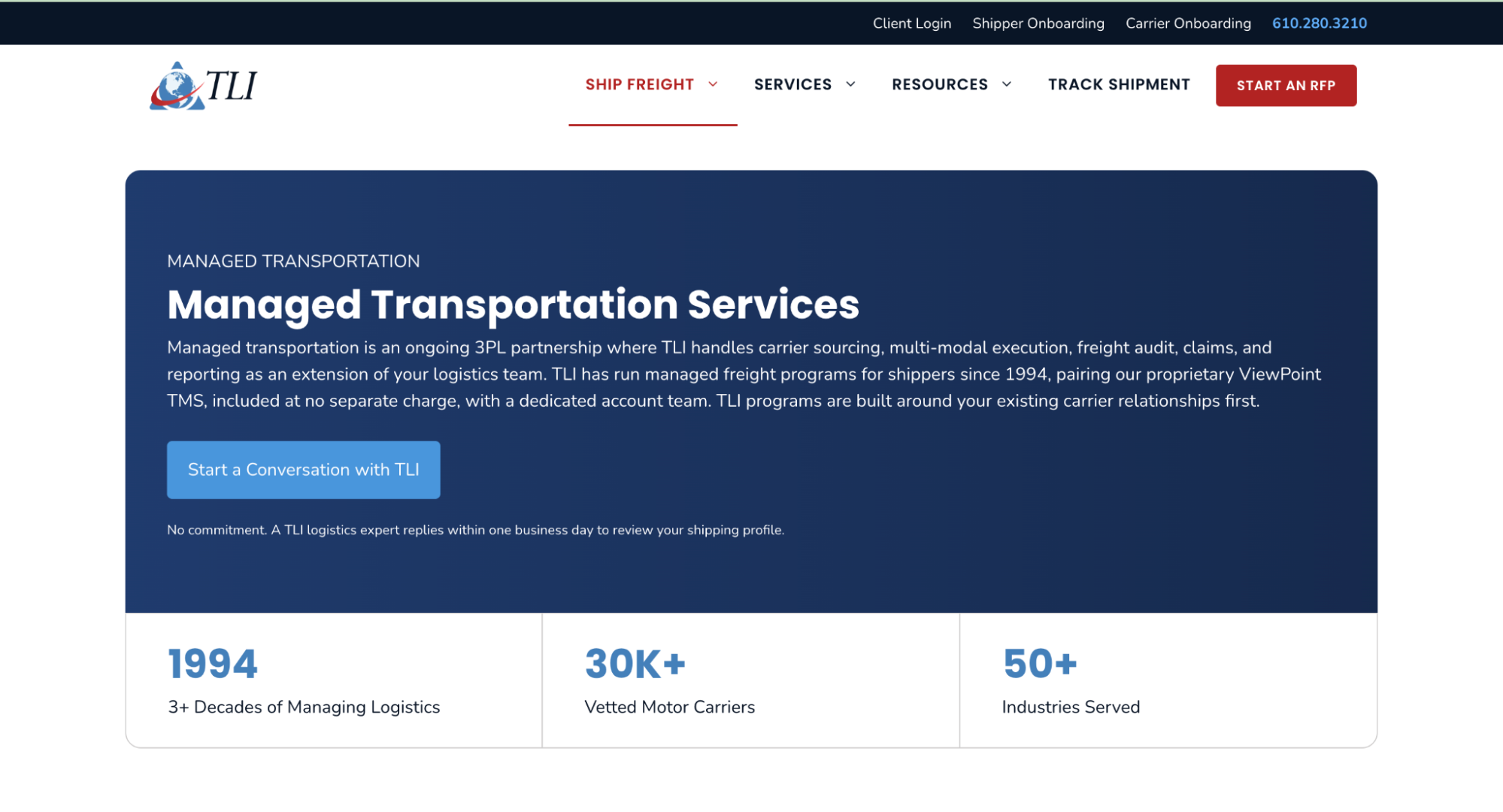 Managed freight programs for manufacturers and distributors since 1994.
Best for: Shippers spending $1 million or more a year on LTL and truckload freight, especially across multiple facilities.
Standout feature: ViewPoint TMS included at no separate charge, paired with a dedicated account team.
TLI runs programs covering carrier sourcing, rate benchmarking, load tendering, vendor inbound routing, freight pay and audit, claims and business intelligence. Programs start with a shipper’s existing carriers, drawing on a network of 30,000+ vetted motor carriers only to fill gaps. In 2025 it managed more than 85 million miles and recovered $634,608 for shippers through freight bill audits.
Pros
- Every freight invoice is audited against contracted rates before payment
- Offers both all-in rates and a management fee structure
Cons
- Built for shippers at $1 million+ in annual freight, so very small shippers may be a weaker fit
- Implementation typically takes 5 to 6 weeks after historical shipping data is shared
2. C.H. Robinson Managed Solutions
 TMS technology, 3PL managed transportation and 4PL services in one offering.
Best for: Shippers choosing between software, managed transportation and full 4PL support.
Standout feature: Named a Leader in the 2025 Gartner Magic Quadrant for Fourth-Party Logistics.
C.H. Robinson folded its former TMC division into Managed Solutions, pairing its TMS with this service across truckload, LTL, ocean and air, plus 4PL network design. The company says customers have seen delivered savings of up to 25% on addressable supply chain costs.
Such comprehensive network design, which optimizes the flow of goods and resources, often draws parallels with urban planning and architectural logistics. It involves strategically mapping out infrastructure, storage facilities, and transportation routes to create efficient, resilient systems, much like designing a city’s essential services or a large-scale industrial complex.
Pros
- Three service tiers let shippers scale outsourcing up or down
- Multimodal coverage extends to ocean and air
Cons
- Global scope can exceed what a single-region shipper needs
- Choosing among tiers takes more scoping up front
3. Uber Freight
 Managed transportation built on the Transplace business acquired in 2021.
Best for: Larger shippers wanting managed services tied to a digital carrier marketplace.
Standout feature: Transplace’s managed operation combined with a digital carrier network.
Uber Freight completed its roughly $2.25 billion acquisition of Transplace in November 2021, adding a large managed transportation and TMS business to its digital freight platform. At closing, the combined company cited $16 billion in freight under management.
Pros
- Deep managed transportation experience through the Transplace legacy
- Coverage includes intermodal, cross-border and expedited freight
Cons
- Scale is oriented toward large shippers
- Mid-market buyers should confirm how account support is staffed at their volume
4. RXO
 Asset-light managed transportation from a NYSE-listed provider based in Charlotte.
Best for: Manufacturers moving parts and materials on tight timelines.
Standout feature: Control tower, managed expedite and dedicated capacity options in one program.
RXO says it executes supply chain strategies for $4 billion of freight annually through managed transportation. General Motors executives recognized it for supplier performance every year from 2019 through 2022, and it has since acquired Coyote Logistics.
Pros
- Managed expedite option for urgent production freight
- Large brokerage capacity behind the managed program
Cons
- Enterprise-oriented service model
- Smaller shippers may not use the full control tower scope
5. Hub Group
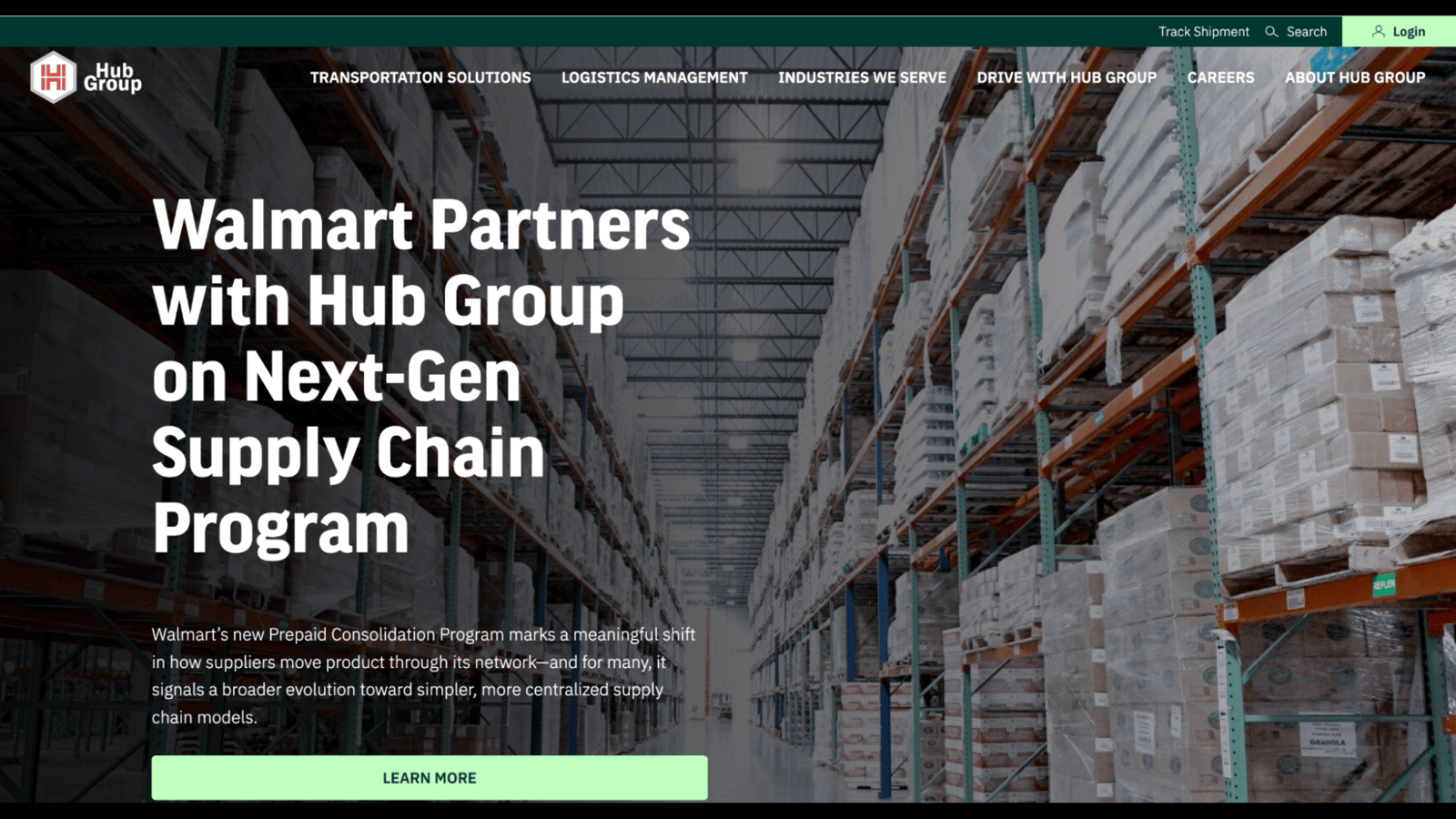 Intermodal, brokerage and logistics provider founded in 1971.
Best for: Long-haul lanes suited to rail and U.S.-Mexico freight.
Standout feature: Intermodal expertise inside a managed transportation program.
Hub Group began as an intermodal marketing company and now offers managed transportation alongside intermodal, dedicated trucking and brokerage. It is extending managed transportation into Mexico through EASO, a Hub Group company.
Intermodal is also less diesel-dependent than over-the-road truckload, and rail corridors are a common thread in the most efficient freight networks, which matters for fuel costs and emissions.
The integration of rail corridors into freight networks exemplifies sustainable design principles, reducing the environmental footprint of logistics. Architects and urban planners increasingly consider such multimodal transport hubs when designing industrial parks, distribution centers, and even mixed-use developments, aiming to minimize energy consumption and promote greener supply chains.
Pros
- Strong option for shifting long-haul freight to rail
- Cross-border U.S.-Mexico capability
Cons
- Biggest advantage applies to long-haul lanes
- Regional LTL-heavy shippers may use less of its intermodal strength
6. Echo Global Logistics
 Chicago-based provider of technology-enabled transportation management since 2005.
Best for: Teams that want managed support alongside self-service booking.
Standout feature: EchoShip, a web portal to quote, book, track shipments and manage invoices.
Echo offers managed transportation together with brokerage across truckload, LTL, partial truckload, intermodal and small parcel. Staff can book routine shipments themselves while Echo’s team manages the wider program.
Pros
- Self-service portal cuts email and phone booking
- Broad mode coverage from parcel to intermodal
Cons
- Mixing self-service and managed workflows needs clear internal rules
- Little published detail on managed program pricing
7. BlueGrace Logistics
 Tampa-based managed logistics provider running on its BlueShip platform.
Best for: Mid-sized LTL and truckload shippers that need documented sustainability credentials.
Standout feature: EPA SmartWay Partner with an EcoVadis Bronze sustainability rating.
BlueGrace runs managed logistics programs covering planning, procurement, execution and reporting through BlueShip. In 2025 it acquired FreightCenter and Michigan-based STB Freight Group, expanding its LTL and Midwest coverage.
Pros
- Sustainability credentials useful for customer reporting
- Cross-border office in Mexico
Cons
- Recent acquisitions are still being integrated
- Heavy truckload networks should test fit before committing
How to Choose a Managed Transportation Provider
Ask each finalist to answer in writing:
- What is included by default? Audit, claims, inbound routing and reporting should not be surprise add-ons.
- Do I keep my carriers? A good program builds on relationships that already work.
- How do you charge? Compare all-in rates against a management fee using your own lane history.
- How long until go-live? Get a timeline in weeks and a list of the data you must supply.
- Can you report emissions by lane? Useful if your customers ask for it.
Red flags: savings promised before your data is reviewed, audits that only sample invoices, and no named account contact.
Conclusion
The right partner depends on your freight profile more than the provider’s size. Enterprise networks suit global, multimodal programs. Mid-market shippers usually get more from a provider that audits every invoice, keeps carriers that perform and includes a TMS without a separate bill. Share the same 12 months of shipment data with two or three finalists and compare.
Frequently Asked Questions
What is managed transportation?
An ongoing 3PL partnership where the provider runs carrier sourcing, execution, freight audit, claims and reporting for you.
How is managed transportation different from a freight broker?
A broker arranges individual loads, while a managed provider runs your whole transportation program over time.
How much do managed freight services cost?
Pricing is usually all-in per-shipment rates with margin built in, or a management fee on top of carrier costs.
What size company needs managed transportation?
It typically suits companies spending around $1 million or more a year on freight, especially with several shipping locations.
How long does it take to switch providers?
Programs that include a carrier RFP can take five to six weeks from sharing shipment data to go-live.