Architects love to talk about glass, smooth concrete panels, and exposed steel. Walk down any downtown corridor and you will hear endless praise for clean facades and minimalist lines. What rarely gets talked about is what holds all of that ambition together from the inside out.
If you remove the finished surface, then every impressive modern building depends completely on a carefully balanced combination of aggregate materials taking on the main structural role; in that case, if the underlying foundation fails, the architectural masterpiece will come down with it. Design and geology are thus permanently linked.
That heavy reliance on raw earth comes with a massive global footprint.
The scale of that quiet dependence is staggering: in its May 2026 Sand and Sustainability report, the UN Environment Programme warns that around 50 billion tonnes of sand are used every year. It says extraction is already outpacing nature’s ability to replenish it and that sand use for buildings alone could rise by up to 45% by 2060.
Why Grading and Sourcing Change the Game
On an actual construction site, stone and sand are never merely used as “filler.” Contractors and engineers take hours to analyze the gradations, the moisture content, and the shape of the particles since small variations affect the performance of the mixture when it is under stress. Correct sieve distribution is what stops premature cracking, surface scaling, and the formation of voids during a large pour.
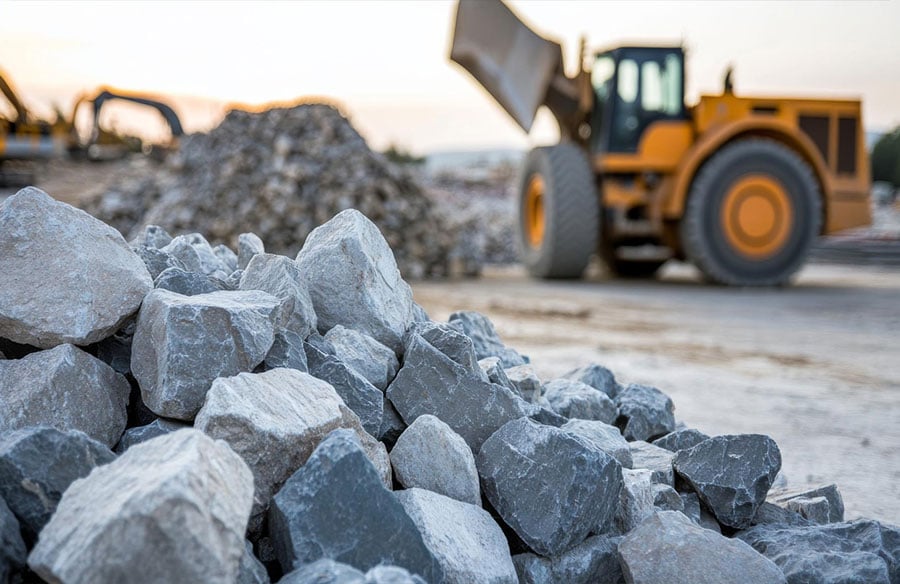
Angular crushed stone locks tightly under extreme loads, giving highway bases, foundational footings, and heavy-duty slabs their sheer compressive strength.
Washed, fine-screened sand fills the microscopic gaps between larger particles, keeping concrete dense, highly workable, and resistant to moisture infiltration over decades of weathering.
Coarser river gravel or specialized rock layers keep subsurface drainage moving smoothly, stopping destructive hydrostatic pressure before it can crack a slab or destabilize retaining walls.
When aggregate materials selection matches exact engineering specifications, crew productivity improves and material waste drops significantly. Proper sourcing guarantees consistent bulk density and particle uniformity across every truckload delivered to the jobsite, ensuring seamless execution from foundation to finish.
Aggregate materials: Shifting the Focus to the Ground Up
It’s not simply a question of inventing new finishes or using tinted panels to alter our methods of construction; it is also necessary to look in more detail at the local supply chains and the natural stone obtained directly from regional quarries. Understanding the physical and source constraints of the materials used will ensure the longevity of buildings, maintain budgets and provide a much more intelligent balance between modern architecture and materials.
Knowing the exact weight, size and density of each bulk delivery of aggregate is key. Having an effective distribution system will ensure that there is a continuous supply of high – quality stone and reduce costs caused by delays during construction. The final product will then meet the exact engineering standards. Overall, considering raw geology as an essential element of architectural design will create longer-lasting infrastructure and create a much higher level of accountability across the building process.