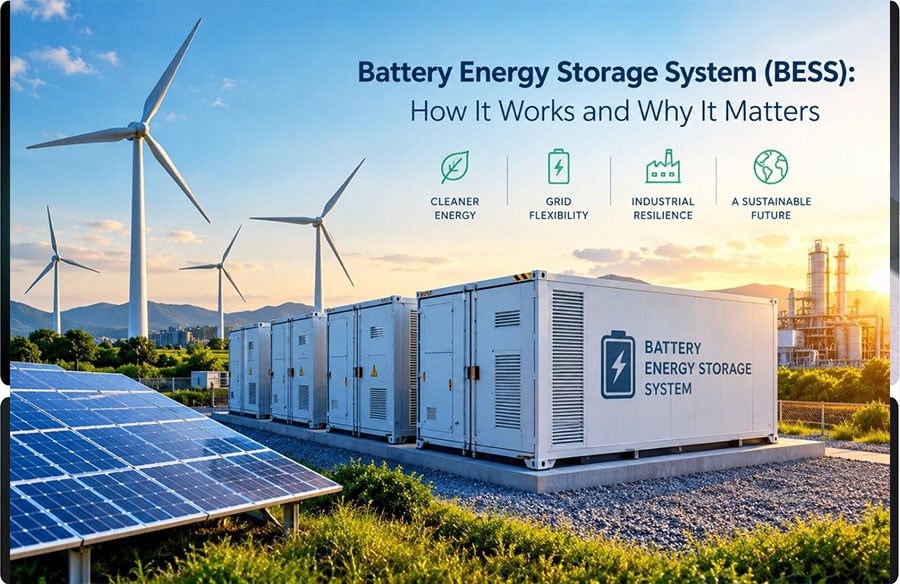
Solar panels generate electricity around midday, when the sunlight is at its peak; however, that energy is mostly used in the evenings in our homes or at business places. Battery Energy Storage Systems allow us to capture extra energy at times when we have it and provide it when we don’t. This is a straightforward solution to a complex problem.
Let’s take a look at how a BESS works and what goes into one.
What is a BESS and How Does It Work?
A Battery Energy Storage System contains many components.
- Battery Cells and Racks
The cells are put together into modules and then racked. Lithium Iron Phosphate (LFP) is the battery chemistry used most often. LFP has many benefits, including safety, thermal stability, and a high cycle life.
- Battery Management Systems (BMS)
The BMS monitors voltage, current and temperature within the battery cells. This helps prevent any problems that might lead to overheating.
- Power Conversion Systems (PCS)
Batteries store energy in DC. However, your home and the grid use AC. That means we have to convert the power with a PCS. It can easily convert AC to DC for charging and back from DC to AC when discharging.
- Energy Management Systems (EMS)
The EMS is the brains of the system. It automatically determines the best times to charge and discharge based on your solar output, grid conditions, and site demand. This can help with peak shaving and load shifting.
How does BESS work?
All BESS systems follow the same basic principles: charging, storing, and discharging energy.
Ideally, energy generated by your solar panels, wind turbines, or the grid is captured when electricity prices are lower or there’s surplus power available. This is then stored in the battery in chemical form until it is required (could be a few hours or the next day).
When demand increases, the system will convert the stored energy and give you usable energy. New systems can switch modes in milliseconds, unlike diesel generators or pumped hydro.
Why Battery Energy Storage System (BESS) Matters
There are three main benefits of energy storage:
- Reliability
Renewable power has natural variability, which can be overcome through energy storage. This means you can rely on your renewable energy long after the sun has set. In early 2026, AEMO reported grid batteries had more than tripled their ability to shift energy from daytime to evening. Delivering 1115MW to the evening peak.
- Cost
For homes, AEMO found homes with solar and battery reduced their net imports from the grid by 73% between 4 pm and 9 pm compared to homes with just solar. For businesses BESS is used for peak shaving, meaning they can use their stored energy at the highest tariff and demand charges. Prices have also come down. Between 2010 and 2025 battery storage costs have reduced by over 90% (IEA).
- Provides Backup & Grid Stability
BESS provides a backup solution during outages. They react instantly to quick fluctuations in supply and demand to keep the grid in balance. This can be invaluable to operations that cannot afford downtime.
Where Can We Use Battery Energy Storage Systems?
There are options at every scale.
- Residential & Small Business
Battery systems provide increased self-consumption when combined with rooftop solar. This decreases dependence on the grid during peak pricing. This also ensures critical systems remain up during a blackout.
Integrating such systems early in the design phase of a residential or small commercial building allows for optimized space planning and aesthetic integration, ensuring the technology enhances rather than detracts from the overall architectural vision. This foresight supports resilient design, where energy independence becomes a core feature.
- Commercial & Industrial Sites
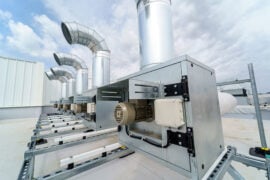
Larger cabinet systems can be deployed to provide peak shaving, backup and arbitrage (buy low use/sell high) within factories, warehouses and commercial sites.
For large-scale commercial and industrial architecture, the strategic placement and integration of BESS units can significantly influence facility layout and operational efficiency. Designers consider not only the energy benefits but also the structural implications, safety protocols, and spatial requirements for these substantial installations, often incorporating them into dedicated utility zones or even as visible, functional elements of the building’s exterior.
- Large Scale
Grid batteries have become a key aspect of the power market. In early 2026, grid batteries are determining the price in approximately 32% of trading intervals within Australia’s National Electricity Market. Worldwide, there was a jump in battery storage additions of approximately 40%, reaching 108GW in 2025. Australia added almost 8GW to its grid.
How To Find the Right BESS System
Not all BESS systems will be right for your project so here are a few things to consider:
- Chemistry & Lifespan
Take a look at cycle life, depth of discharge and warranty. LFP systems will generally have thousands of cycles which means they will last longer and will give you a lower cost per kWh. Find out where the cycles have been tested.
- Right Sized
Make sure you have the correct sized system by using your actual energy loads and solar generation. Having an oversized system will mean you are paying for something you don’t need. An undersized system will leave you short during peak times.
- Look For Standards
Look for recognized standards such as IEC 62619 & UN38.3 to make sure it has good thermal management and fire detection. Check if it is compatible with your inverter.
Summary
A BESS system will provide a stable resource from an intermittent source. Solar and wind can be used during off-peak times. This will reduce your electricity bills and allow you to keep essential services running. The technology works well, the math adds up and the grid is becoming increasingly reliant on this technology.
If you are looking into your options, take a look at the available range of BESS and renewable energy solutions to find the right system for your project.