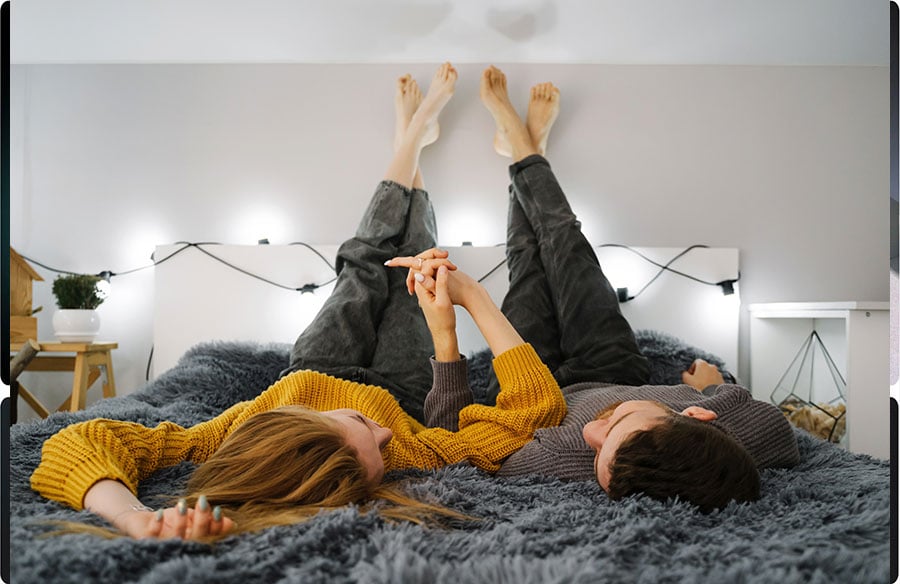
Sharing a bed is one of the quiet pleasures of a relationship, right up until one of you is kicking off the covers at 2 a.m. while the other reaches for a second blanket. Mismatched sleep temperatures are one of the most common bedroom complaints couples have, and they rarely get solved by fighting over the thermostat.
The better approach is to stop searching for one “right” temperature and start designing a bedroom that lets each person control their own. Here’s how to do that, from the room itself down to the surface you sleep on.
Why Two People Feel the Same Room So Differently
No two bodies regulate heat the same way. Metabolism, body composition, age, hormones, activity level, and even how late you exercised all affect how warm you run at night. Hormonal shifts, such as those during menopause, can change a person’s comfort range within a few months.
Temperature also shapes how easily you fall asleep. Core body temperature naturally drops as bedtime approaches, and the body sheds much of that heat through the hands and feet. In a study published in Nature titled “Warm feet promote the rapid onset of sleep,” Kräuchi and colleagues found that warmer extremities were one of the strongest predictors of how quickly people fell asleep.
That’s why a hot sleeper and a cold-footed partner can both be right about what they need. One is struggling to release heat; the other needs warm extremities to start that process. The design takeaway is simple: a shared bedroom shouldn’t depend on a single fixed setting. It should give each person room to adjust.
Start With the Room: Set a Cool Baseline
Most sleep guidance points toward a cool bedroom. The Sleep Foundation puts the ideal at about 65°F (18.3°C), and most experts cite a range of roughly 60–68°F. For couples, set the thermostat toward the cool end of whatever the colder partner can tolerate with extra layers. It’s far easier to add warmth to one side of a bed than to pull heat away from it.
A few room-level details make that baseline work:
- Automate the schedule. A programmable or smart thermostat can start cooling the room an hour before bed and hold a steady temperature overnight.
- Check the bed’s position. A bed under an AC supply vent or beside a drafty window creates an uneven split that no bedding can fix. Move the bed or redirect the vent.
- Manage humidity. Damp air makes heat feel worse, and very dry air can irritate. Use a dehumidifier in humid climates and a humidifier in dry ones.
- Block solar heat. Lined or blackout curtains, closed during the hottest hours, keep the room from storing heat. In winter, insulated curtains reduce heat loss through glass.
- Aim fans at a person, not the room. A fan doesn’t lower air temperature; it cools by moving air across skin. A small bedside fan pointed at the warm sleeper delivers that effect without chilling the other side.
Give Each Sleeper Their Own Bedding
Separate duvets are the highest-impact, lowest-cost change most couples can make. The Scandinavian approach, two individual duvets on one bed, lets the hot sleeper use a lightweight fill while the cold sleeper uses a heavier one. It also ends the nightly tug-of-war over the covers.
To keep the bed looking intentional rather than mismatched, coordinate color and texture: matching covers in two weights, or complementary tones like white and oatmeal. Share the fitted sheet and mattress protector, and split everything above them.
Fabric matters as much as fill:
- Cotton percale feels crisp and cool, a good fit for hot sleepers.
- Linen breathes well and handles moisture, which makes it strong in warm climates. It softens with every wash.
- Cotton sateen feels smoother and slightly warmer.
- Flannel or brushed cotton adds winter warmth for the colder partner.
Be skeptical of “cooling” labels on their own. How a fabric performs depends on the fiber, weave, and finish, not the marketing copy.
Choose a Sleep Surface With Temperature in Mind
The mattress is where body heat builds up, so it deserves attention. Dense traditional memory foam tends to hold heat. Latex, hybrids with coil cores, and open-cell or perforated foams generally breathe better. Still, no material guarantees a cool night, because protectors, sheets, and room conditions all add up.
Motion isolation matters too. A hot sleeper who tosses and turns can wake a partner, so a mattress that limits motion transfer softens the knock-on effect.
For couples with large, persistent differences, the most direct fix is to control temperature at the sleep surface itself, separately on each side. Dual-control electric mattress pads are the familiar entry point, though they only add heat. Active systems go further by both cooling and warming.
A newer category adds zoning within each side. A four-zone temperature-controlled mattress cover such as OVAL Adapt sits on top of an existing mattress and adjusts each side of the bed independently, with separate upper- and lower-body zones. In practice, one partner can sleep cool while the other keeps their legs and feet warm, which lines up with the warm-feet research above.
Before buying any active system, check that it fits your mattress size and depth. Also ask about noise, upkeep, and whether key features require a subscription.
Create Subtle Temperature Zones Around the Bed
Treat each side of the bed as its own microclimate.
- The hot sleeper’s side: a bedside fan, a lightweight duvet, and breathable sleepwear within reach. Keep decorative throws and stacks of pillows off this side, since they trap heat.
- The cold sleeper’s side: a folded blanket in a bedside basket, warm socks in the nightstand, and, if used, a heated pad or electric blanket with its own control.
Always use heated bedding according to the manufacturer’s instructions. Choose models with automatic shutoff, and replace anything with damaged cords or controls.
Let Sleepwear Do Some of the Work
Sleepwear is the cheapest temperature control you own. Hot sleepers do best in loose, lightweight, breathable fabrics. Cold sleepers can layer with long sleeves, light thermals, and especially socks. Given the role warm feet play in falling asleep, bed socks are a small change that can help the colder partner without warming the whole bed.
Keep the Design Cohesive
Practical fixes don’t have to look like a compromise. A shared headboard and consistent bed frame anchor the room, and coordinated duvet covers make two weights look deliberate. Matching nightstands give each person storage for their own comfort items. Warm, dimmable lamps on each side let both partners wind down on their own schedule without lighting the whole room.
Agree on a Routine
Design handles most of the problem; a short conversation handles the rest. Agree on a starting thermostat setting, then manage individual comfort through bedding, sleepwear, and side-specific tools instead of changing the room at midnight. Revisit the setup when the seasons change, because what works in July rarely works in January.
If one partner develops persistent night sweats, a sudden change in temperature tolerance, or ongoing sleep disruption, talk to a doctor. Bedroom design improves comfort, but it can’t treat an underlying medical cause.
The Bottom Line
Couples don’t need to agree on one temperature to sleep well together. Start with a cool, stable room, split the bedding, choose fabrics that breathe, and give each side of the bed its own controls. That can be as simple as a fan and an extra blanket, or as precise as a zoned sleep surface. The best bedroom for two isn’t the one with the most expensive gear. It’s the one designed so neither person has to trade their sleep for the other’s.
References
- Sleep Foundation, “Best Temperature for Sleep”
- Kräuchi, K., Cajochen, C., Werth, E., & Wirz-Justice, A. (1999). Warm feet promote the rapid onset of sleep. Nature, 401, 36–37.