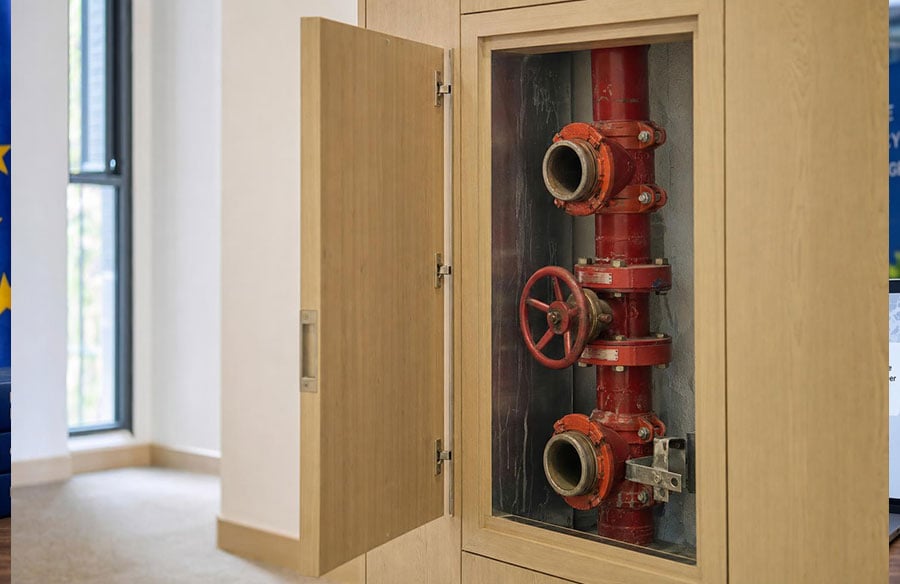
A sprinkler riser behind a flush door may be accessible at handover.
If a cleaner’s cupboard later blocks the door and a shelf sits across the control valve, the inspector has to work around those obstacles.
Fit-out and storage decisions can make an unchanged system harder to maintain.
Owners manage fire protection system maintenance after occupation, but design decisions affect how easily that work can be done.
NFPA 25 addresses inspection, testing, and maintenance of water-based fire protection systems. For United States projects, confirm its local adoption and requirements.
Readers elsewhere should check their jurisdiction’s rules before treating it as binding.
Key takeaways
- Distinguish recurring inspection, testing, and maintenance from acceptance of a new installation and review of its design.
- Keep equipment and inspection routes accessible after fit-out, including exterior fire department connections.
- At handover, identify the owner’s designated representative and where test reports and repair records will be kept.
Where NFPA 25 fits after handover
ANSI’s listing describes NFPA 25 as the baseline for inspection, testing, and maintenance of water-based fire protection systems.
These systems include sprinklers, standpipes, fire pumps, and private water supplies.
Fire alarms, portable extinguishers, and passive protection such as rated walls follow separate requirements.
NFPA 25 focuses on systems already in service. Texas State Fire Marshal guidance states that a licensed maintenance inspector is not responsible for determining whether a system was designed and installed properly.
This describes a Texas licensing role rather than a national liability rule.
Acceptance testing addresses a new installation; recurring upkeep checks an in-service system’s condition and performance within the scope of the work.
If the building changes, a fire protection engineer may need to assess whether the original design still suits its use.
Inspection, testing, and maintenance. Inspection examines condition, such as visible pipe damage or a gauge reading.
Testing operates a system or component to produce measured results. FLOW’s explainer describes flows, pressures, and times as examples of results captured in a test report.
Maintenance covers upkeep and repairs. The provider-written explainer offers a useful introduction to these activities; use the applicable standard and local authority’s requirements for compliance decisions.
Published edition versus adopted edition. ANSI lists the 2026 edition, and NFPA issued an erratum in October 2025 and two tentative interim amendments in December 2025.
Publication does not establish which edition a project must follow. That depends on local adoption, often through a building or fire code.
Confirm the edition and applicable amendments with the authority having jurisdiction (AHJ), the official or agency responsible for enforcement, before writing specifications or handover notes.
Design for access throughout the building’s life
RTF’s earlier article on plumbing access argues that maintenance access and interior design can work together. The same approach applies to water-based fire protection.
Keep equipment reachable. Walk the routes to risers, control valves, the fire pump room, test connections, drains, and private hydrants with the fire protection designer before layouts are fixed.
Ask where a technician stands, what they carry, and where test water discharges. Access-panel sizes, equipment-removal routes, and discharge arrangements are project-specific.
Confirm them with the designer and the AHJ rather than assuming a dimension. Outside the building, Fairfax County’s business-occupancy checklist asks whether hydrants and fire department connections are unobstructed and readily accessible.
Planting beds, bike racks, and bin stores can obstruct that access.
For supplementary background on inspection, testing, and maintenance, FLOW’s provider-written NFPA 25 explainer can be read alongside the applicable standard and local authority’s requirements.
Coordinate finishes around inspection. Redmond, Washington, states in its reliability guidance that all sprinkler heads require visual inspection except those in concealed spaces.
Its guidance explains why an annual inspection cannot rely on a sample of apartments. Coordinate ceilings, joinery, and decorative screens so they do not obstruct required inspection access; confirm which elements need access before detailing finishes.
The standpipe amendment issued for the 2026 edition in December 2025 states that pipe and fittings are to be free of mechanical damage, leakage, and corrosion.
A qualified inspector should assess visible condition and determine appropriate follow-up. A surface mark alone does not establish a need for replacement.
Revisit access when layouts change. In a hypothetical conversion of an office floor into a clinic, new partitions enclose the corridor containing the inspector’s test connection.
A built-in reception desk covers a drain, and a planter screens the fire department connection at the entrance. Even without changes to the pipework, these moves should prompt an access review.
An earlier inspection report describes the condition observed at that time; it cannot account for later layouts. Review landscaping and storage changes for the same reason.
Make maintenance part of the handover
Handover should give the owner clear responsibilities and usable maintenance information. The following checklist helps organize that package.
Confirm required documents and procedures against the applicable edition and the AHJ’s requirements.
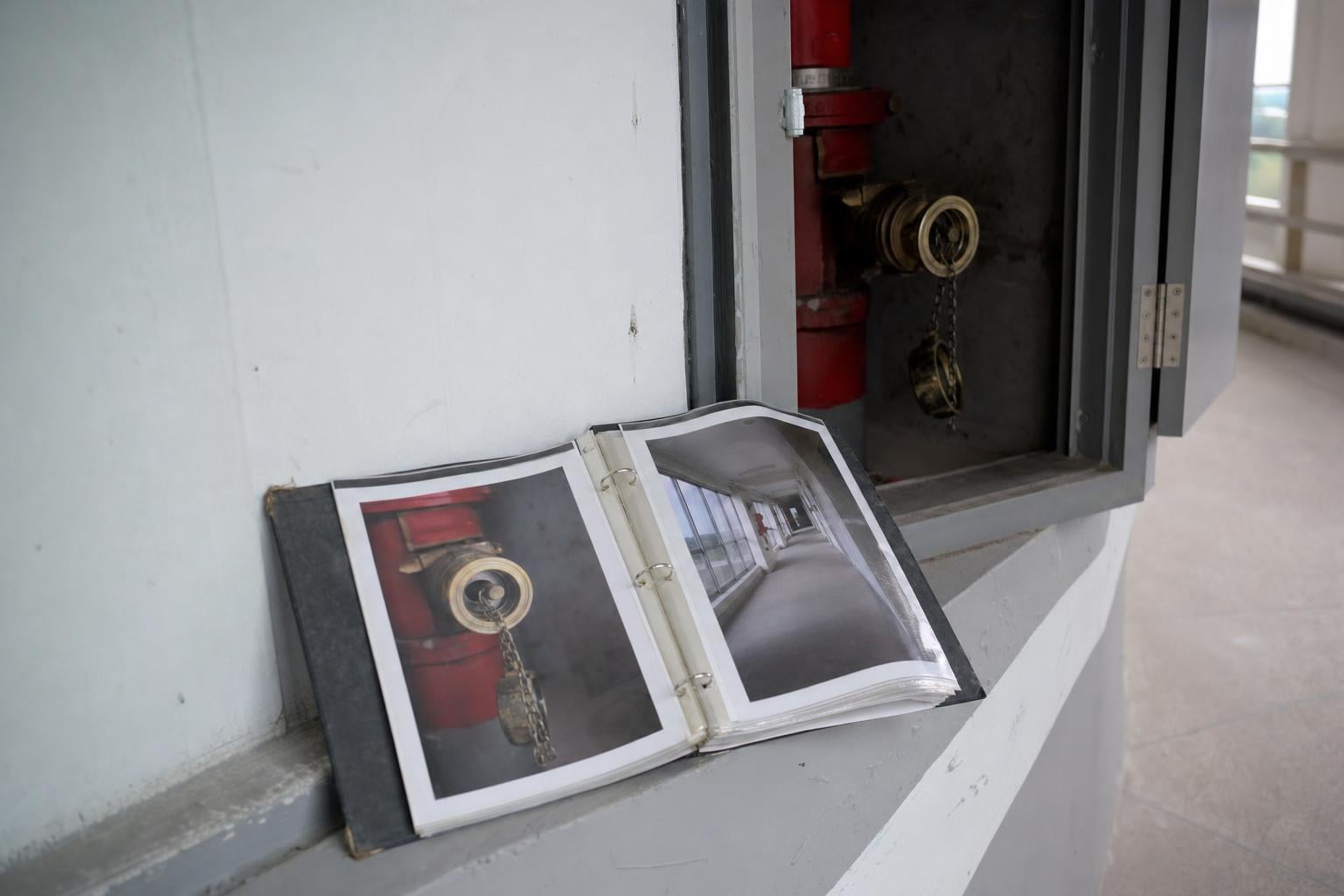 Identify responsibility. The corrected 2026 text assigns correction or repair of deficiencies and impairments to the property owner or designated representative, and specifies qualified personnel for the work.
Identify the owner’s representative and the contractors responsible for inspection, testing, maintenance, and repairs.
Confirm licensing requirements locally. Keep the architect’s coordination role distinct from the contractor’s maintenance work.
Make records usable. Fairfax County’s code-reference package for the 2021 Virginia code calls for written fire pump and standpipe test and maintenance records that can be made available to the code official on request.
Check the applicable retention requirements rather than assuming a standard period.
A usable handover package includes system locations and drawings, available installation and acceptance information, manufacturer instructions, a task schedule tied to the applicable edition, contractor contacts, and a place to file findings and corrective actions.
FLOW’s explanation of measured test results helps clarify what test reports contribute to that package.
Keep those reports with the related findings and records of corrective work.
For related background, owners can consult material on regular sprinkler inspections alongside the project records.
Plan for interruptions. An impairment is a condition in which a system or part of it is out of service, whether for planned work or because of a failure.
Before planned work, confirm the required notifications, tagging, temporary protection, and restoration arrangements with the owner and fire protection specialists.
The applicable standard and the AHJ govern those arrangements. As a local example, Fairfax County’s pre-demolition guidance requires signage and tags identifying all out-of-service fire protection systems.
For occupied refurbishment, confirm the project’s own requirements and record the agreed notification and identification procedures in the project documents.