Ceiling fans with lights deserve a place in the design brief before the furniture arrives. They occupy the same visual field as beams, pendants, and recessed lighting, so choosing one only by finish leaves important decisions unresolved. For homeowners comparing AirSurferHome ceiling fans with lights, the useful starting point is the room itself: its proportions, ceiling conditions, lighting needs, and everyday routines. These seven decisions provide a practical shortlist for selecting a fixture that belongs in the interior.
1 Plan ceiling fans with lights around the occupied zone
Start with a simple furniture plan. Mark where people sit, sleep, work, and walk, then consider the fan in relation to those areas. In an open living and dining room, the geometric center of the ceiling may not align with the seating group that needs air movement. A decorative pendant over the table can remain a separate decision.
Review the ceiling plan alongside the floor plan. Beams, tall cabinets, and existing fixtures can narrow the usable position. Establish a workable location before selecting a blade shape or treating the fan as a purely decorative accessory.
2 Check ceiling height before choosing the silhouette
An appealing profile is only useful if the mounting arrangement suits the room. Record ceiling height and note slopes or changes in level. Compare those conditions with each model’s installation instructions rather than assuming that every fan accepts the same downrod or mounting kit.
For a lower ceiling, investigate models designed for that application, but do not assume a flush mount automatically makes every room suitable. Required blade clearances and structural support still need verification. Have a qualified installer assess the mounting point and electrical compatibility before ordering.
3 Compare ceiling fans with lights by scale and airflow
Blade span changes how a fixture reads against the ceiling, but visual proportion is only one part of selection. Compare the manufacturer’s room guidance and published airflow information for the models being considered. A larger diameter alone does not establish how a particular fan will perform in your layout.
In a compact room, sketch the full blade circle rather than judging the small motor housing. In a broad room, consider the occupied zones and potential obstructions. This prevents a familiar size from becoming the default without reference to the actual space.
4 Keep the fan light within a layered lighting plan
Treat the integrated light as one contributor, not an automatic replacement for every other fitting. Reading chairs, kitchen worktops, and mirrors may need their own dedicated light. Decide what the fan light must do before comparing its appearance.
Check the stated light output, color temperature options, and dimming compatibility for the exact model. Coordinate the chosen light with nearby lamps and fixtures rather than relying on product photography. If the room already has carefully planned task lighting, the fan can support the overall scheme without becoming its brightest visual feature.
5 Choose the finish from the whole ceiling composition
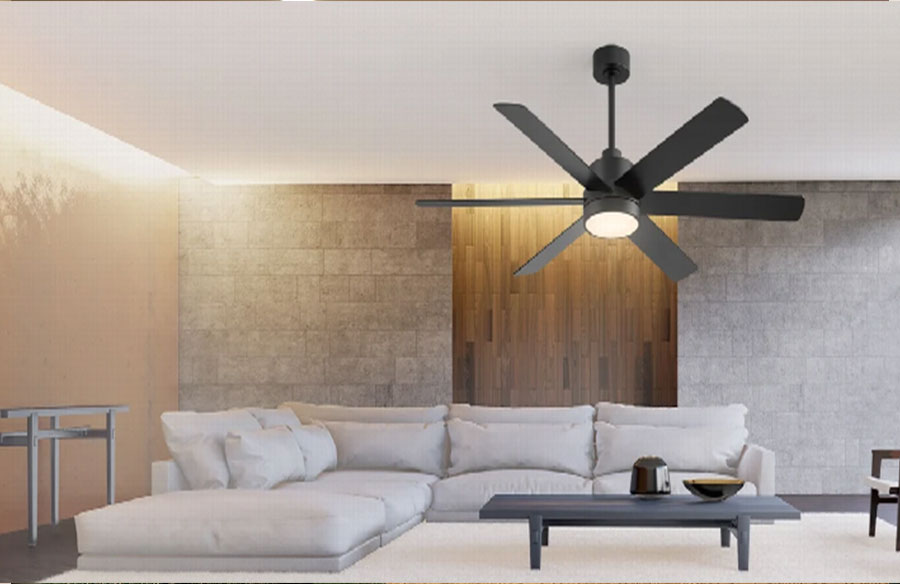
A white fixture can be worth considering against a pale ceiling when a quieter visual presence is desired. A contrasting finish may suit a room where the fan is intended to be visible. Neither approach is inherently better; the decision depends on what else competes for attention overhead.
Compare finish samples or reliable close-up photographs with the room’s hardware, timber, and lighting. Look beyond the blade color to the motor housing, light diffuser, and canopy. These smaller components remain visible and can affect whether the installation feels coordinated.
6 Specify controls around daily use
Write down the actions occupants actually need: switching the light without running the fan, adjusting air movement from bed, or finding a control when entering the room. Check which of these actions the model supports and whether the necessary controls are included.
Do not assume that an existing wall dimmer, smart switch, or remote will be compatible. Ask about the intended wiring and approved control arrangement before installation. A household should also know where the remote will live and how ordinary operation works when a preferred control is unavailable.
7 Plan maintenance before committing to the fixture
Consider how the fan will be reached for routine cleaning and how its lighting components can be serviced. Ask whether the model uses replaceable lamps or an integrated light module, and check the availability of replacement parts. These questions belong in the specification stage, not only after a component fails.
Review the care instructions, warranty terms, and installation documentation for the exact product. A visually appealing design is a stronger choice when the owner also understands its maintenance requirements. Avoid treating a broad collection description as a guarantee that every model has identical features.
A shortlist to take to the installer
| Room condition | Decision to resolve | Information to check |
| Lower ceiling | Suitable mounting profile | Mount type and required clearances |
| Open living area | Fan position and scale | Occupied zones and published airflow |
| Layered lighting | Role of the integrated light | Output and control compatibility |
| Bedroom | Convenient independent operation | Included controls and model specifications |
Choose the room before choosing the finish
A successful shortlist starts with the space and ends with a model whose documentation supports the design. Measure the room, map the ceiling, define the lighting role, and confirm the controls with the installer. Then compare finishes among the options that remain suitable. This sequence keeps a ceiling fan with lights connected to the architecture and the people using it, rather than making it an isolated purchase.