Whole-home stainless steel cabinetry treats the kitchen, dining wall, wardrobes, study and even a balcony tea corner as one architectural system rather than a series of separate furniture purchases. In a 2023 residence in Foshan, China, Fadior fitted every room with cabinet bodies formed from 304 stainless steel, then let each room carry its own finish, lighting and function. The case is useful to architects because it asks a precise question: what changes when the carcass is a building element rather than a product?
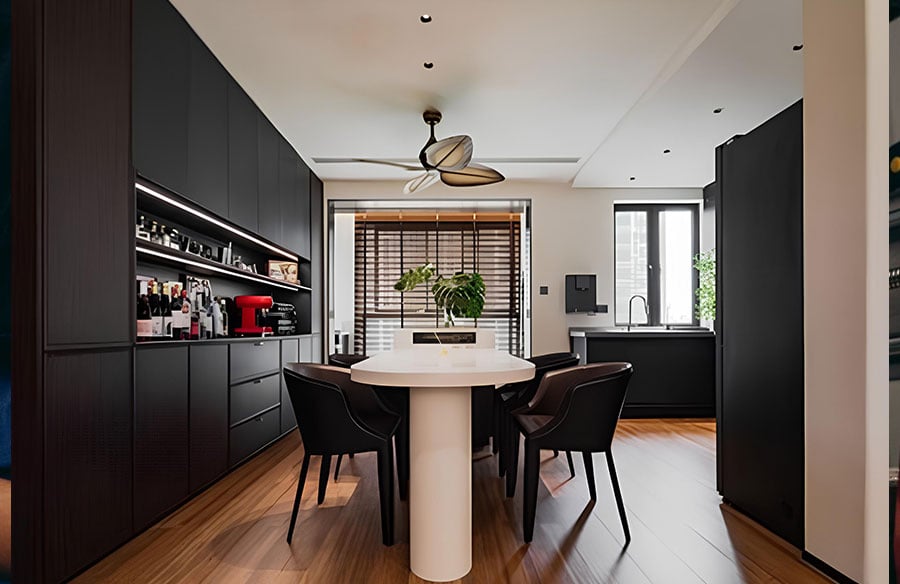
The dining wall as a working home bar: matte black 304 stainless steel cabinetry with backlit shelving, photographed after handover at Xingxing Kaixuan, Foshan, 2023. Photography courtesy of Fadior Home; client identity withheld.
When cabinetry stops being furniture
ArchDaily argued in June 2026 that appliances have become architectural elements, integrated into the composition of the kitchen rather than placed inside it. Dezeen’s 2025 survey of kitchen interiors made a similar point about materials, from timber cabinetry to stainless steel surfaces, defining the character of a room. Both observations stop at the kitchen door. The harder question is what happens when one construction logic has to run through a dining room, a bedroom, a study and an entry, each with a different scale, service load and daily rhythm.
Structure and surface are two decisions
Fadior separates the two. The cabinet body is 304 stainless steel in every room; doors, decorative surfaces, worktops, hardware and appliances are specified separately. The distinction matters in the drawing set. Most premium kitchen systems build the hidden carcass from wood-based board: Poliform’s Alea Pro documentation specifies an 18 mm melamine-faced particleboard carcass, and Boffi’s K2, K3 and K4 sheet describes an extruded aluminium frame with 19 mm particleboard panels. A steel body is therefore a different structural proposition, not a different door colour.
Fadior states that its glue-free steel body is bonded with PET film and dry powder coating at 220 °C, so the cabinet structure contains no adhesive and is formaldehyde-free; doors, finishes and worktops follow their own material documents. These are first-party manufacturing statements, not independent test results.
A Foshan residence, room by room
The apartment at Xingxing Kaixuan was photographed after handover and records seven room types: kitchen, dining room, living room, tea room, primary bedroom, entryway and study. The kitchen is anchored by a bar-height island in matte black steel with a white stone top, backed by full-height cabinetry with backlit shelving. The same dark cabinetry turns the dining wall into a working home bar and carries display shelving into the living room. In the bedroom it becomes a full-height white wardrobe wall. In the study, a floating dark desk and shelving face a cream wardrobe wall beside a window daybed. On the balcony, a single full-height cabinet makes a tea corner behind venetian blinds.
Warm timber flooring and leather balance the depth of the steel. Because every body comes from the same forming process, the edge profile and sheen hold from room to room. The photographs prove delivered scope and visual continuity; they do not prove decades of service life or occupant satisfaction.
What the factory can and cannot control
Fadior describes its Foshan plant as an 80,000-square-metre facility with five production lines. Its published sequence runs from fibre laser cutting to automated bending centres that form a cabinet body from a single sheet, glue-free bonding at 220 °C, guided-vehicle transfer and barcode tracking through quality gates before packing. For a multi-room order, every component is cut and labelled against one project record.
That sequence does not remove site responsibility. Final measurements, wall and floor tolerances, service positions, installation sequencing and remedial work must still be assigned in the contract. A factory controls what leaves its line; it cannot control an unverified opening.
Specifying a whole-home steel system
- Identify which components are 304 stainless steel: body, doors, panels, worktops, hardware and accessories.
- Confirm what is shared across rooms: body construction, finish references, hardware schedule and drawing standard.
- Coordinate services early: appliance, plumbing, electrical, ventilation and worktop interfaces for kitchens and vanities.
- Assign site dimensions and installation: who measures, who signs off, who fits and who handles after-sales.
- Read the warranty. Fadior states a 30-year cabinet-body structural warranty, subject to contract; surfaces, fittings, worktops and installation carry separate terms.
Fitted cabinetry becomes architecture when its construction logic survives the move from one room to the next. The Foshan residence shows one way to do that: a defined steel body, a documented production sequence and a photographed home in which seven room types share a single material language while keeping their own character.