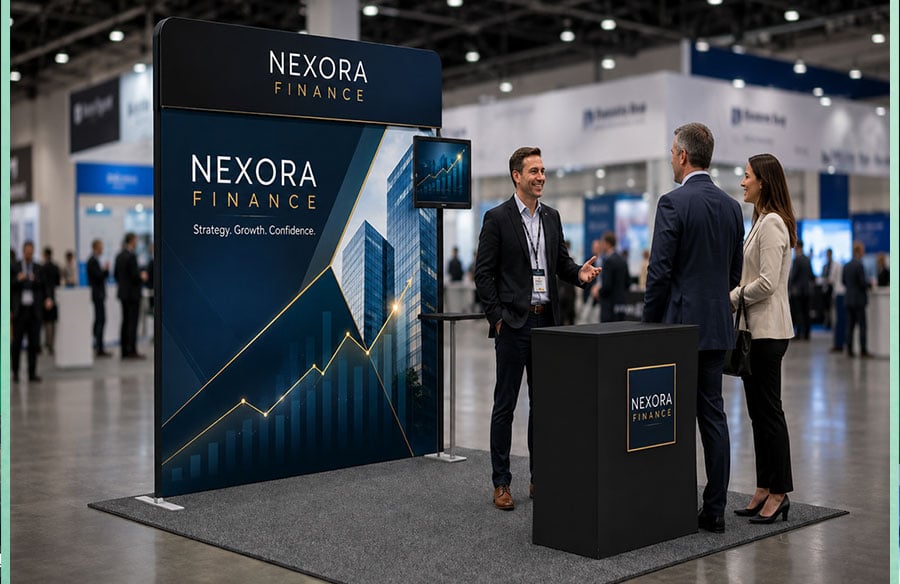
A startup walking into a major expo floor for the first time is competing against companies with ten times the budget and twenty times the booth space. That’s not a reason to stay home. It’s a reason to compete on the things budget doesn’t automatically win: attention, curiosity, and a reason to remember one specific table out of two hundred. Here’s what actually separates the startups people talk about after an expo from the ones nobody noticed.
Invest in a Professional Display, Not a DIY One
Attendees form an opinion about a company’s stability within seconds of walking past its booth, long before anyone from the team says a word. A sagging banner, a wrinkled backdrop, or a folding table with a printed sign taped to the front reads as underinvestment, and underinvestment reads as risk to anyone evaluating whether a young company is worth their attention.
This doesn’t require a massive budget. A properly built backdrop with dye-sublimated graphics holds its color and shape across dozens of events, so a startup can invest once and reuse the same professional presentation at every show that follows. Founders building a repeat presence on the trade show circuit often start with a custom canopy tent canada startups and small businesses actually rely on for outdoor activations and expo overflow spaces, while a compact custom canopy tent 10×10 covers a standard indoor booth allocation without overspending on square footage a young company doesn’t need yet.
Say One Thing, Loudly
The biggest messaging mistake at any expo is trying to explain the entire business on the booth itself. Attendees walking a crowded floor process visual information in a second or two, and a wall of text describing every feature gets skipped entirely. One sharp headline describing the actual problem the startup solves, in language a stranger understands without context, does more work than a paragraph ever will.
Keep supporting details, pricing, technical specs, integrations, for the actual conversation once someone stops. The booth’s job is to earn that stop, not close the sale from across the aisle.
Give People a Reason to Physically Stop
Passive booths get passive attention. A live product demo, a hands-on element, or even a simple interactive screen gives attendees a concrete reason to pause instead of glancing and continuing on. This matters even more for startups specifically, since a working demo does something a slide deck can’t: it proves the product actually exists and functions, which is exactly the kind of proof-of-legitimacy a new, unfamiliar company benefits from most.
Smaller touches work too. A quick two-question survey with a visible, growing result, a small giveaway tied to a specific action, or a genuinely useful sample all create a moment of engagement that a static booth can’t replicate.
Make the Next Step Obvious
A visitor who’s interested but unsure what to do next usually does nothing. Every booth needs one specific, visible call to action, not “learn more,” but something concrete like “scan for a free trial,” “book a 15-minute demo,” or “get your first month free.” Vague language creates hesitation. Specific language creates action.
Place that call to action somewhere visible from a few steps away, not buried on a business card someone has to be handed first.
Think About Where and How the Booth Sits in the Space
Booth placement within a floor plan matters, but so does how the booth uses its own footprint. An entrance blocked by a table pushes visitors away before they’ve even decided whether to stop. Keep the front open, position staff to the side rather than behind a barrier, and make sure the most eye-catching visual element, whether it’s a screen, a product, or bold graphics, is visible from the main aisle, not tucked toward the back.
Consistency Compounds Across Events
A startup that shows up looking slightly different at every expo, a new banner here, a borrowed table there, never builds the visual recognition that turns “I think I’ve seen this company before” into a real memory. Reusing the same coordinated display, colors, and messaging across every event builds that recognition over time, and it’s one of the few competitive advantages available to a young company that doesn’t depend on outspending anyone.
Standing Out Isn’t About the Budget Gap
The startups that leave a strong impression at a crowded expo rarely have the biggest booths on the floor. They have the sharpest message, the most inviting setup, and a specific reason for a stranger to stop walking. Get those three things right, and a compact booth competes just fine against a company ten times its size.