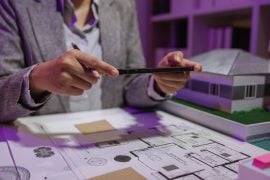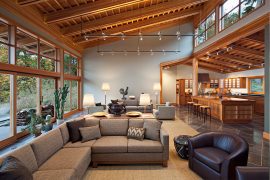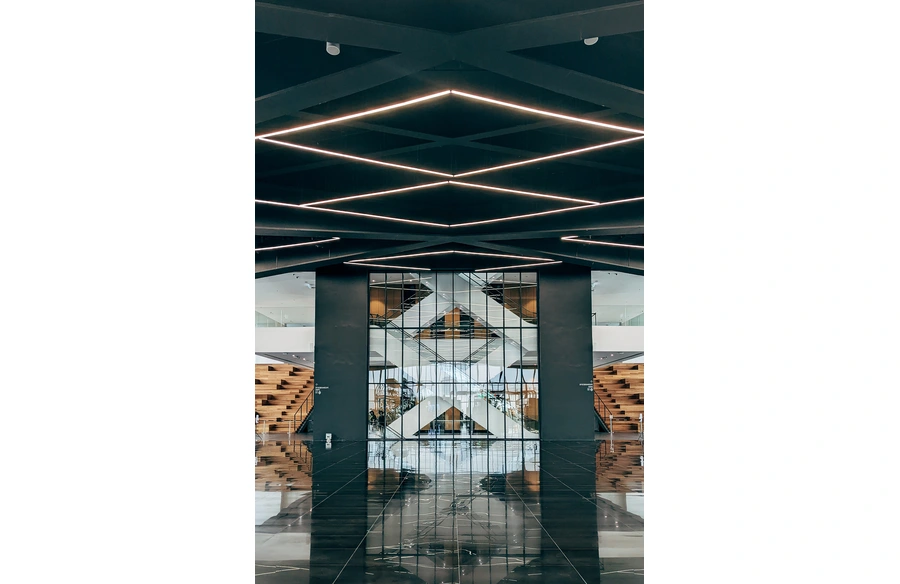
Modern architecture tends to think of lights as built into the design rather than as separate objects. Linear accents can define circulation paths, highlight building elements, add depth to details, and create desirable working conditions without overwhelming the designed space. Such optical effects are possible thanks to linear LED profiles that shape the light beam from integrated LED strips.
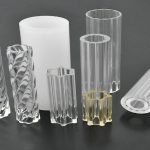
An LED profile usually refers to the channel that houses the light source, protects it, and, in some cases, serves an aesthetic function. Aluminum profiles, in particular, help create elegant line effects while also dissipating heat from the LED strip. At the same time, channels with built-in diffusers are used to hide the LEDs’ points and achieve a uniform light distribution. As a result, linear LED profiles have found their way into residential, commercial, hospitality, retail, and office lighting.
Why LED Profiles Matter in Contemporary Architecture
One of the main advantages of profile-based lighting is that it allows designers to integrate illumination into surfaces. Instead of installing a conventional fixture that becomes a separate visual element, architects can recess a profile into a ceiling, wall, cabinet, floor, or architectural detail. The result is a more continuous relationship between light and structure.
For projects requiring a clean linear effect, a TANGOO LED Profile can be selected according to mounting method, shape, dimensions, diffuser requirements, and intended application. Available profile approaches include surface-mounted, recessed, suspended, wall-mounted, plaster-in, skirting, stair, tube, and circular designs, giving designers multiple ways to incorporate illumination into an architectural concept.
Recessed Lighting for Seamless Surfaces
Recessed profiles are appropriate for contemporary minimalist homes and are characterized by the fact that only the diffuser is visible after the LED profile is mounted. The profile itself is inserted into a specially made groove or recess in the desired detail. Thanks to this technology, it becomes possible to arrange seamless LED lighting effects on ceilings, walls, and other surfaces.
Recessed linear lighting is often used in offices, corridors, galleries, and hotels to highlight the architecture without overshadowing it. In addition, plaster LED profiles allow creating truly seamless effects since they hide the light guide inside the plaster partitions.
Suspended and Surface-Mounted Linear Lighting
Suspended profiles offer a different architectural language. Instead of hiding the lighting system, they allow it to become part of the interior composition. Long linear fixtures can be positioned above desks, counters, dining areas, reception spaces, or circulation zones, combining functional illumination with a strong geometric presence.
Surface-mounted profiles are useful when recessing a channel into the building structure is impractical. They can be attached to walls, ceilings, cabinets, furniture, or other surfaces using mounting clips, screws, or suitable adhesive systems. This makes them useful for renovation projects where designers want contemporary linear lighting without major structural modifications.
Flexible Profiles for Creative Geometry
Not all buildings and interiors are characterized by straight lines, so arranging linear LED lighting in such places may be challenging. Flexible LED channels are used to create lighting effects around circular or other uniquely shaped objects and surfaces.
Flexible profiles are beneficial when it is necessary to create the effect of circular, wavy, or other shapes in a seamless manner. They help make linear statements in circles and other forms, which allows them to be used in a wide range of applications.
Choosing Materials and Diffusers
When selecting LED profiles, particular attention should be paid to their material. This characteristic affects the light output, installation site, and mounting technology. The channel material also affects the dissipation of heat from the working area of the LEDs, which ensures their long-term performance. Aluminum profiles are suitable for most cases since they have a good heat dissipation property.
On the other hand, the diffuser material is chosen based on the desired effect and the required level of light transmission. Modern LED profiles offer three options: polycarbonate, PMMA, and micro-prismatic diffusers. The last option is also good for masking undesirable reflections because the TANGOO product catalog includes solutions with a UGR value of less than 19.
Key Applications in Modern Buildings
Linear LED systems can be adapted to a wide range of architectural requirements. Selecting the correct profile depends on the location, desired lighting effect, installation method, and physical geometry of the project.
| Architectural Application | Suitable Profile Type | Typical Design Purpose | Key Consideration |
| Office ceilings | Recessed / suspended | General illumination | Glare control |
| Retail displays | Surface / cabinet | Product highlighting | Compact installation |
| Hotel interiors | Recessed / wall-mounted | Ambient and accent lighting | Seamless appearance |
| Staircases | Step and stair | Wayfinding and safety | Edge visibility |
| Furniture | Cabinet / surface | Task and accent lighting | Slim dimensions |
| Atriums | Circular / suspended | Decorative centerpiece | Large-scale geometry |
| Curved interiors | Flexible | Continuous illumination | Bend radius |
| Wall features | Wall-mounted | Up/down wall washing | Even distribution |
Customization for Architectural Projects
Custom extrusion makes it possible to create high-quality solutions even for the most demanding projects. Particular attention is paid to the choice of width, length, geometry, color, and diffusers when manufacturing special profiles. Custom extrusion is relevant when there is a need to repeat the same profile throughout the building or when the dimensions are significantly different from standard ones.
Custom plastic extrusion is also appropriate when there is a need to make a flexible plastic diffuser for a long LED channel since the longer the strip is, the more challenging it is to achieve uniform light output. It is also helpful to choose between PC and PMMA diffusers so that the desired balance between strength and optical properties is achieved. Using the customization option, it becomes possible to create truly seamless effects since the profile is manufactured in one piece.
Designing for Performance as Well as Appearance
Good linear lighting design requires more than selecting an attractive profile. Architects and lighting designers should consider heat management, diffuser performance, LED density, power requirements, mounting conditions, maintenance access, and the visual comfort of occupants.
Installation planning is equally important. Profiles need to be measured and cut accurately, LED strips tested before final closure, and diffusers and end caps installed correctly. In areas exposed to moisture, designers should also confirm that the selected profile, diffuser, LED strip, and connections provide the required level of protection rather than assuming every LED channel is waterproof.
The Future of Integrated Linear Lighting
In the future, as buildings become more multifunctional and multi-layered, linear built-in lighting will remain an essential element of the design. LED profiles help shape the interior as a whole rather than adding a lighting object to it. Linear statements can be hidden in ceilings and walls, integrated into cabinets and furniture, and serve as highlights in floors, stairs, and hanging structures.
It is helpful to understand that the most interesting architectural concepts are shaped not only by technical possibilities but also by the attention to detail. Choosing an LED profile, one needs to consider the characteristics of the building, the required geometry and lighting effect, the technology of mounting, and material properties. With their multifunctionality, linear LED solutions are an indispensable tool for any project.