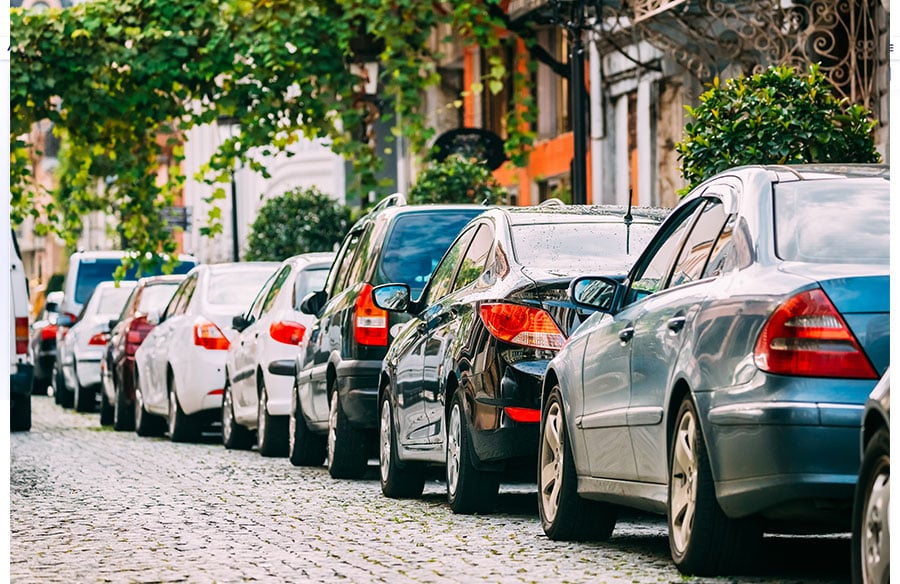
Most conversations about road safety focus on speed, driver behaviour and vulnerable road users. But there’s a quieter problem built into the fabric of UK streets that rarely gets the same attention: the damage done to parked cars by the very roads they’re parked on. Every year, thousands of legally parked vehicles are scraped, dented and reversed into, not because of reckless driving, but because the street itself made the collision almost inevitable.
The UK government’s January 2026 road safety strategy targets a 65% reduction in killed or seriously injured casualties by 2035, and that’s a welcome commitment. But stationary vehicles don’t appear in KSI statistics, and the low-speed, high-frequency damage to parked cars rarely features in any policy discussion. This piece covers where street layouts go wrong and what drivers are left to deal with as a result.
Narrow Carriageways and the Squeeze Effect
On many residential streets across the UK, carriageway widths haven’t changed since the houses were built, sometimes over a century ago. But the vehicles using them have. Modern cars, SUVs and delivery vans are significantly wider than what these streets were designed for.
When you’ve got two-way traffic and on-street parking on both sides, the effective driving lane can shrink to less than three metres. That forces drivers to thread past parked cars with very little clearance. Wing mirrors get clipped. Doors get scraped. Bumpers get nudged. It happens dozens of times a day on tight terraced streets, and most of it goes unreported.
The problem compounds at pinch points. Where a parked car sits opposite a wheelie bin or a dropped kerb, the space narrows even further. Drivers make a snap judgement about whether they can fit through, and they often get it wrong.
Where Bollards and Build-Outs Are Missing
In areas where on-street parking is common, you’d expect some physical separation between the parking bay and the live traffic lane. But in most UK streets, it doesn’t exist. There are no kerb build-outs to buffer parked cars from passing traffic, and no bollards to mark the boundary of the parking zone.
This is partly a cost issue. Retrofitting build-outs isn’t cheap, and local authority budgets are stretched. But it’s also a design philosophy issue. Parking bays are often treated as leftover space, painted onto the road surface with little thought about how vehicles will interact with them.
Poor Sightlines at Junctions
Some of the worst damage to parked cars happens at junctions and corners. A car parked just a little too close to a junction gets its rear bumper caught by a turning vehicle. The geometry doesn’t work, and the parked car pays the price.
Many residential junctions in the UK were designed with tight turning circles to keep traffic speeds down. That’s good for pedestrian safety, but it means larger vehicles will swing wide and clip anything parked near the corner. Current guidance in Manual for Streets recommends keeping parking away from junctions, but enforcement is patchy. In older parts of cities like London, Manchester and Edinburgh, you’ll find cars legally parked within a metre or two of a junction with no yellow line restrictions.
What Happens When Your Parked Car Gets Hit
When someone hits your legally parked car and you’ve got their details, either from a note or CCTV footage, the natural reaction is to phone your insurer. But going through your own insurance can mean paying an excess, risking your no-claims bonus and facing higher premiums at renewal, even when you weren’t at fault.
On-street incidents are among the most common triggers for parked car damage claims, and liability tends to be clear-cut when one vehicle is stationary. Because of that, accident management companies can often deal directly with the at-fault driver’s insurer to arrange repairs and a replacement vehicle, without the innocent driver having to claim on their own policy. It’s an option most people don’t hear about until they’ve already opened a claim with their own insurer.
The Stationary Vehicle as a Design Blind Spot
Road design in the UK has, rightly, prioritised the safety of pedestrians and cyclists in recent years. Active travel schemes, low-traffic neighbourhoods and 20mph zones have all been introduced with vulnerable road users in mind. But the parked car, which occupies road space for the majority of its life, is still treated as an afterthought.
When a parked car is damaged, it doesn’t appear in police crash data. It doesn’t trigger a review of the street layout. It just becomes a personal cost for the vehicle owner: a repair bill and a few days without a car.
A Problem Built into the Road
The collective cost of parked car damage in the UK runs into the billions, and most of it is absorbed by individual drivers. Wider parking bays, physical separation from traffic lanes, better junction geometry and dedicated loading zones would all reduce the volume of avoidable damage. Until planners and engineers start accounting for the stationary vehicle in their designs, parked cars will keep taking the hit.